Sunday, 30 April 2023

The Pandas of Bulgaria

The bear family as it exists today contains relatively few species. All but two of these species are placed in a single subfamily, the ursine bears, which includes the familiar black, brown, and polar varieties along with a couple of species unique to southern Asia. A second subfamily, the short-faced bears, includes the living spectacled bear of South America and several, often exceptionally large, fossil species. They are thought to have split from the ursine bears around 12 million years ago, towards the end of the Middle Miocene. The third living subfamily is both much older and more distinctive.

This, of course, is the subfamily of the pandas, the Ailuropodinae. Pandas are sufficiently odd that it was unclear for a time whether they were really bears, or something else, although their status hasn't really been in doubt since the 1980s when genetic evidence proved what had, even then, been suspected for a couple of decades. Today, only one species of ailuropodine exists, the giant panda (Ailuropoda melanoleuca), and it is found only in China. The same evidence used to estimate the split between the other living subfamilies puts the date of the split between pandas and other bears much further back, to around 20 million years ago, not long after the dawn of the Miocene. 

Sunday, 23 April 2023

The Raccoon Family: Cacomistles

Ringtail
While true raccoons and coatis were first scientifically described during the 18th century, the third member of the raccoon family that's native to the United States was not described until 1830, by Heinrich Lichtenstein - who later went on to found the Berlin Zoo. It's unclear (at least to me) exactly what he thought the animal was. So far as I can translate the original German, his original description says that it's somewhere between a civet and a coati in appearance, but also looks quite like a fox. Based on which, he gave it the scientific name Bassaris astutus, a mixture of Greek and Latin that roughly translates as "cunning fox".

The scientific name didn't stand, because it turned out that the first part of it had already been used for a kind of butterfly. Furthermore, while he originally referred to the animal by its Spanish name "cacomixtle", since the specimen he knew of came from somewhere near Mexico City, in English we now call it a ringtail (Bassariscus astutus) or, less accurately, a "ring-tailed cat". Even so, in many parts of the US, an Anglicised form of the Spanish name is still in wide use. 

Sunday, 16 April 2023

The Life and Habits of the Father of Cats

Today, all large land-dwelling carnivorous placental mammals belong to a single group named, appropriately enough, the Carnivora. This includes all the cats, dogs, bears, badgers, and many others besides, and it has long been clear that they are a genuine biological group, all more closely related to each other than to anything else. Indeed, the similarities between these animals are sufficient that, even though the current name only dates from 1821, it's essentially identical to the "Ferae" order first described back in the 18th century.

Even if we look at the fossil record, we find that for millions of years, the great majority of such animals were also members of the Carnivora even if, in some cases, their specific family no longer exists. The great majority, but not all. In 1875, American palaeontologist Edward Drinker Cope coined the term "creodont" for a collection of early carnivorous mammals that lacked the key defining features of the carnivorans. His original definition was relatively narrow, but over the next few decades it was expanded until, in 1909, it came to include essentially all of the large land-dwelling carnivorous placentals that weren't carnivorans.

Sunday, 9 April 2023

Decline of the Sea Otters

Sea otters (Enhydra lutris) are an endangered species, native to the coasts of the northern Pacific from Japan to California. I've discussed them in detail before, but suffice it to say here that they are remarkable creatures, able to survive without setting foot on land, digging no dens as other otters do, and even giving birth at sea. They also have the densest fur of any mammal, making it especially valuable.

Which, of course, explains how they became an endangered species in the first place.

Humans have been hunting sea otters for their fur for many centuries, but for much of history, this was small scale, with the local tribes being unable to make any lasting dent in their numbers even if they had wished to. Estimates for the worldwide population of sea otters prior to the 18th century are naturally difficult to come by, but it may have been as high as 300,000. The herald of coming doom came in 1741.

Saturday, 1 April 2023

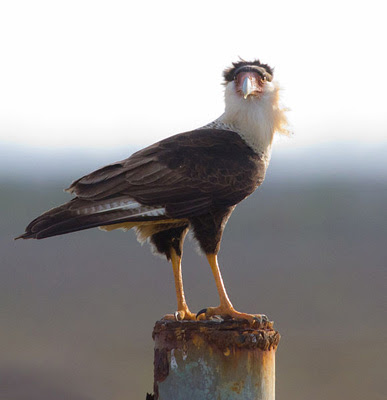
First of the Falcons?

Crested caracara
As I write this, it's 1st April, and that means, in lieu of trying to make a joke that somebody in the future will think is a real science item when they fail to notice the date, that it's time for: birds!

Trying to figure out the higher-level evolutionary relationships among animals can be tricky. Until the last few decades, we had to rely on physical comparisons and visible points of similarity, essentially a more sophisticated and well-informed version of what Linnaeus did back in the 18th century. With lower-level groups this can be reliable; nobody is surprised to discover that a moose is a type of deer or that rats are related to mice. But even here, parallel evolution can leave a misleading signal. It is not, for example, obvious that hyenas are more closely related to cats than to dogs (although, of course, they're neither). 

This problem gets bigger when we move to higher-level groups where physical similarity is no longer a reliable guide at all. Is a mouse more closely related to a dolphin than an elephant? That's not an easy one to answer on physical grounds alone. (Dolphin, probably, before anyone asks). It's much the same with birds.

Sunday, 26 March 2023

The Raccoon Family: Coatis

White-nosed coati
The common raccoon is the only member of the family whose scientific name dates back to the official dawn of biological taxonomy in 1758. However, people continued sending him new specimens to catalogue and, just eight years later, in a later edition of the same work, Linnaeus added two further species that we would now also place in the raccoon family - albeit, he initially described them as civets.

These two animals were coatis (or "coatimundis"), with one first identified from Mexico, and the other from Brazil. They were given their own genus by Gottlieb Storr in 1780 when he first named the raccoon family. It's probably fair to say that, to modern eyes, Storr's classification seems the more reasonable of the two; coatis look a lot more like raccoons than they do like civets.

Sunday, 19 March 2023

Age of Mammals: The Oligocene (Pt 1)

It's been over a decade since I started including bimonthly looks at specific slices of Earth's past in this blog. In that time, I have covered three epochs: the Pleistocene, Pliocene, and Miocene. Together with the current Holocene epoch, these comprise what we currently consider to be two "periods": the Quaternary and Neogene. Both of these are dominated, more or less, by mammals of the sort we'd generally recognise today, even if the details are different. All of the earlier chunks of time since the extinction of the non-avian dinosaurs, however, constitute a different period, the Paleogene, where this was much less true.

When Charles Lyell devised the current system of dividing the "Age of Mammals" into epochs in 1833, he originally defined four. A few years later, he revised this to five, but even then, the entirety of what we'd now call the Paleogene was placed into a single epoch, the Eocene. In 1854, however, German palaeontologist Heinrich Beyrich, split off the later part of the Eocene into a new epoch, which he saw as a distinct period of transition in the development of fossil seashells. He called this the Oligocene, and it proved useful beyond his original mollusc-based definition, and so has remained in use to this day. (Beyrich's wife, incidentally, was a children's author, and made the unusual step of favourably commenting on the work of Charles Darwin in a novel for young girls at a time when it was still controversial).