Showing posts with label hair. Show all posts

Sunday, 20 October 2024

Moulting Marmots

Moulting is a feature of mammalian physiology that will be familiar to pet owners worldwide. While it's not present in all mammals, it is very widespread despite the fact that, when you think about it, it's obviously costly to the animal in question. Why shed and replace a large amount of hair in a short time when you could replace it bit by bit as humans do?

The fact that so many mammals, of widely different kinds, moult to at least some extent shows that it must be an evolutionary ancient phenomenon. In fact, it turns out that animals have probably been moulting since before they even had hair. We can tell this because it's not unique to mammals. For instance, birds moult their feathers, and the process is similar to hair moulting in mammals. More significantly, perhaps, moulting has the same underlying mechanisms as reptiles periodically shedding their skin and can be tied back to sloughing in fish and amphibians as well. 

Sunday, 15 September 2024

Hair, Fur, Bristles, and Spines

Trinomys
Hair is one of the key defining features of mammals. Apart from cetaceans, such as dolphins, no mammals are entirely hairless, although, for example, hippos and some babirusa species come very close. The original purpose of hair was almost certainly to maintain body heat, something that matters to warm-blooded animals in a way that it doesn't to, say, reptiles. Since then, however, hair has adapted to fulfil many other functions as well.

To begin with, there is colouration, a function that hair needs to take over once it obscures the skin. The most obvious way that hair colour can help an animal is camouflage. While this is instinctively true, there have been statistical studies that demonstrate certain hair colours are, indeed, more common in animals living in certain environments. For instance, multi-species analyses of lagomorphs and cloven-footed mammals have shown that animals with grey fur are more likely to live in rocky environments. The same studies, as well as similar ones on carnivores, show that pale fur is associated with open environments, especially deserts, while dark fur is most common in those animals living in jungles, dense forests, or heavily vegetated swamps. And, surely to the surprise of almost nobody, white fur is associated with the Arctic, or with the winter coats of those living where it snows.

Sunday, 16 January 2022

Why Animals Have Whiskers

One of the key defining features of mammals is that they have hair, or are at least descended from other animals that once had hair. The primary purpose of hair is to keep the animal warm, something useful for any warm-blooded animal, especially if it's small (elephants and rhinos, for example, while they do have hair, aren't really what you'd call "furry"). But, over millions of years of evolution, hairs have also evolved to carry out other functions, such as the protective spines of hedgehogs and porcupines.

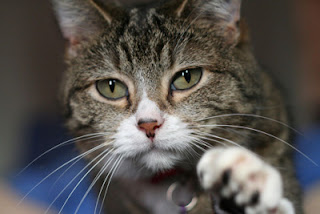
Another example of specialised hair is that of whiskers. Technically known as vibrissae, whiskers are remarkably common in mammals. When we think of whiskers, it's likely that most people's thoughts jump immediately to the long, mobile, whiskers of cats and mice. But whiskers can also be shorter and less mobile than this, as we see in such animals as horses. Indeed, even if we look at a cat, whiskers are not restricted to the long ones on the snout; they also have whiskers on the eyebrows, on the cheeks and chin, and on their forelegs just above the paws. 

Sunday, 14 October 2012

Why are Elephants Hairy?

The Asian elephant is the hairiest of the three living species
Elephants are, as is well-known, the largest land-dwelling animals alive today. Being so large presents a number of problems, and these are only increased by the fact that elephants, being mammals, are warm-blooded. Specifically, they have to maintain a body temperature of 36°c, only one degree below that of humans.

Perhaps the most obvious problem is that they need to eat a lot in order to survive. The need to keep their metabolism going means that they need more calories for their size, than, say a crocodile, which - being "cold-blooded" - can rely on the sun to warm it up. However, that internal body heat presents another problem as well, and that's keeping cool.

The larger an object is, the smaller its surface area proportional to its volume. This is basic mathematics; if I double the dimensions of an object, while keeping it the same shape, the surface area increases four-fold (22), but the volume increases eight-fold (23). Since heat is lost through the surface, the bigger an animal is the more heat it will tend to retain. This is actually a greater problem for small animals than large ones, since they tend to lose heat rapidly, and therefore need a very high metabolism just to keep up. Mice, shrews, and the like need to eat a huge amount, relative to their size, in order to keep functioning. It obviously doesn't help if the weather is cold, which was the original reason proposed for Bergmann's Rule - the idea that animals are larger in cold climates than they are in warm ones.