So, what exactly are marsupials?
If you answered "mammals where the female carries her young in a pouch," I'm afraid the big QI buzzer has just gone off. That's because, while its mostly true, there are, in fact, some marsupials that don't have pouches.
Along with the placental mammals, the marsupials represent one of the two main groups of mammals alive today - although there is of course, also a third, much smaller, group that includes the enigmatic platypus. The oldest known marsupial fossil, Sinodelphys, dates back to 125 million years ago, as does Eomaia, the oldest fossil on the line leading to placentals. Our best guess is that the two groups diverged not long before that, probably no more than 131 million years ago. But its worth pausing to consider how far back that is; its a little over half way through the age of dinosaurs, and long before such famous animals as Tyrannosaurus, Velociraptor, and Triceratops evolved. Indeed, its as far back from Tyrannosaurus as that animal is from us today - half the history of marsupial evolution occurred before dinosaurs went extinct.
Showing posts with label general. Show all posts
Sunday, 20 March 2011
Sunday, 13 February 2011
Sons or daughters?
![]() |
| Tammar wallaby, with a joey |
There are several reasons why this might be useful, but, for the moment, lets just look at two of the more popular ones. The Trivers-Willard hypothesis applies to species where males normally mate with several females, and states that healthy mothers should tend to have more sons than unhealthy ones. The assumption is that less fit mothers will also tend to have less fit offspring, and that they want to have as many grandchildren as possible. For female offspring that's not much of an issue; they're going to mate with somebody at some point anyway.
But for males offspring, it makes quite a difference - if male offspring aren't fit, they won't get the chance to mate, because the bigger males grab all the females first. So, if you're healthy, have lots of sons, because they will give you lots of grandchildren, but if you're not so fit, concentrate on daughters, because your sons won't have much luck. Its worth noting that 'healthy' in this context, doesn't necessarily refer to disease (although it could), but to anything that affects the chances of males mating - genes for larger antlers, perhaps, or for a more sexually dominant attitude.
The "local resource competition" hypothesis, on the other hand, suggests that mothers living in areas of dense population should have more male offspring than those living elsewhere. This is because, in most mammal species, males tend to wander off in search of females when they reach adulthood, while the females stay around in the area they were born - and, as a result, ensure they don't end up mating with their brothers. (There are a few species where the opposite happens, in which case this theory predicts that they will want female offspring when the population is high). The reason for this is that there is only so much food to go round - if you have lots of daughters, they will hang around and leave less food for you. If the population is high and food is scarce, you want sons that will wander off and find less inhabited places where they aren't pestering you, but, if not, you can afford lots of daughters.
There's no particular reason, of course, why both of these explanations can't be true at the same time, which can make it very difficult to tell what's going on in a particular species.
But all this raises the question of exactly how you ensure you have more children of one sex than the other. Perhaps the most obvious reason why you wouldn't expect this in mammals is that whether your child is male or female depends on their genetics. Males have the XY chromosome pattern, and females the XX, and the two should be produced in reasonably equal numbers. (It's worth noting, incidentally, that the XX/XY system is a peculiarly mammalian thing and isn't true, for example, of reptiles). There is some evidence that rhinoceroses, among others, might be able to influence the survival of embryos in the womb, although the details are not fully clear.
Another problem is that, compared with other animals, mammals spend a lot of time looking after their offspring. Even by the time you've finished being pregnant, and discovered that your offspring isn't the sex you wanted, you've already put a lot of biological resources into raising them, and its a bit of a waste to abandon them now. On the other hand, mammals do at least have the option that they could do that if they really wanted, by giving the offspring less milk. That won't work for mammals that give birth in litters, but it might for those that only have one at a time. In fact, a study conducted on tammar wallabies last year did seem to demonstrate this. The researchers swapped baby wallabies between different mothers, and found that mothers who had given birth to sons did a better job of raising their foster children, even when the foster children were (unbeknownst to the wallaby) female.
Indeed, it has recently been suggested that marsupials are exactly where we should look for sex selection in mammals. Although the authors give a number of reasons for this, perhaps the most apparent is that pregnancy is really very brief in marsupials. That means that, compared with placental mammals, putting less effort into raising offspring after birth wouldn't be quite such a waste of energy. The authors point out that strong biases, mostly in favour of males, do occur in many marsupial species, to the extent that this can be a nuisance for anyone trying to breed them in captivity. A particularly interesting study from 2009, supporting the Trivers-Willard hypothesis, showed that Tasmanian devils infected with a nasty face-eating disease had more daughters than those that were healthy.
Most mammal species do seem to produce roughly equal numbers of sons and daughters, as humans do. But with those that don't, being able to understand how they manage it could have important implications for preserving endangered populations.
[Picture from Wikimedia Commons]
Tuesday, 2 November 2010
What is a Mammal?
I'm going to briefly pause from looking at recent mammalogical news to examine a more general question about mammals. And they don't come much more general than "what is a mammal?"
Doesn't sound a very difficult question, does it? A mammal is a warm-blooded, air-breathing vertebrate that, crucially, feeds its young with milk from its mammary glands. Right? Well, kind of...
For the last twenty years or so, animals have been placed into groups on the basis of something called cladistics. Essentially, the idea is that a proper, meaningful, group of animals will be one that contains a single common ancestor and all of its descendants. Or, to put it another way, that everything in the group has to be more closely related to other animals in that group than it is to anything else. Which seems pretty straightforward and common-sense, and, indeed, is a very useful way of doing things. But applying it strictly does sometimes lead to some fairly surprising results.
Vertebrates first freed themselves entirely from the water when they evolved a way of making their own little pools of water, surrounded by a protective shell, and leaving their tadpoles inside that pool with a supply of yolk to feed off until they became developed enough to hatch. The animals that evolved this feature are called amniotes. Later on, some mammals evolved a way of doing away with the shell, and keeping the pond inside a membranous sac in the mother's body, but the principle is the same, and they still count as amniotes.
Not long after the amniotes first appeared, they split into two great evolutionary lines. One led to the reptiles and birds, and the other, called the Synapsida, led to the mammals.
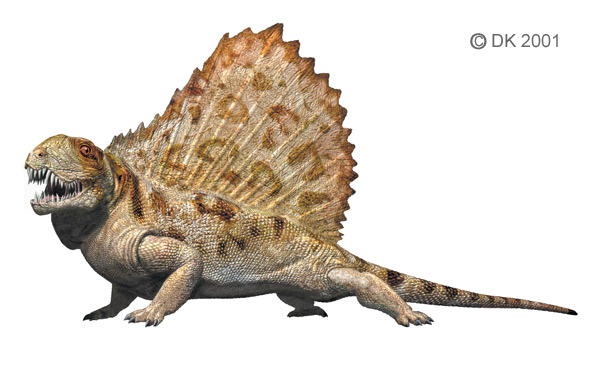
Wait a minute, I can hear you saying, but didn't mammals evolve from reptiles? Well, it depends what you mean by "reptile". Certainly, if we could look at the early synapsids today, most people would probably call them reptiles. They were cold-blooded, hairless, laid eggs, wouldn't have produced milk, and anyway, they just kind of looked reptilian. Take a look at this one, for example. By most people's standards, that's a reptile.
But here's how the early amniotes evolved into the animals we have today:
Bearing in mind out definition for what constitutes a "group" of animals (a monophyletic clade if we want to get technical - but let's not) there are two problems with this chart. The first is that reptiles aren't actually a proper group at all - they can't be, because crocodiles are more closely related to birds than they are to, say, turtles. Which isn't to say that crocodiles are particularly close to birds, admittedly, just that they're even further from turtles. (This is because birds evolved from dinosaurs, which were fairly close to crocodiles).
When we say that a proper biological group has to consist of a common ancestor, and all of its descendants, the key word is "all". The common ancestor of all living reptiles is at the point I've marked (A), and if we want to include all of its descendants, then we have to count the birds. Either birds are reptiles, or reptiles don't really exist as a meaningful group. Bummer!
Be that as it may, the other problem is that even if the reptiles are a group, their last common ancestor, and therefore the first reptile, is the creature at (A), and mammals didn't evolve from that. So mammals evolved from creatures that certainly looked very reptilian, but which weren't, in a strict scientific sense, reptiles as we understand them today. They are entirely their own line.
But, at any rate, it's fairly clear that while the early synapsids may not have been reptiles, they weren't mammals, either. At some point, they evolved into mammals, and all of the earlier forms of reptilian-looking synapsids died out. So at what point did that happen? When did not-mammals become mammals?
The obvious answer is "when they developed mammary glands and began producing milk". Which is all very well, but a bit of a bugger when all you've got to go on is fossil bones. How do you tell from the bones whether the animal produced milk or not? You can't, pretty much. So palaeontologists have to use a different definition.
The lower jaws of the early amniotes consisted of multiple bones. For example, there was the dentary bone, which had most of the teeth, and the articular bone, which formed the hinge joint with the skull. In the line that led to reptiles and birds, this didn't change much (at least until birds evolved beaks), but in the synapsids, something strange began to happen. The dentary bone began to get larger, slowly pushing out and shrinking the other bones, until most of them disappeared altogether.
Eventually, the dentary formed its own joint with the skull, and the lower jaw actually had two joints on each side for a while. That's not much of a problem, so long as the joints are lined up properly, but there's really no need for it, so eventually, the only remaining other bone in the lower jaw, the articular, began to shrink as well. In the end, the dentary was the only bone left in the lower jaw at all; and in mammals, we call it the mandible.
But the articular bone, and its old joint with the skull didn't disappear altogether. Both it, and the skull bone that it used to attach to shrank and became entirely separated from the jaw, moving up the side of the head. They are still there today, still with the old joint between them, but now we call them the malleus and incus, and they form two out of the three bones in the middle ear.
And that, at least when you're looking at fossils, is the defining characteristic of a mammal: that it has one bone on each side of the lower jaw, and three bones in each middle ear.
[Pictures from Wikimedia Commons]
Doesn't sound a very difficult question, does it? A mammal is a warm-blooded, air-breathing vertebrate that, crucially, feeds its young with milk from its mammary glands. Right? Well, kind of...
For the last twenty years or so, animals have been placed into groups on the basis of something called cladistics. Essentially, the idea is that a proper, meaningful, group of animals will be one that contains a single common ancestor and all of its descendants. Or, to put it another way, that everything in the group has to be more closely related to other animals in that group than it is to anything else. Which seems pretty straightforward and common-sense, and, indeed, is a very useful way of doing things. But applying it strictly does sometimes lead to some fairly surprising results.
Vertebrates first freed themselves entirely from the water when they evolved a way of making their own little pools of water, surrounded by a protective shell, and leaving their tadpoles inside that pool with a supply of yolk to feed off until they became developed enough to hatch. The animals that evolved this feature are called amniotes. Later on, some mammals evolved a way of doing away with the shell, and keeping the pond inside a membranous sac in the mother's body, but the principle is the same, and they still count as amniotes.
Not long after the amniotes first appeared, they split into two great evolutionary lines. One led to the reptiles and birds, and the other, called the Synapsida, led to the mammals.
Wait a minute, I can hear you saying, but didn't mammals evolve from reptiles? Well, it depends what you mean by "reptile". Certainly, if we could look at the early synapsids today, most people would probably call them reptiles. They were cold-blooded, hairless, laid eggs, wouldn't have produced milk, and anyway, they just kind of looked reptilian. Take a look at this one, for example. By most people's standards, that's a reptile.
But here's how the early amniotes evolved into the animals we have today:
Crocodiles Birds Other Turtles Mammals
Reptiles
^ ^ ^ ^ ^
| | | | |
| | | | |
------------- | | |
| | | |
| | | |
------------------ | |
| | |
DIAPSIDA ANAPSIDA SYNAPSIDA
| | |
--------------------- |
| |
(A) |
| |
------------------------
|
|
Bearing in mind out definition for what constitutes a "group" of animals (a monophyletic clade if we want to get technical - but let's not) there are two problems with this chart. The first is that reptiles aren't actually a proper group at all - they can't be, because crocodiles are more closely related to birds than they are to, say, turtles. Which isn't to say that crocodiles are particularly close to birds, admittedly, just that they're even further from turtles. (This is because birds evolved from dinosaurs, which were fairly close to crocodiles).
When we say that a proper biological group has to consist of a common ancestor, and all of its descendants, the key word is "all". The common ancestor of all living reptiles is at the point I've marked (A), and if we want to include all of its descendants, then we have to count the birds. Either birds are reptiles, or reptiles don't really exist as a meaningful group. Bummer!
Be that as it may, the other problem is that even if the reptiles are a group, their last common ancestor, and therefore the first reptile, is the creature at (A), and mammals didn't evolve from that. So mammals evolved from creatures that certainly looked very reptilian, but which weren't, in a strict scientific sense, reptiles as we understand them today. They are entirely their own line.
But, at any rate, it's fairly clear that while the early synapsids may not have been reptiles, they weren't mammals, either. At some point, they evolved into mammals, and all of the earlier forms of reptilian-looking synapsids died out. So at what point did that happen? When did not-mammals become mammals?
The obvious answer is "when they developed mammary glands and began producing milk". Which is all very well, but a bit of a bugger when all you've got to go on is fossil bones. How do you tell from the bones whether the animal produced milk or not? You can't, pretty much. So palaeontologists have to use a different definition.
![]() |
| Skull of a turtle - note that the lower jaw consists of at least four different bones. (d = dentary, ar = articular) |
Eventually, the dentary formed its own joint with the skull, and the lower jaw actually had two joints on each side for a while. That's not much of a problem, so long as the joints are lined up properly, but there's really no need for it, so eventually, the only remaining other bone in the lower jaw, the articular, began to shrink as well. In the end, the dentary was the only bone left in the lower jaw at all; and in mammals, we call it the mandible.
![]() |
| Lower jaw of a mammal - note the absence of separate bones |
And that, at least when you're looking at fossils, is the defining characteristic of a mammal: that it has one bone on each side of the lower jaw, and three bones in each middle ear.
[Pictures from Wikimedia Commons]
Subscribe to:
Posts (Atom)