Showing posts with label opossum. Show all posts

Sunday, 23 January 2022

Out of the Amazon: A History of the Opossums

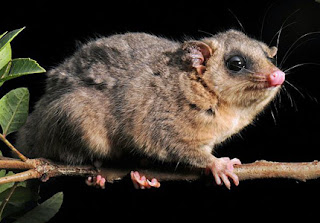
Tate's woolly mouse-opossum,
a marmosin species
When most people think of marsupials, it's likely that Australia is the first place to spring to mind; the land of kangaroos, koalas, and wombats among many others. In fact, even the "Australian" marsupials aren't restricted to that country, since they are also found further north, notably in New Guinea - which, for example, has its own species of wallabies. But, more significantly, marsupials are also found outside of Australasia, in the Americas.

The best known of these American marsupials is surely the Virginia opossum (Didelphis virginiana). This lives across most of the US outside of the western mountains and interior deserts, and is also found just across the border in parts of southern Canada, through the whole of Mexico, and well into Central America. It's the only species of opossum found north of Mexico, but it's very far from being the only species of opossum anywhere.

Sunday, 24 June 2018

What is a Marsupial?

A possum
In America, the word "possum" is usually used to describe a moderately-sized, somewhat rat-like, animal that has grey fur, sometimes pretends to be dead, and has far too many teeth for any self-respecting land-based mammal. Officially, this creature is an "opossum", and more specifically, the Virginia opossum (Didelphis virginiana). The word comes from the language of the Powhatan people of Virginia, and has been in use in English since at least the 17th century.

Over on the other side of the world, in Australia, the word "possum" is, however, used to refer to an entirely different animal. These are nocturnal, tree-dwelling creatures, typically with large eyes and long tails, and the majority of the seventy or so species are herbivorous. Early settlers, who had probably only vaguely heard of the American animal, nonetheless decided to give it the same name. Like the Americans, over time they confused "opossum" with "a possum", and shortened the word. Unlike the Americans, their shortened word became not merely colloquial, but the one formally used in zoological texts.
Sunday, 12 April 2015

A Time to Breed and a Time to Die

Grey slender opossum
Looking after the children can be a stressful and exhausting activity. Other issues aside, offspring need feeding and looking after, which can put a drain on the mother's own energy reserves, never mind the need to feed the extra mouths in the first place. For mammals, one particular energetic stress is the need to provide milk, and this seems to be particularly true for marsupials, who carry their young around, permanently clamped onto teats inside their pouches, for the earliest part of their life.

Given these extra energy requirements, it's unsurprising that most mammals time their births for times when the greatest amount of food is likely to be available in their environment. Certainly there are species that breed pretty much year round, at least in the absence of unexpected drought or the like, but most have at least some kind of 'breeding season', arranged so that the young are born at the best time of the year - often the spring, in temperate climes, but more likely the rainy season near the tropics, where there isn't a winter to avoid. In the case of marsupials, the breeding season and the birthing season are pretty much the same thing, since pregnancy is an extremely brief affair, and it's the time spent in the pouch that's really crucial.