Showing posts with label Colobines. Show all posts

Sunday, 4 December 2022

Leaf-Eating Monkeys: Leading by a Nose

Proboscis monkey (male)
Perhaps the most distinctive and well-known of all the colobine monkeys is the proboscis monkey (Nasalis larvatus). Sufficiently distinctive that it's hard to confuse it with anything else, it was first described as a species all the way back in 1787 by botanist Friedrich von Wurmb, then working for the Dutch East India Company, and given its own genus in 1812.

Indeed, it is strange enough that, during the 20th century, it was assumed to represent a very early side-branch in colobine evolution, existing outside all the other groups in the subfamily. That wasn't just because of its odd appearance, but also because it had two extra pairs of chromosomes to every other colobine monkey. But it turns out that that's a false signal and that, not only are proboscis monkeys a relatively recent branch within the subfamily, their closest relatives include the snub-nosed monkeys whose noses are noted for being extraordinarily short.

Sunday, 6 November 2022

Leaf-Eating Monkeys: Monkeys on the Mountainsides

Golden snub-nosed monkey
Much of eastern China is dominated by two great river basins: the Yellow River in the north and the Yangtze in the south. In the western parts of the country, the upper reaches of the two basins are separated by the Qinling Mountains, running eastward from the vast Tibetan Plateau. And here, in addition to many other unique animals and plants, we find a rather strange species of monkey.

This is the golden snub-nosed monkey (Rhinopithecus roxellana) and its oddity merely begins with its unusual appearance. As the name implies, its fur is mostly golden, ranging from a brownish-red hue to a much brighter golden-yellow. Contrasting stripes of black fur run down the outer edges of the limbs and there are white patches on the back of the thighs. All of these colour patterns are brighter in the males, which are also noticeably larger than the females, indicating that these are likely used in sexual signalling - something supported by the fact that the genitalia also have a contrasting dark colour.

Sunday, 9 October 2022

Leaf-Eating Monkeys: The Colourful Doucs of Vietnam

Red-shanked douc

Modern genetic analysis has shown that the leaf-eating monkeys of the Old World consist of three, related, evolutionary branches. Two of these, the colobus monkeys of Africa, and the langurs of Asia, had long been recognised as distinct, but the third was not always so. The monkeys belonging to this branch had, for the most part, previously been considered to be langurs, or at least part of the langur line, but it turns out that they split off from the others early on. Because of the comparative recency of this discovery, this third group doesn't have any distinctive common name and nobody seems to have come up with a scientific one, either. ("Rhinopithecinini" would seem the obvious choice to me, but one can see why nobody bothered).

So, instead, this group, when scientists need to refer to it, ends up being called the "odd-nosed monkeys". Even then, not all of them have noses that look (at least to me) especially odd, and this is most clearly true of the doucs. 

Sunday, 11 September 2022

Leaf-Eating Monkeys: Borneo and Beyond

Hose's langur
Borneo is the third largest island in the world (after Greenland and Papua New Guinea), being about 10% larger than Texas, and around three times the size of the entire UK. The interior is rugged and mountainous, especially in the north, and, in its natural state, almost entirely covered in dense jungle. This is a perfect environment for spawning new species, which can easily become isolated from one another and still have plenty of lush vegetation to feed upon. It's also ideal for hiding these species from naturalists so that it's possible that even the species we currently recognise from the island are not a complete list.

As was common at the time, several species were named in the 19th century, often by naturalists unaware that what they'd just described had already been named in some obscure source by somebody else. Even after the general taxonomic tidying up of the 20th century, however, no fewer than four species of the genus Presbytis - loosely speaking, the Indomalayan group of langurs - were still recognised as living on Borneo.

Saturday, 13 August 2022

Leaf-Eating Monkeys: The Leaf Monkeys of Sumatra

Black-crested Sumatran langur
When the system of scientific naming that we now use was first devised, all monkeys were placed in a single genus, Simia. The initial listing of names, from 1758, does not include any species we would now recognise as leaf monkeys but, as these were "discovered" over the next few decades, most were placed in Simia, although a few were placed in newly-created genera that contained other, more typically fruit-eating, monkeys. The first naturalist to create a genus specifically for what we would now describe as "leaf monkeys" was Johann von Eschscholtz, a naturalist who had served on a Russian expedition that circumnavigated the globe. His write-ups of that expedition included the first scientific description of the plantlife of California, but they also included the description of a new kind of monkey, which he felt was distinct enough to give its own genus: Presbytis.

That was in 1821, and, while various other naming schemes were suggested through the 19th century, for much of the 20th, all langurs were placed in Eschscholtz's genus as a group distinct from the colobus and other leaf monkeys. During the 1980s, however, the grey and golden langurs, and their various close relatives, were split off into the genera they now occupy, leaving relatively few species still with their older designation.

Sunday, 17 July 2022

Leaf-Eating Monkeys: Golden Langurs and Silvery Lutungs

Golden langur
During the Ice Ages, it is thought that the early grey langurs, ancestors of the modern sacred langur and its kin, sheltered in southern India where the climate allowed the warm forests on which they rely to continue to flourish. A second group of langurs, which had originally diverged from the grey langurs over five million years ago, sheltered instead further east, and their descendants include the spectacled and "limestone" langurs that still live in that area today. At some point, however, both moved northward again, and they met up somewhere near Assam in northeastern India.

In this region, they remained separated by mountains and rivers, but the barriers were not perfect, and there is some evidence that the two hybridised, leaving a genetic trace in the non-grey langurs of the region. Certainly, while these descendants are close enough to the spectacled and "limestone" langurs to be placed in the same genus, they form the oldest branch within it, somewhat distinct from the others.

Sunday, 19 June 2022

Leaf-Eating Monkeys: Treetops and Limestone Cliffs

Dusky langur
Although the term "langur" is perhaps most associated with the monkeys of India, the term has been used more widely to refer to a range of similar monkeys found to the east. In this sense, the term is really one of convenience, reflecting both the resemblance and the relatively close evolutionary relationship between the various monkeys in the group. However, the word "langur" itself comes from Hindi and Urdu which are, of course, not native languages of the lands to the east, so there has been a move in recent times to use more local names for some of the species. I'm going to stick with the names that seem to be most common in English language sources, but there is considerable variation and not always much consistency.

One of the better studied of these species is the dusky langur (Trachypithecus obscurus). These live in the Malay Peninsula, from the southernmost parts of Myanmar in the north, through southern Thailand, and across essentially the whole of Peninsular Malaysia. Over the last few years, a small number have also been spotted in residential areas of Singapore, presumably having swum across the Johor Strait from the mainland, but they are not native there. Although definitive genetic evidence is lacking, seven different subspecies are currently recognised, three of which occupy different regions along the peninsula, with the other four found only on certain small islands off the coast. 

Sunday, 22 May 2022

Leaf-Eating Monkeys: Sacred Langurs of India

Sacred langur

In Hinduism, the monkey god Hanuman is a companion of Rama, one of the more popular incarnations of Vishnu, and represents, among other things, loyalty and virtue. The specific type of monkey most associated with him is known by various names, including "Hanuman langur" and the rather uninspired "northern plains grey langur", but I'll stick with sacred langur (Semnopithecus entellus).

As currently defined, the sacred langur is found across almost the whole of northern India where suitable habitat exists. The biggest limitation to that habitat is elevation; sacred langurs are very much a lowland species, not found above about 400 metres (1,300 feet) - which cuts out rather a lot of the more northerly parts of the country as it reaches towards the Himalayas. Other than that, they require forest, but they seem adaptable to different types. 

In practice, they mostly live in dry tropical deciduous woodland because that's largely what there is in that part of the world, but they extend into thorny scrubland in the northwest near the deserts of Rajasthan and into damper forests in the east. They are also common, probably due in part to their reputation as a sacred animal, on the outskirts of densely settled urban areas. A population is also found in southwestern Bangladesh, but they aren't thought to be native there and were likely brought across by Hindu pilgrims in the late 19th century.

Sunday, 24 April 2022

Leaf-Eating Monkeys: Red and Olive Colobuses

Zanzibar red colobus
The strict food requirements of red colobus monkeys make them one of the most endangered groups of African primates but they are still found across a surprisingly wide swathe of the continent. While we used to recognise only three or four species (albeit with many subspecies), it has become clear over the last thirty years or so that there are many more, around half of which are now restricted to very small areas. In most cases, this is because of the obvious reason that their old habitat has been destroyed and that they used to range further afield. Some, however, have never strayed far from home.

The easternmost species of red colobus falls into this latter category. Named the Zanzibar red colobus (Piliocolobus kirkii) this has historically restricted to the eponymous island. Since 1964, this has been the "zan" part of Tanzania, and lies just over 20 miles off the east coast of the mainland with an area of a little under 1,500 km² (565 square miles). With a human population of around 1,500,000 it is, as one might expect, substantially given over to agriculture and other development. As a result, while they once ranged across the island, they are now primarily found in the less settled eastern half of the island, where there are some inland national parks. In the 1970s, a small population was re-introduced to a patch of land on the west coast north of the main urban areas and others were translocated to Pemba Island to the north, where the species has never existed naturally. While one of the latter groups did survive and breed, their descendants are likely quite inbred and it has been argued that we'd be better off supporting the main population in their original home.

Sunday, 20 March 2022

Leaf-Eating Monkeys: Red Colobuses of Central Africa

Ashy red colobus
The problem with being a primate subsisting primarily on leaves is that, on their own, they aren't very nutritious. Humans on a vegan diet can hardly be expected to live on lettuce alone; they need grains, pulses, nuts and so on, and we have the advantage of cooking making much of our food easier to eat and digest. Colobus monkeys have complex digestive systems that allow them to extract more nutrition from leaves than a primate would otherwise be able to, so they have the edge over us in that respect, but they still require plenty of fresh leaves and this leads to the more exclusively folivorous ones having specific habitat requirements that leave them vulnerable to any degradation or loss of their environment.

The end result of this is that many colobine monkeys are endangered. In Africa, the most endangered group, and probably the most threatened group of primates of any kind on the continent are the red colobuses.

Sunday, 27 February 2022

Leaf-eating Monkeys: Black-and-White Colobuses

King colobus
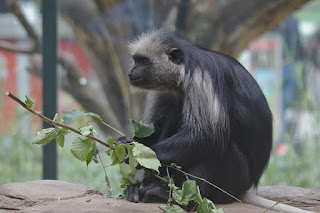
The Old World leaf-monkeys are formally known as "colobine" monkeys, with the name of their subfamily coming from what British zoologist Thomas Jerdon considered to be the most typical member of their subfamily when he first named it in 1867. These, of course, are the colobus monkeys, of which there are a great number of species. Jerdon, however, was thinking in particular of what we would now call the black-and-white colobus monkeys, so it's these against which, taxonomically speaking, all other leaf monkeys are compared.

The first colobus monkey of any kind to be scientifically described was the animal now known as the king colobus (Colobus polykomos). This was in 1780, with Eberhard von Zimmerman basing his description on a specimen collected from an island off Sierra Leone. His original name meant something like "many-singing monkey", and it was only in 1811 that the word "colobus" was coined. This comes from the Greek word for "maimed" and refers to the fact that colobus monkeys have no visible thumbs, just a small lump on the side of the palm, making it look as if they have been cut off.

Saturday, 29 January 2022

Monkeys with Many Stomachs

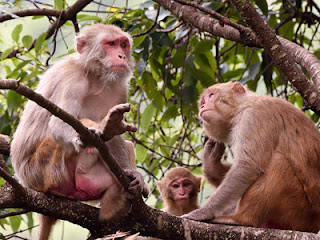
Rhesus monkeys have entirely
normal stomachs
The word "monkey" entered the English language relatively late, in the 16th century. It's not at all clear where it came from, and it doesn't have a direct counterpart in most other European languages. Instead, they, like medieval English, used the same word for both monkeys and apes (and that word was, in our case, "ape"). From a modern, scientific, point of view, these other languages are correct, because there is no scientifically definable group of animals that fits with what most people mean by "monkey".

This is due to the rule, often mentioned on this blog, that the members of any scientifically defined group of animals have to be more closely related to all the other members of that group than they are to anything else. The diagram further down this post showing how all the major groups of simian are related illustrates why this is. At the top, we have the macaques and the leaf monkeys, both of which are indisputably monkeys. But their closest relatives are the apes (which, of course, includes gibbons as well as "great apes"). Only then do we get to the other monkeys, which means that, for example, a macaque is more closely related to a gorilla than it is to a marmoset.