Showing posts with label sociability. Show all posts

Sunday, 17 May 2026

Not Leaving Home: Wolves on the Serengeti

There is a popular belief that wolf packs are led by an "alpha male", a dominant individual who directs the pack and monopolises breeding opportunities through the force of his masculine aggression. It's all-but universal in modern stories about werewolves, and has even crept into the messaging of online influencers, apparently following the reasoning that anything true of wolves must necessarily also be true of humans.

It is, however, simply not true.

Having said which, it used to be a serious scientific theory, derived from behavioural studies on captive wolves conducted in the mid 20th century. Better studies at the end of the century, looking at wolves in their natural habitats and not stressed by close confinement with non-family members in zoo cages, revealed the truth: not only is the dominant female at least as important as the male, but the correct word for that dominant pair isn't "alpha", it's "parents".

Sunday, 4 January 2026

Staying Away from the Boys

Many large, hooved mammals live in herds. This has obvious advantages of safety in numbers, spreading the work of looking out for predators, as well as benefiting from the knowledge of more experienced herd members as to the best places to find food or shelter. The structure and composition of these herds vary from species to species, but one common trait is that males and females often form single sex herds that travel apart for much of the year.

This is referred to as "sexual segregation", and was first formally described by Charles Darwin in The Descent of Man. It isn't unique to mammalian herd animals, being seen in everything from fish shoals to bird flocks, as well as in non-hooved mammals (dolphins, bats, primates, etc.) Most zoological research, however, has tended to focus on large cloven-hooved mammals, such as deer and antelopes.

Sunday, 16 November 2025

Splitting the Troop

Primates are, for the most part, social, group-living animals. This underlies many aspects of human behaviour and likely played a role in our development of intelligence. Often, these groups have a fission-fusion structure, where new members come and go, but, in other species, they can be long-lasting and stable. Either way, just as with nation-states or tribal societies among humans, nothing lasts forever. Groups die and new groups form.

This can be due to disaster or misfortune, but it can equally well be due to success. If a group becomes too large, there may no longer be enough food in the local area to keep it healthy, or parasites or disease may spread too rapidly within it. Or it may simply become too large for dominant individuals to control. In fission-fusion societies, this may lead to a temporary break-up into local subgroups that otherwise remain in contact. Sometimes, however, the pressure is too great and the only solution is for a new group to form.

Sunday, 12 October 2025

The Family Life of a Spectral Bat

It may not be Halloween just yet, but it is October, so that's as good a time as any to talk about an animal that goes by the name of the spectral bat (Vampyrum spectrum).

You might think from the scientific name that this is a close relative of the vampire bat but, while it does belong in the same family, vampire bats are a side-branch of that family thought to have diverged from the main branch around 50 million years ago. Its closest relative may be the far less fearsomely named "big-eared woolly bat" (Chrotopterus auritus), with which it shares some of its unusual feeding habits. 

Sunday, 5 October 2025

Delphinids: Killer Whales

Orca / killer whale
The dolphin family is scientifically defined as including all the species more closely related to the common dolphin than they are to porpoises. The great majority are what we'd normally think of as "dolphins" but four species are so much larger that, instead, we tend to call them "whales". Three, including the two species of pilot whale, are of roughly similar size to each other, but the fourth is noticeably larger still.

It's the biggest "dolphin" of all: the orca or killer whale (Orcinus orca).

That it is a dolphin has never been seriously doubted from a scientific perspective. It is one of just three species of dolphin to be listed as such in the first catalogue of scientific names in 1758 - and one of the other two is a porpoise, and so has since been moved elsewhere. On the other hand, it has been recognised as belonging to a distinct subfamily with the dolphins since 1846, and modern genetic studies confirm that its ancestors diverged from those of most other dolphins unusually early. 

Sunday, 7 September 2025

Delphinids: Pilot Whales

Long-finned pilot whale
The term "dolphin" is not, strictly speaking, a scientific one. It refers, in common parlance, to any small cetacean, often even including porpoises. Even ignoring the porpoises, however, not all dolphins are members of the dolphin family, technically referred to as "delphinids". This is because some freshwater animals are not closely related to the dolphins proper (or, indeed, to the porpoises). We call them "dolphins" because they're about the right size, a similar shape, and... well, we don't have a better word, at least for them all collectively.

But it works the other way, too. Not all members of the dolphin family are commonly called "dolphins". With the exception of the melon-headed whale, which it's hard to think of as anything other than a dolphin, this is because they're too big. We call them "whales" - another term that doesn't map to anything scientifically - since that's what we call any large cetacean.

Sunday, 10 August 2025

Delphinids: Newest and Largest Dolphins

Fraser's dolphin
One of the largest features at the British Natural History Museum is a full-scale model of a blue whale, occupying a large chunk of one of the mammal halls. This was installed in 1938 by Francis Fraser, a Scottish zoologist with a lifelong interest in cetaceans. Eighteen years later, still working at the museum, he was put in charge of reorganising their collection of cetacean skeletons and came across one that hadn't been closely examined since it had arrived in 1895.

It had been donated by Charles Hose, a colonial administrator and amateur naturalist who had found the skeleton on a beach near a river mouth in Sarawak (then a British Protectorate). Hose hadn't been quite sure what it was, and simply labelled it "white porpoise ? Lagenorhynchus sp." before sending it on. When Fraser examined it, however, he soon realised that it couldn't possibly be what Hose had guessed and that it was, instead, an animal previously unknown to science.

Sunday, 9 March 2025

Gorilla Communities

It is, I would hope, well-known that the closest living genus to our own is that of the chimpanzees and bonobos. The second-closest is, of course, that of the gorillas. There are two species of gorilla, each with two subspecies, and both are considered "critically endangered" - literally on the verge of extinction. For one species, this is, as one would expect, largely due to their tiny surviving population and restricted range. 

There are many factors that we need to consider when attempting to reverse this, and some of them also have a bearing on the evolution of our own species. Among these is the question of how gorilla groups are socially constructed and how they interact. It turns out that here, we can't just consider "gorillas" en masse because the two species behave in very different ways. For example, while one species can have multiple silverback males in the same troop, this is rare (but not unheard of) in the other.

Sunday, 9 February 2025

Delphinids: Common and Bottlenose Dolphins

Common dolphin
When the genus Delphis was first named in 1758 at the dawn of taxonomy, it included three species of small to medium-sized toothed cetacean. By the time the dolphin family, Delphinidae, was named in 1821, one of those species (the porpoise) had been moved elsewhere, but five new ones had been added. Many more followed, but, from the mid-18th century onwards, naturalists began to notice subtle differences between animals that were probably more mysterious to them than land-dwelling mammals, and many species of dolphin began to be separated out into newly created genera.

So much so in fact, that by the time we reach the 21st century, only one species remains in the genus originally created to contain all dolphins and dolphin-like animals. That species is, of course, the one that we believe Linnaeus happened to be thinking of when he named the genus, and therefore is the defining (or 'type') species not only for its genus but for the dolphin family as a whole. This is the aptly named common dolphin (Delphinus delphis).

Saturday, 1 February 2025

Call of the Mole Vole

There are over 170 recognised species of vole. The exact number is hard to determine because new species keep being described and not all will necessarily stand the test of time but we can certainly say that there are a lot. Although we might typically think of voles as being all rather similar to one another - small, mouse-like animals with short tails and rounded snouts - within such a large group there is inevitably some variation.

Most obviously different from regular voles are the giant species. Although genetic data shows us that these are voles, in the sense of being offshoots of the vole family tree rather than something distinct, we don't normally refer to them as such in English. Instead, we call them "lemmings" or, in the case of the very largest species, "muskrats". To avoid potential confusion, in more scientific language we would therefore use the taxonomic name when referring to the subfamily as a whole and say that voles, lemmings, and muskrats collectively are "arvicolines". 

Sunday, 13 October 2024

You Scratch My Back...

One of the most widespread behaviour patterns among non-human primates is their habit of grooming one another. Technically referred to as "social grooming" or "allogrooming", this refers to cleaning the fur of other animals, removing ticks and other parasites. In addition to the obvious health benefits, this also helps maintain cohesion among social groups that can be structurally complex. Indeed, it's generally thought to be one of the main reasons primate societies are so sophisticated in the first place.

Many mammal species live solitary lives, at least outside of the mating season. For those, there would be little opportunity for social grooming and no wider benefit to be gained from it if there was. Self-grooming or "autogrooming" - such as licking one's own fur - may well be sufficient for them. But, of course, primates are not the only social mammals, and many of those other animals have fur in which parasites could hide, so it's reasonable to ask if allogrooming really is unique to primates.

Sunday, 11 June 2023

A Tale of Three Ground Sloths

Today, sloths are slow-moving tree-dwelling animals found only in South and Central America. For most of their evolutionary history, however, the majority of sloths have been ground-dwellers, in many cases too large to have climbed a tree even if they had wanted to. In comparison, tree sloths are a relatively recent evolutionary development. 

Ground sloths, however, are not a single type of animal in the strict biological sense. This is because the two-toed and three-toed sloths that we have today are not especially close relatives, last sharing a common ancestor at least 28 million years ago. In fact, tree sloths evolved twice, in separate branches of the sloth family tree, and some ground sloths were more closely related to one or the other. On this basis, we used to divide the ground sloths into two families, but the fact that some of lived recently enough that we can recover and analyse DNA from their fossils gave us some surprising detail and a key 2019 study suggested that we should consider there to be no fewer than six different families of ground sloth.

So whatever we can say about one sort of ground sloth isn't necessarily true of all the others, even on quite a broad scale.

Sunday, 26 March 2023

The Raccoon Family: Coatis

White-nosed coati
The common raccoon is the only member of the family whose scientific name dates back to the official dawn of biological taxonomy in 1758. However, people continued sending him new specimens to catalogue and, just eight years later, in a later edition of the same work, Linnaeus added two further species that we would now also place in the raccoon family - albeit, he initially described them as civets.

These two animals were coatis (or "coatimundis"), with one first identified from Mexico, and the other from Brazil. They were given their own genus by Gottlieb Storr in 1780 when he first named the raccoon family. It's probably fair to say that, to modern eyes, Storr's classification seems the more reasonable of the two; coatis look a lot more like raccoons than they do like civets.

Sunday, 5 March 2023

Friendship and Fission-Fusion

Mammal species have a wide range od different social systems into which they organise themselves. Many are essentially solitary outside the breeding season, others form long-lasting pair bonds, and others live in larger associations which may themselves have varying different structures. Among the latter, one common pattern is that of the fission-fusion society.

Here, rather than having a long-lasting association, perhaps bonded by ties of family, the animals live in groups but the membership of that group is not constant. New animals are constantly wandering in, while others break off and leave for other groups. On a larger scale, it may be that the individual fission-fusion groups - the actual bands of animals you would see travelling together - are themselves gathered into larger social networks that may have a relatively consistent structure. That is, the new animals joining the group aren't random; they're individuals already known to the group, and rival social networks may exist nearby that do not mix their members.

Sunday, 15 January 2023

Grumpy Old Voles?

Meadow vole (a related species)
It should go without saying that the behaviour of young mammals changes as they approach, and eventually reach, adulthood. Obviously, there's the development of the mating drive, but there are also social changes, as the animal gains independence, first from suckling, and then more generally from its parent(s), often leaving home, whether to live alone or to find a new pack where its potential mating partners aren't also its own siblings. 

Drawing parallels between these changes and the way that humans develop isn't without risk; the complexity of our society, the existence of culture and so on significantly colour how we behave. But that's not to say that such parallels don't exist, and can't tell us anything, even if it's only how we evolved. We are, after all, still affected by our biology and evolutionary history in at least some respects. For instance, it's notable that exactly how animal pups are raised by their mother can affect how they behave as adults, even if the details are going to be less complex than they are with human child-rearing.

Sunday, 4 December 2022

Leaf-Eating Monkeys: Leading by a Nose

Proboscis monkey (male)
Perhaps the most distinctive and well-known of all the colobine monkeys is the proboscis monkey (Nasalis larvatus). Sufficiently distinctive that it's hard to confuse it with anything else, it was first described as a species all the way back in 1787 by botanist Friedrich von Wurmb, then working for the Dutch East India Company, and given its own genus in 1812.

Indeed, it is strange enough that, during the 20th century, it was assumed to represent a very early side-branch in colobine evolution, existing outside all the other groups in the subfamily. That wasn't just because of its odd appearance, but also because it had two extra pairs of chromosomes to every other colobine monkey. But it turns out that that's a false signal and that, not only are proboscis monkeys a relatively recent branch within the subfamily, their closest relatives include the snub-nosed monkeys whose noses are noted for being extraordinarily short.

Sunday, 6 November 2022

Leaf-Eating Monkeys: Monkeys on the Mountainsides

Golden snub-nosed monkey
Much of eastern China is dominated by two great river basins: the Yellow River in the north and the Yangtze in the south. In the western parts of the country, the upper reaches of the two basins are separated by the Qinling Mountains, running eastward from the vast Tibetan Plateau. And here, in addition to many other unique animals and plants, we find a rather strange species of monkey.

This is the golden snub-nosed monkey (Rhinopithecus roxellana) and its oddity merely begins with its unusual appearance. As the name implies, its fur is mostly golden, ranging from a brownish-red hue to a much brighter golden-yellow. Contrasting stripes of black fur run down the outer edges of the limbs and there are white patches on the back of the thighs. All of these colour patterns are brighter in the males, which are also noticeably larger than the females, indicating that these are likely used in sexual signalling - something supported by the fact that the genitalia also have a contrasting dark colour.

Sunday, 9 October 2022

Leaf-Eating Monkeys: The Colourful Doucs of Vietnam

Red-shanked douc

Modern genetic analysis has shown that the leaf-eating monkeys of the Old World consist of three, related, evolutionary branches. Two of these, the colobus monkeys of Africa, and the langurs of Asia, had long been recognised as distinct, but the third was not always so. The monkeys belonging to this branch had, for the most part, previously been considered to be langurs, or at least part of the langur line, but it turns out that they split off from the others early on. Because of the comparative recency of this discovery, this third group doesn't have any distinctive common name and nobody seems to have come up with a scientific one, either. ("Rhinopithecinini" would seem the obvious choice to me, but one can see why nobody bothered).

So, instead, this group, when scientists need to refer to it, ends up being called the "odd-nosed monkeys". Even then, not all of them have noses that look (at least to me) especially odd, and this is most clearly true of the doucs. 

Sunday, 27 February 2022

Leaf-eating Monkeys: Black-and-White Colobuses

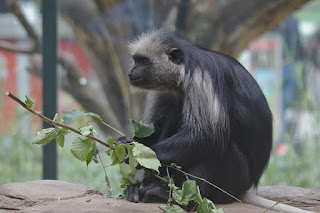
King colobus
The Old World leaf-monkeys are formally known as "colobine" monkeys, with the name of their subfamily coming from what British zoologist Thomas Jerdon considered to be the most typical member of their subfamily when he first named it in 1867. These, of course, are the colobus monkeys, of which there are a great number of species. Jerdon, however, was thinking in particular of what we would now call the black-and-white colobus monkeys, so it's these against which, taxonomically speaking, all other leaf monkeys are compared.

The first colobus monkey of any kind to be scientifically described was the animal now known as the king colobus (Colobus polykomos). This was in 1780, with Eberhard von Zimmerman basing his description on a specimen collected from an island off Sierra Leone. His original name meant something like "many-singing monkey", and it was only in 1811 that the word "colobus" was coined. This comes from the Greek word for "maimed" and refers to the fact that colobus monkeys have no visible thumbs, just a small lump on the side of the palm, making it look as if they have been cut off.

Sunday, 9 January 2022

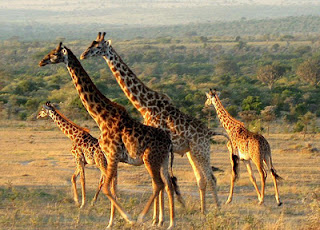
The Social Lives of Giraffes

Many of the cloven-hoofed mammals are herd animals, living in large groups that typically have dominance hierarchies and other relatively complex internal structure. We see this in both of the main families of such animals: the deer and the "cattle family" (which includes goats, sheep, and antelopes besides the obvious). On the other hand, there are certainly plenty of exceptions. Smaller deer, such as muntjacs, for instance, tend to be relatively asocial, apparently gaining more benefit by hiding from predators than they would from living in large and watchful, but visibly obvious, herds.

But it isn't just the smaller cloven-hoofed mammals that can lack sophisticated social lives, because the same also seems to be true of the largest of all such animals: the giraffe (Giraffa camelopardalis). At which point, I should probably take a brief diversion to explain what a giraffe is, and where it fits in the larger mammalian family tree.