Showing posts with label cetaceans. Show all posts

Sunday, 14 December 2025

Prehistoric Mammal Discoveries 2025

Computer reconstruction of the skeleton of the Miocene
 right whale Megabalaena, published this year
As another year draws to a close, it's time to take another dash through the mammalian palaeontological findings of the last twelve months. As always, this will be a rapid survey of some discoveries that I find particularly interesting without any detailed discussion, but hopefully covering as wide a range of prehistoric mammals as I can.

Large Herbivores

Land mammals don't come much larger than mammoths, and such animals, and their mastodon relatives, have shaped the world around them through their mere presence and the food they chose to eat. A study on southern mammoths (Mammuthus meridionalis) uncovered at a million-year-old site in northern Spain showed that the climate at the time was already Mediterranean, a warm gap within the Ice Ages, causing them to feed more on grasslands than trees. While hyenas had fed on some of the carcasses, they were not alone, as the evidence also shows clear signs of butchering with stone tools.

Elsewhere, a new study found that the South American gomphothere, Notiomastodon, which had entered the continent when the Panama Land Bridge formed, had a diet rich in fruit. When they went extinct as the climate warmed 10,000 years ago, their disappearance spelt trouble for the plants with large, fleshy fruit that had relied on them for seed dispersal.

But if Spain had a reasonably modern Mediterranean climate one million years ago, that obviously didn't last. Although we know they must have existed earlier, until this year, the oldest known cold-adapted mammals from Spain dated to no more 190,000 years ago, during the second-to-last Ice Age. This year, however, a reindeer tooth was described from the country that could date back as far as 300,000 years, during the Ice Age prior to that - it's the most southerly known reindeer fossil ever discovered. 

On the subject of deer, a new analysis of the DNA of the Toronto Subway deer (Torontoceros hypogaeus) discovered during the construction of the eponymous transport system suggested that, while undeniably a distinct species, it might be more closely related to the living white-tailed deer than previously thought. It lived in open habitats, and was driven to extinction at least partly by the spread of the forests that now cover the area.

Studies of isotope ratios in the short-legged hippo-shaped rhinceros Teleoceras from Nebraska showed that they lived in much in the same areas throughout their lives, not migrating, or even moving as far as we would expect when they reached adulthood and left their parents. This may have been because they relied on habitats with plenty of water to wallow in, and they just couldn't find them elsewhere. Over in eastern Siberia, the longest ever fossilised horn from a woolly rhino (Coelodonta antiquitatis) was described; it was over 164 cm (65 inches) long, far larger than those of any living rhino.

Fossils are not necessarily of things like bones and horns, however. This year, the oldest known fossilised cowpat was described from 20 million-year-old deposits, also in Nebraska. At least it looks like a cowpat - it's about the right size and shape, and it's obviously dung - but cows didn't exist that far back, and, honestly, neither did anything closely related to them. So, probably a ruminant of some sort, but what kind will likely always remain a mystery.

Carnivores

Europe is devoid of big cats today, unless you count the occasional lynx. This was not always so, however, and a publication this year expanded the range of the European jaguar (Panthera gombazagoensis) to Poland and to Suffolk in England between 700,000 and 350,000 years ago. Another large cat, the famous sabretooth Smilodon fatalis, was discovered further south than ever before - in Uruguay

We already knew about leopards (the modern species) in the Pyrenees during the Ice Ages, but their fossils are rare. A new study of their overall distribution and history showed that they became steadily larger as the Pleistocene wore on, and also that males and females were more similar in size than in living members of their species. Moreover, they showed a preference for mountainous habitats, and their body shape shifted towards that of modern snow leopards prior to their local extinction.

The largest mammalian carnivore during the Ice Ages in North America was the giant short-faced bear (Arctodus simus), with some individuals estimated to have weighed up to 950 kg (2,000 lbs). However, some fossils were significantly smaller than this and had been suggested to represent a distinct subspecies. Genetic analysis this year was unable to find any significant differences between the larger and smaller specimens except for one: all the large ones were male, and the small ones female...

And, well, yes, I should probably mention this, since it was all over the news. This year, a company claimed to have returned the dire wolf (Aenocyon dirus) from extinction, in the form of three, rather cute, white puppies. Almost nobody outside the company with any expertise agrees that this is really what they have done, simply adding a few dire wolf-like genes to what are rather obviously grey wolves.

Cetaceans are also carnivores, although descended from creatures that were not. An analysis of the skull of the very primitive dolphin-sized Protocetus showed that it had already developed the large brain that cetaceans are known for today but, more importantly, that it still had a keen sense of smell. Modern whales and dolphins have no use for smell but Protocetus likely spent at least some of its time on land, giving it a very different lifestyle.

Among more recognisable whales, Idiophorus is either the most primitive known sperm whale or a close relative of their last common ancestor. Recovered from Miocene age deposits in Patagonia, it had a long snout shaped like a wine bottle (so hardly like a modern sperm whale) and was around 6.6 metres (22 feet) in length. The key fossil was thoroughly re-examined this year for the first time since it was uncovered in the 19th century, revealing that it was a deadly predator feeding on relatively large vertebrate prey, unlike other known sperm whale species living in the area at the time. 

At the other end of the Americas, and a few million years earlier, Fucaia was a Canadian whale belonging to a now-extinct group. Analysis of a well-preserved fossil this year showed that, like Idiophorus, it was an agile and active predator, although, partly because it was rather smaller, its hunting style was probably most like that of a modern sea lion. Despite this, its closest living relatives include the toothless krill-feeding baleen whales.

Other Placentals

Glyptodonts were gigantic relatives of armadillos, their heavy armour plating making them the mammalian equivalent of tanks. A study this year provided the first analysis of damage to that armour in three South American species, adding to those already performed on more common ones. It also confirmed that, like certain dinosaurs, they likely did wallop each other with the clubs on their tails, likely while competing for mates or territory.

Ground sloths have a long evolutionary history, much larger relatives of the small(ish) tree-dwelling animals that are their only remaining close relatives. A new analysis shows how they gradually increased in size as the climate shifted, but that, probably to the surprise of few people, it was not climate change that eventually drove them to extinction, but the arrival of humans. 

Look at any reconstruction of a ground sloth, and it will inevitably show a large, somewhat shaggy animal. But it had been argued that, like elephants and rhinos, the largest ground sloths may not have had much fur at all, being so big that they did not lose much body heat anyway. It was a minority view, but geochemical analyses and simulations published this year seem to put the nail in its coffin. Given the relatively cool environments in which they lived, the simulations suggest that even the largest species would have needed a pelt of fur 10mm (0.4 inches) thick, and some would have needed fur three to five times that long. This, despite the fact that palaeothermometric analysis in the same study showed that they had unusually low body temperatures for their size.

Several studies this year took a look at the development of increasing brain size during primate evolution - primarily monkeys and apes. They did not all come to the same conclusions, which, while they don't necessarily contradict one another, either, suggests that there was probably a lot going on rather than one single answer. One study pinpoints visual processing as the main factor, with visual parts of the brain becoming disproportionately large before the rest caught up, something that would make sense for an animal that had to navigate through tree branches.

Another points to socialisation, with parts of the brain responsible for some of our most complex behaviour starting to enlarge early on. A third points out that brain enlargement correlates, to some extent, with the elongation of our thumbs (which are obviously very different from those of most non-primates), implying that fine manipulation of objects may have been another key element in the drive for greater intelligence.

Going further back in time, another study this year challenged the traditional view of primates originating in tropical jungles. Instead, it suggests that the very first primates appeared in cold and temperate habitats in the north, the changeable climates of such areas promoting the evolution and dispersal that allowed them to reach the tropics later on.

Among the rodents, analysis of a new fossil and comparison to others already known shed light on the origins of the group that includes the gophers. The fossil belongs to an unusually large relative of the ancestor of gophers and kangaroo rats, and seems to have already been a skilled digger. This supports existing theories that the ancestral gopher looked like, and had a similar lifestyle to, today's pocket mice.

An unusually complete fossil free-tailed bat found north of Marseilles in France dates back over 30 million years to the Early Oligocene. The shape of the wings and muscular anchors in the body shows that it was fast and capable of sustained flight, probably catching insects in the air as it flew over what was then a large lake.

Conoryctes was a medium-sized burrowing mammal living in North America just 3 million years after the extinction of the non-avian dinosaurs. It's probably a placental mammal, but it has been argued that it may actually be an early relative that's simply closer to true placentals than to marsupials. A study of the microscopic structure of its bones shows that it must have grown rapidly, reaching adult body size in a single year and that it would have been weaned at about the age we would expect for a true placental of its size. So even if, by some chance, it wasn't literally a placental mammal, it lived very much like one.

Marsupials and More

The best-known and distinctive marsupial species are probably the kangaroos and wallabies. All but one living species belong to a subfamily that spread through Australia starting around 11 million years ago. The oldest known fossil belonging to this subfamily belongs to Dorcopsoides, which may hold some clues as to why the group became so succesful on their home continent. A new analysis published this year found that it was a more efficient hopper than had previously been thought, suggesting that it was already adapted to open environments, something that was just starting to become more common at the time, as the Australian outback began to dry out. 

It may have helped that, as another new analysis of the wear patterns on their teeth showed, Ice Age kangaroos had a wider diet than was apparent from their anatomy alone. On the downside, if they were adaptable, the fact that so many kangaroo species went extinct around 40,000 years ago is probably not primarily due to the change towards a colder climate...

While fairly detailed DNA analysis is possible for mammoths and other Ice Age animals preserved in permafrost, it is much harder for animals of similar age in warmer climates. A new study this year therefore used the molecular structure of collagen from sinews and other tissue to confirm the relationships between some of the marsupials that went extinct in the last 100,000 years. Perhaps the most significant finding was that the closest living relative of the extinct carnivorous marsupial lion Thylacoleo may be the koala, rather than it being an earlier relative of the koala-wombat common ancestor.

On the subject of carnivorous marsupials, these were at least as prominent in South America in prehistoric times, dominated in particular by the large sparassodonts. A new analysis of the skulls of South American marsupials this year showed that, while most had similarly shaped (elongated) brains to modern marsupials, that of the sabretooth marsupial Thylacosmilus was more rounded, due to its shorter, cat-like face. More significantly, revised estimates of its body weight showed that its brain was smaller than previously thought, in the range of some of its earliest ancestors, its size having evolved less than expected.

Similar analysis of an armbone belonging to the mysterious mammal Kryorectes confirmed that it was, as previously thought, a monotreme. Living alongside Australian dinosaurs a whopping 106 million years ago - 40% further back in time than Tyrannosaurus rex - the study also showed that it was probably a semiaquatic burrowing animal. The platypus lifestyle may be truly ancient. 

Finally, the multituberculates were neither placental, marsupial, nor monotreme but a fourth grouping that survived well into the Age of Mammals. An analysis this year of their habitats and distribution across North America suggested that, at least on that continent, they were restricted to damp temperate forests dominated by redwoods and swamp cypress and that they finally disappeared when those forests dramatically declined as the world cooled at the end of the Eocene. This contradicts the popular theory that it was competition with newly arrived rodents that killed them off, since they were apparently living elsewhere at the time.


Synapsida is taking a break for the holiday period and will return on the 4th January

[Image from Yanaka et al. 2025, available under CC-BY-4.0]

Sunday, 26 October 2025

Oligocene (Pt 18): Sawfish-Dolphins and Baleen Whales with Teeth

Olympicetus, a simocetid whale
Although the oldest fossils of seal-like animals may date back to the end of the Oligocene, there are very few of these, and the dating may not be wholly reliable. Whales, however, are a different matter and were already well established even at the beginning of the epoch, 33 million years ago. In fact, the Oligocene marks an important phase in their evolution, since it was at this time that the oldest living groups first appeared and that, potentially, the last common ancestor of all living whales roamed the seas.

Even so, especially towards the end of the epoch, it is possible to place some Oligocene cetaceans into groups we are familiar with today. For example, there was Kentriodon, which is better known from the Miocene, but first appeared in the southern oceans at the tail end of the Oligocene. Although it is not placed in any living family, it is the oldest member of a branch that diverged from the common ancestor of dolphins and porpoises around this time. It likely looked rather similar and had a similar fish-and-squid-based diet.

Sunday, 15 December 2024

Prehistoric Mammal Discoveries 2024

Zalamdalestes
I have reached the end of another year and that means it's time for what has become a tradition on this blog over the last eight years: a look back at some of the discoveries about fossil mammals made in 2024 that didn't make into the regular posts. As usual, this will be a quick whistle-stop tour of mammalian palaeontology, hopefully focusing on some of the more interesting findings. Like any field of science, it has not been standing still.

Large Herbivores

Woolly mammoths (Mammuthus primigenius) are among the best-known of all prehistorical mammals to the general public and, aided by the fact that some lived recently enough to be preserved in permafrost, they are also amongst the best-studied. But there is still more to learn about the details of their lives and habits. A study published this year looked at the detailed isotopic composition of a fossil mammoth that had died about 12,000 BC in Alaska, showing that she was female, and had migrated over 1000 km (600 miles) during her lifetime, having originally been born in the Yukon. The area in which she died was popular with mammoths, but also with humans - she may have died peacefully, but the presence of people where mammoths congregated may not be a coincidence.

Sunday, 26 May 2024

The Vocabulary of Sperm Whales

It's well known that whales and dolphins can communicate using sound, sometimes over long distances. In some cases, this can involve sophisticated "whalesong" that animals can use, for example, to identify each other, and that may impart other information, too. But there are a great many species of cetacean, and what is true for one won't necessarily be true for all of the others, just as what's true of chimps won't always be true for baboons or marmosets.

We'd expect the most complex messages to come from those species with the most complex social lives. In these cases, it would be useful for the animal to identify not only its gender, fitness, sexual status, and so on, but also which other whales it might associate with, and where it stands in the local hierarchy. Most (but not all) cetaceans live in pods although, for many, we haven't gotten very far in identifying how those are structured. They all, however, have relatively large brains and it can be worth asking, for any given species, just how complex their communication really is.

Sunday, 17 December 2023

Prehistoric Mammal Discoveries 2023

Potamotherium
It's the last post of the year for 2023, and that means it's time once again to take a brief look at discoveries from the last year in the world of fossil mammals that didn't make it into this blog. Because, while dinosaurs are undoubtedly popular, the study of prehistoric mammals is also a major field, aided by that, being (mostly) relatively recent they tend to be more numerous and better preserved. Of course, everyone's heard of woolly mammoths and sabretooth cats but there's plenty more out there and, if I'm going to zip through them at speed today, I'm also going to try and cover as wide a range as possible. So, let's get going...

Saturday, 25 November 2023

The First Whales to Use Sonar?

Xenorophus
Other than their obvious physical adaptations, one of the most familiar features of dolphins and whales is their ability to use ultrasound to echolocate. All dolphins, porpoises, and toothed whales (collectively called odontocetes) can echolocate and, while some of the fine details do vary between, say, sperm whales and some of the smaller species, the basic mechanism is much the same. Ultrasound would not have been useful to the large, ground-dwelling ancestors of whales in the same way that it is for bats, so it must have evolved after they entered the water. But how soon after?

We can put some limits on this. At the younger end, since all odontocetes echolocate, it's unlikely to have evolved any later than their last common ancestor, which is estimated to have lived around 34 million years ago. On the other hand, it's notable that the toothless, baleen, whales do not use ultrasound; in fact, they are specialised in the exact opposite direction to produce sounds well below, not above, the range of human hearing. This suggests that they evolved along different lines, and that the origins of ultrasonic echolocation lie somewhere after the two split. 

Sunday, 5 March 2023

Friendship and Fission-Fusion

Mammal species have a wide range od different social systems into which they organise themselves. Many are essentially solitary outside the breeding season, others form long-lasting pair bonds, and others live in larger associations which may themselves have varying different structures. Among the latter, one common pattern is that of the fission-fusion society.

Here, rather than having a long-lasting association, perhaps bonded by ties of family, the animals live in groups but the membership of that group is not constant. New animals are constantly wandering in, while others break off and leave for other groups. On a larger scale, it may be that the individual fission-fusion groups - the actual bands of animals you would see travelling together - are themselves gathered into larger social networks that may have a relatively consistent structure. That is, the new animals joining the group aren't random; they're individuals already known to the group, and rival social networks may exist nearby that do not mix their members.

Sunday, 22 January 2023

Miocene (Pt 37): The Miocene Oceans

Xiphiacetus
Given their extreme adaptations to a life at sea, it should not be surprising that whales and dolphins have a long evolutionary history. Even at the dawn of the Miocene, when seals were at best, only very recent arrivals, and may still have been semi-aquatic, like otters, the cetaceans were already well-established. A time-travelling whale-watching expedition at almost any point during the Miocene would likely have been just as rewarding as one today and, especially so far as one would have been able to see them above the waves, the animals you would have been spotting would not have looked all that different.

At a more detailed anatomical scale, that would have been less true and many of the creatures would not have been as closely related to the modern forms as one might have supposed. Today, the largest number of cetacean species belong to the "true" or "oceanic" dolphin family, including not only all of the sea-going dolphins but some larger animals such as killer whales. But in the Miocene, true dolphins seem to have been comparatively rare and we know of very few fossils predating the subsequent, Pliocene, epoch.

Sunday, 24 July 2022

How Big is a Small Whale?

The ongoing expansion of humanity has placed several animal species under threat of population decline or extinction, whether due to direct effects such as loss of wild spaces or more indirect ones such as climate change. (And a great many of these species are non-mammalian, of course, despite the focus of this blog). On the other hand, there have also been many conservation efforts that aim to restore, or at least preserve, species at risk. As I've previously described, for example, both black-footed ferrets and European bison went completely extinct in the wild during the 20th century, but are now back living in their original native habitats, if only in small numbers.

Not all such restoration efforts have been successful, and there can be many different reasons for this, not all of which are necessarily biological. Better then, of course, to try and prevent species from becoming endangered in the first place. For this reason, many species are protected even if they are not currently at risk. The more we can understand about these species, the better we will be able to keep them that way. 

Sunday, 10 July 2022

The Dolphins of Switzerland

Kentriodon
The Mediterranean is very nearly an inland sea. Its only natural connection to the world's wider oceans is through the Strait of Gibraltar between Spain and Morocco, a passage just 13 km (8 miles) wide at its narrowest point and in places just 300 metres (1,000 feet) deep; pretty shallow as such things go. It's probably because of this that some of the larger whales that inhabit the Atlantic (blue whales, humpback whales, etc.) are rarely if ever seen venturing into its waters.

Dolphins are a different matter, with the majority of North Atlantic dolphin species also being commonly seen in the Mediterranean, albeit in some cases only in its most westerly waters. This includes some of the really big dolphins that we'd normally call "whales", such as the killer whale, and there are three species of genuine whale that live there, too. The connection between the Mediterranean and the Atlantic has not always been there, however; for a long time during the Late Miocene, the two bodies of water were separated by a land bridge between Spain and Morocco, entirely cutting the Mediterranean off until it ended in the cataclysmic Zanclean Flood

Sunday, 6 February 2022

How Dolphins Got Their Large Brains

As a rule, larger animals tend to have larger brains, just as they have larger hearts, livers, and other internal organs. But the relationship is not a linear one, partly because, unlike the liver, there's a minimum size below which the brain doesn't have room for the basic housekeeping functions that keep the body ticking over, so that small animals have proportionately larger brains than large ones. If we want to know whether a particular creature has a larger, or smaller, brain than we'd expect then, as I've described before, we use a mathematical formula called the encephalisation quotient to determine what the size of the brain "should be". 

By definition, an average mammal should have an EQ of 1. The formula breaks if we try to apply it to non-mammalian animals, such as birds, probably because their brain architecture is different from ours at quite a fundamental level. Even for mammals, there is some debate as to exactly what formula we should be using; most older studies have determined that brain size typically rises as the 2/3 power of body size (that is, as the cube root of the square) but a 2019 study argued that it's perhaps more accurate to base it on the 3/4 power and this seems to be a growing consensus.

Sunday, 14 November 2021

Arctic Sonar Beams

Dolphins and porpoises are well-known for using biosonar to navigate their way around and detect the fish on which they feed. There are a large number of different dolphin species, with well over 30 in the Oceanic dolphin family alone, which includes not only the regular-sized species but also much larger "dolphins" such as the killer whale. Given this physical variety, and the variation in habitats between the different species, it's unsurprising that there are also many variations in the exact details of the sounds they emit and how they use them.

Much of this variation seems to date from the Middle to Late Miocene when both dolphins and porpoises underwent a rapid increase in the number of known species. This may be related to the loss of the connection between the Mediterranean and the Indian Ocean, creating a change in the worldwide circulation of water and corresponding changes in the habitats available to these animals, allowing them to exploit new opportunities.

Sunday, 28 June 2020

What's the Closest Living Relative of Whales?

(For the TLDR crowd; just read the last paragraph).

It's been known for a long time that, at the highest level, mammals can be divided into three evolutionary groups based on their method of giving birth: marsupials, the egg-laying monotremes, and the placental mammals. That last group contains around 95% of all living mammal species, including everything from wolves to dolphins and moose to monkeys.

Given that wide variety, it's less obvious how we should divide up the placental mammals into smaller groups that genuinely reflect their evolutionary relationships. It's obvious that, say, cheetahs are members of the cat family and, at a slightly higher level, it's unsurprising that, for example, the dog and bear families are reasonably close relatives of one another. But once you get much higher than that, it becomes less so.

Sunday, 1 July 2018

Fishing in the Ganges

The most spectacular cetaceans are, arguably, the really big ones - sperm whales, blue whales, and so on. However, while our knowledge of the exact numbers is a little hazy, somewhere around half of the cetacean species alive today represent much smaller animals. The majority of these belong to just two taxonomic families.

By far the most numerous are the "true" or "oceanic" dolphins, a family that also includes killer whales and pilot whales - small in comparison with the like of humpbacks, but fairly large by most standards. The second family are the porpoises, which are exclusively small, by cetacean standards, and usually slightly smaller than dolphins.

But there are a few small-sized cetacean species that fall into neither group. These oddities share one thing in common: they don't live in the sea. While they are, of course, just as fully aquatic as their better-known kin, this has lead to them receiving the common collective name of "river dolphin", thus distinguishing them from the "oceanic" sort that most people are more familiar with.

Sunday, 10 June 2018

The Fast Lives of Early Sperm Whales

Livyatan melvillei, a Miocene species
(It was supposed to be 'Leviathan', but the name was
already taken)
Sperm whales are magnificent and highly distinctive animals. While they may not be quite as large as the great toothless whales, they are still pretty huge: a fully grown male is typically about 16 metres (52 feet) in length and weighs over 40 tons. So distinctive is it, in fact, that today it is usually considered to be the only living species in its family, the Physeteridae.

The caveats in that last sentence - "today", "usually", and "living" - are all significant. On the first two points, the sperm whale family used to be considered to contain no less than three living species, and some researchers still define it that way. The other two species are the dwarf and pygmy sperm whales (Kogia spp.), and they're typically (but not always) placed in their own family these days. As their names suggest they are much, much smaller than the "true" sperm whales, being more like the size of a large dolphin.

Sunday, 6 May 2018

Diving for Your Dinner

Dinner!
Cetaceans (whales, dolphins, and porpoises) are the best adapted of all mammals to life underwater. Their food is often found far below the waves, requiring them to dive deep to find it. But this, of course, is countered by the fact that, not being fish, they also have to return to the surface to breathe. The deeper the desirable food happens to be, the longer they will have to dive for just to reach it, and the longer they will have to spend recovering on the surface afterwards - even if the actual feeding time remains the same.

Such pay-offs are arguably particularly important for the huge rorqual whales, which feed by lunging at great masses of krill or other small prey and gulping them down. For them, it really matters that wherever they are diving is rich in food, so that they can find enough to offset the effort required to catch it. Quite how they strike that balance should depend on how good they are at diving, which relates to things such as their lung capacity and how much oxygen they need to sustain their bodies.

Sunday, 18 February 2018

Early Whales of the North Pacific

The majority of living cetacean species belong to a group called the odontocetes, or "toothed whales". Most of them aren't really what we think of as "whales" at all, since the group includes all of the dolphins and porpoises. The group does, however, include a number of much larger species - some of them just really big dolphins, such as the killer whales, but others being less closely related, such as sperm whales, beaked whales, and narwhals.

The odontocetes as a whole stretch back far into the fossil record, with the oldest known examples dating back to around the dawn of the Oligocene epoch 34 million years ago. They rapidly spread across the globe, unhindered by the geographical barriers that often affect more land-based mammals. (The continents were all separate at the time, which would have helped, since it was possible to swim right around the globe without leaving the mid-latitudes).

Sunday, 17 December 2017

Prehistoric Mammal Discoveries of 2017

Albertocetus meffordorum, the post-cranial anatomy of which
was described for the first time this year.
At the end of each year, I do a slightly different post to wrap up the blog for the season. The format of these has changed over the years, and this year, again, it's time to do something slightly different from previous occasions. Not that there haven't been some interesting new species discovered this last year, with, to my mind, the Skywalker gibbon (Hoolock tianxing) being the stand-out example. This was announced early in the year, having been discovered in the Chinese/Myamar border region by a group of researchers who were fans of a certain science fiction franchise ("tianxing" literally translates to "sky-walker" in Standard Chinese), and is likely already endangered.

But this year, instead of discussing just how many new kinds of bat we discovered in the last twelve months, I'm going to note that my posts on fossil mammals tend to be more popular than those on the living sort, and take a look at a partial assortment of scientific papers published on this subject in the last year that, for various reasons, didn't end up in my regular blog posts. So here goes.

Sunday, 9 July 2017

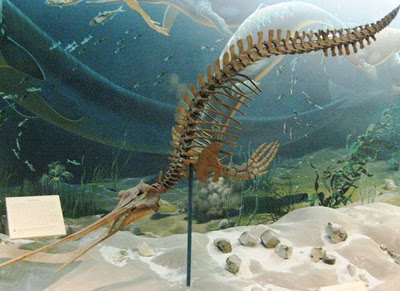
First and Last of the South Asian River Dolphins

South Asian river dolphin skeleton -
note the strange shape of the skull
Although the whales are undeniably spectacular, the majority of cetacean species are much smaller; the sort of animals we generally refer to as "dolphins". The great majority of these belong to the family Dephinidae, variously termed the "oceanic dolphins", "pelagic dolphins", or even "true dolphins". This is a large family, with nearly forty species, including killer whales and pilot whales alongside their smaller kin.

Whatever we call this family, it, in turn, belongs to the larger group of the "delphinoid cetaceans", which also includes the six species of the porpoise family and two other whales - the narwhal and beluga. Taken together, these animals and their extinct relatives have dominated the count of cetacean species across the world for millions of years, forming a key part of the ocean ecology. Of all the other cetacean groups, only the mysterious deep-sea beaked whales come close in terms of the number of species, and even they don't appear to be as varied.

Sunday, 16 April 2017

Pliocene (Pt 16): The Pliocene Oceans

Bohaskaia
Over the last two and a half years, I have talked about a range of mammal species found across the Pliocene world. So far, I have only looked at the continents, and the various animals that lived on land. But the Pliocene seas were, of course, equally teeming with animal life. Much of this naturally consisted of either fish (most famously the giant "megalodon" shark) or invertebrates of various kinds. Sea turtles also existed, including some quite large ones, but, in keeping with the scope of this blog, I'm going  to focus on the mammals.

While we often tend to think that prehistoric animals tended to be larger than those alive today, this, was however, rather less true of whales, which have grown more or less steadily in size over the course of their evolution, perhaps in part to make it increasingly difficult for anything else to eat them. So, for example, the Pliocene killer whale (Orcinus citoniensis) was around 4 metres (12 feet) in length, barely more than half that of the modern species - although still quite impressive on a human scale.