 |
| Northern right whale dolphin |
Some dolphin species, however, are less well-known than others. I've covered some already, but perhaps the most obscure are the right whale dolphins.
|
| Northern right whale dolphin |
Some dolphin species, however, are less well-known than others. I've covered some already, but perhaps the most obscure are the right whale dolphins.
.jpg) |
| Fraser's dolphin |
It had been donated by Charles Hose, a colonial administrator and amateur naturalist who had found the skeleton on a beach near a river mouth in Sarawak (then a British Protectorate). Hose hadn't been quite sure what it was, and simply labelled it "white porpoise ? Lagenorhynchus sp." before sending it on. When Fraser examined it, however, he soon realised that it couldn't possibly be what Hose had guessed and that it was, instead, an animal previously unknown to science.
 |
| Irrawaddy dolphin |
The Irrawaddy dolphin (Orcaella brevirostris) was first described in 1866, from a specimen caught, not in a river, but off the northeast coast of India. We now know that this is at the far western edge of its range, and that it is also found all along the coast from northeast India, around the Malaysian Peninsula, to as far east as southern Vietnam. It is also found further south, around Borneo and along the north coasts of Sumatra and Java. In 1999, a very small population was discovered in the Philippines, living in a couple of isolated bays very far from the remainder of the animal's range, presumably the result of some having been swept away in a storm decades or even centuries before.
 |
| Tucuxi |
With, it turns out, one exception.
The tucuxi (Sotalia fluviatilis) is unique among Oceanic dolphins is being an exclusively freshwater animal. It lives in the Amazon River and its major tributaries, mostly in Brazil, but also further upstream into Colombia, Peru, and Ecuador. Indeed, it was first formally described, by Paul Gervais in 1853, from an animal sighted in Peru, about 2,500 km (1,500 miles) from the mouth of the Amazon... and they are known to get further upriver than that, until they are stopped by features such as waterfalls.
 |
| Rough-toothed dolphin |
While for some dolphin species the only real limitation is pack ice preventing them from surfacing to breathe, most have more specific requirements. Temperature is the most obvious, with some species preferring tropical or subarctic seas, but the depth of the underlying water is also significant. Species such as common and bottlenose dolphins are most comfortable over the continental shelves, where nutrients well up from the sea bed to feed the fish and squid on which they prey. Rather more species prefer shallow waters, close to the coast. Here, the water is shallow enough for light to reach the bottom, allowing seaweed or coral to grow, which benefits a different kind of fish than those further out.
.jpg) |
| Common dolphin |
So much so in fact, that by the time we reach the 21st century, only one species remains in the genus originally created to contain all dolphins and dolphin-like animals. That species is, of course, the one that we believe Linnaeus happened to be thinking of when he named the genus, and therefore is the defining (or 'type') species not only for its genus but for the dolphin family as a whole. This is the aptly named common dolphin (Delphinus delphis).

Technically known as the Delphinidae, this was named by John Edward Gray in 1821 as part of one of the earliest formal lists of mammal families. Gray's original definition basically included all toothed cetaceans other than narwhals and sperm whales, encompassing four genera, only one of which is still placed in the family today - Delphinus, from which it takes its name. He didn't list how many species he thought that genus contained, but it would certainly have included the two named by Linnaeus in 1758, and probably at least three others that had been described in the interim. Over the following decades, the number expanded considerably, with Gray himself identifying several of them, notably when he catalogued the observations and specimens collected by the Ross Expedition of 1839-43.
_(16365830393).jpg)
Here, rather than having a long-lasting association, perhaps bonded by ties of family, the animals live in groups but the membership of that group is not constant. New animals are constantly wandering in, while others break off and leave for other groups. On a larger scale, it may be that the individual fission-fusion groups - the actual bands of animals you would see travelling together - are themselves gathered into larger social networks that may have a relatively consistent structure. That is, the new animals joining the group aren't random; they're individuals already known to the group, and rival social networks may exist nearby that do not mix their members.
 |
| Xiphiacetus |
At a more detailed anatomical scale, that would have been less true and many of the creatures would not have been as closely related to the modern forms as one might have supposed. Today, the largest number of cetacean species belong to the "true" or "oceanic" dolphin family, including not only all of the sea-going dolphins but some larger animals such as killer whales. But in the Miocene, true dolphins seem to have been comparatively rare and we know of very few fossils predating the subsequent, Pliocene, epoch.
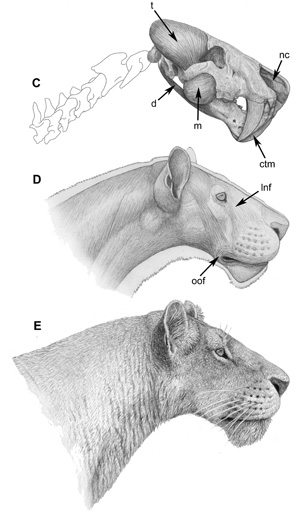 |
| New reconstruction of the sabretooth cat Homotherium, showing that the teeth would not have been as visible as popularly supposed |
Probably the most distinctive thing about deer is that the males have antlers; branching bony head ornaments that are shed and regrown each year. This naturally raises the question of how this evolved, since no other animal has quite the same thing. Acteocemas was an Early Miocene deer, but despite living very early in the group's evolutionary history, it already had antlers that split into two near the tip - which the horns of animals such as cows and true antelopes never do. A Spanish fossil of the antlers described earlier this year showed that it was already shed and regrown, but microscopic analysis indicated that it appeared to have been present for over a year, suggesting longer a more irregular pattern of shedding that must have changed to the seasonal pattern we are familiar with more recently, perhaps in the Middle Miocene.

Not all such restoration efforts have been successful, and there can be many different reasons for this, not all of which are necessarily biological. Better then, of course, to try and prevent species from becoming endangered in the first place. For this reason, many species are protected even if they are not currently at risk. The more we can understand about these species, the better we will be able to keep them that way.
 |
| Kentriodon |
Dolphins are a different matter, with the majority of North Atlantic dolphin species also being commonly seen in the Mediterranean, albeit in some cases only in its most westerly waters. This includes some of the really big dolphins that we'd normally call "whales", such as the killer whale, and there are three species of genuine whale that live there, too. The connection between the Mediterranean and the Atlantic has not always been there, however; for a long time during the Late Miocene, the two bodies of water were separated by a land bridge between Spain and Morocco, entirely cutting the Mediterranean off until it ended in the cataclysmic Zanclean Flood.

By definition, an average mammal should have an EQ of 1. The formula breaks if we try to apply it to non-mammalian animals, such as birds, probably because their brain architecture is different from ours at quite a fundamental level. Even for mammals, there is some debate as to exactly what formula we should be using; most older studies have determined that brain size typically rises as the 2/3 power of body size (that is, as the cube root of the square) but a 2019 study argued that it's perhaps more accurate to base it on the 3/4 power and this seems to be a growing consensus.
 |
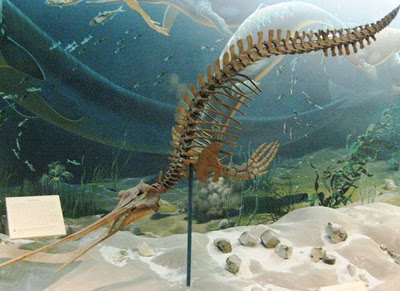
| The largest known Oligocene whale was moved into the new genus Ankylorhiza this year |

Fast forward to 1956, and scientific research confirmed another interesting fact about such animals: they can echolocate by sending out sonar pings. In 1968, the two facts were put together when it was demonstrated how the unusual structure of the porpoise's head allows it to transmit the necessary sound pulses, which are initially generated somewhere in the nasal passages.


 |
| South Asian river dolphin skeleton - note the strange shape of the skull |
 |
| Bohaskaia |

