This, of course, is the subfamily of the pandas, the Ailuropodinae. Pandas are sufficiently odd that it was unclear for a time whether they were really bears, or something else, although their status hasn't really been in doubt since the 1980s when genetic evidence proved what had, even then, been suspected for a couple of decades. Today, only one species of ailuropodine exists, the giant panda (Ailuropoda melanoleuca), and it is found only in China. The same evidence used to estimate the split between the other living subfamilies puts the date of the split between pandas and other bears much further back, to around 20 million years ago, not long after the dawn of the Miocene.
Sunday, 30 April 2023
The Pandas of Bulgaria
Sunday, 18 December 2022
Prehistoric Mammal Discoveries 2022
![]() |
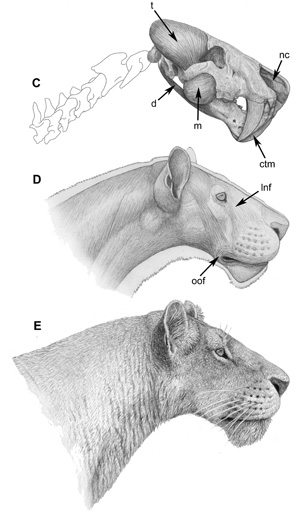
| New reconstruction of the sabretooth cat Homotherium, showing that the teeth would not have been as visible as popularly supposed |
Large Herbivores
Probably the most distinctive thing about deer is that the males have antlers; branching bony head ornaments that are shed and regrown each year. This naturally raises the question of how this evolved, since no other animal has quite the same thing. Acteocemas was an Early Miocene deer, but despite living very early in the group's evolutionary history, it already had antlers that split into two near the tip - which the horns of animals such as cows and true antelopes never do. A Spanish fossil of the antlers described earlier this year showed that it was already shed and regrown, but microscopic analysis indicated that it appeared to have been present for over a year, suggesting longer a more irregular pattern of shedding that must have changed to the seasonal pattern we are familiar with more recently, perhaps in the Middle Miocene.
Sunday, 19 December 2021
Prehistoric Mammal Discoveries 2021
| Lesmesodon, a weasel-sized hyenadont. A new species from Early Eocene France was described this year |
Large Herbivores
When we think of vertebrate fossils, the first thing that pops to mind is almost certainly going to be a skeleton of some kind, or perhaps just part of one. But there are also such things as ichnofossils - fossilised remains of how an animal affected its environment that no longer include any physical part of the animal itself. Perhaps the most obvious of these are fossil trackways - footprints of long-gone animals preserved in mud or other soft material that has since turned to stone. A study published this year examined the tracks left by two species of fossil horse. One of them, a one-toed close relative of the living species inhabiting southern Canada during the Ice Ages, turned out to have been galloping at around 34 kph (21 mph), which is quite fast for its small size (perhaps it was running from something). More significantly, however, the three-toed Miocene horse Scaphohippus was using a relatively unusual gait called the "rack" typically only seen in specialised domestic breeds today.
Sunday, 15 August 2021
Of Pandas and Bamboo
The other, of course, is the giant panda (Ailuropoda melanoleuca).
This is a most peculiar bear. So much so, in fact, that for much of the 20th century it was unclear whether it really was a bear at all - a misunderstanding due to its similarity, and presumed close relationship to, the decidedly un-bearlike red panda. However, we now know that the two animals are not particularly close relatives and the resemblances between them are largely due to the fact that they share a similar diet.
Sunday, 15 December 2019
Prehistoric Mammal Discoveries of 2019
![]() |
| Nehalaennia, an 8 million-year-old rorqual from the Netherlands, first described this year |
Saturday, 27 May 2017
Just What Is a Red Panda, Anyway?
The red panda (Ailurus fulgens) was first formally described by Frédéric Cuvier, brother of the much more famous Georges Cuvier, in 1825. He gave it the scientific name that it still bears, which translates to "shining cat" because of what he thought it looked like. Of course, this was long before Darwin, so he wasn't suggesting that the animal was literally related to cats, since, like his brother, he presumably thought that all species were created independently. In fact, probably because of the bushy striped tail and the shape of the teeth, he instead placed it within the recently named raccoon family, the Procyonidae.
Sunday, 5 February 2017
Pandas in Cages
There are doubtless many zoos across the world, especially in poorer countries, where things haven't improved all that much. But, at least in the West, things have changed significantly. Animals frequently get the chance to roam in outdoor enclosures with grassy environments, rocks and trees to climb, ropes or other toys to play with, and so on. Furthermore, modern zoos do have an important role to play in issues such as conservation - there are species in the world today that would have gone entirely extinct had not some of them been kept in zoos. (For what it's worth, two mammal species - a deer and an antelope - are currently listed as "extinct in the wild" by the IUCN. Re-introduction efforts are underway for both, but it's a slow and difficult process).
Wednesday, 23 January 2013
News in Brief #8
Attack of the Killer Walrus (Or Not)
The two principal families of fully aquatic carnivoran are the seals and the sea lions. To the casual observer, they can most easily be distinguished by the shape of their hind limbs. Sea lions can walk on all fours (albeit with a comical waddle), while true seals have to drag themselves about on land, their hind flippers being of little use out of the water. It's this that tells us that fur seals, for example, are members of the sea lion family, and not 'true' seals. But seals and sea lions are not the only aquatic carnivorans: there are two others. Firstly, there's the sea otter, a member of the weasel family. And then there is the walrus.Walruses are kind of weird, when you think about it. Although they're probably more closely related to sea lions than they are to true seals, they're actually neither, and the walrus family is one of those odd mammal "families" that has only one species in it. But, as is so often the case with such "monotypic " families, that's only true if you count the living species. Because there used to be more.
Part of the reason that the walrus is so obviously peculiar is that it's adapted to doing only one thing (eating shellfish) and, moreover, doing it in a fairly specific habitat. But not all prehistoric walruses were the same. Some, for example, used to live in subtropical waters, and by no means all of them fed on shellfish.