Showing posts with label phylogenetics. Show all posts

Wednesday, 23 July 2025

How the Lemming Got its Coat

The Ice Ages were, without doubt, the most dramatic natural climatic changes on Earth in the last few million years. The last one was particularly severe, with vast ice sheets covering much of northern Europe and northern North America. This, naturally enough, forced many species of animals in the Northern Hemisphere to move south. Even those well-suited to the cold, such as reindeer, musk oxen, and woolly mammoths, would have had to avoid the barren ice sheets, even if they were happy in the broad tundra belt to the south.

In Europe, in particular, there is only so far south you can go before hitting the coastline. This meant that many animals were forced into small areas, some of which may still have been marginal habitat for them, to avoid extinction. These areas are called "refugia", and their small size and isolation were a driver for evolutionary change. Sometimes populations were split apart for so long that they became separate species and, for example, we can date many species of northern birds to this time, even though, for them, the Mediterranean would not have been an issue. 

Sunday, 30 October 2022

Horns v. Geography - Relationships Among Rhino Species

White rhino
Rhinoceroses are amongst the largest land animals alive today, exceeded in size only by the elephants. As one might imagine, given their distinctive appearance, the group has a long evolutionary history. What is perhaps less obvious is that the family was once much larger than it is today, with many species living side-by-side. In total, we have so far named something like 100 species of fossil rhinoceros and, while some of those will probably not survive more detailed analysis, it's also true that there must be several we haven't found yet. Either way, it's quite a lot.

Most of these lived during the Miocene epoch (although the family is older than this) with the number of species thinning out during the following, Pliocene, epoch between around 5 and 2 million years ago. Even so, we know of nine species that lived during the later Ice Ages. Four of these, however, did not survive their end, leaving us with the five that - in some cases only just - survive today.

Sunday, 19 December 2021

Prehistoric Mammal Discoveries 2021

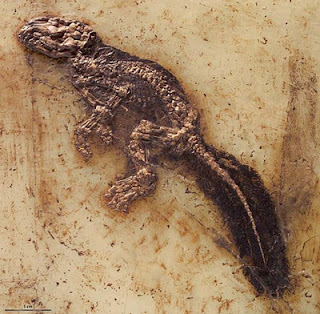
Lesmesodon, a weasel-sized hyenadont.
A new species from Early Eocene France was
 described this year
And so another year approaches its conclusion and the pandemic seemingly isn't done with us yet. I had to self-isolate after a positive test myself for a couple of weeks (no symptoms, though) but if there's one thing that doesn't interrupt, it's blogging, so everything went smoothly here. But now it's time for what's becoming a traditional look at the paleontological discoveries of the past year that didn't get covered here but are worthy of at least a brief mention.

Large Herbivores

When we think of vertebrate fossils, the first thing that pops to mind is almost certainly going to be a skeleton of some kind, or perhaps just part of one. But there are also such things as ichnofossils - fossilised remains of how an animal affected its environment that no longer include any physical part of the animal itself. Perhaps the most obvious of these are fossil trackways - footprints of long-gone animals preserved in mud or other soft material that has since turned to stone. A study published this year examined the tracks left by two species of fossil horse. One of them, a one-toed close relative of the living species inhabiting southern Canada during the Ice Ages, turned out to have been galloping at around 34 kph (21 mph), which is quite fast for its small size (perhaps it was running from something). More significantly, however, the three-toed Miocene horse Scaphohippus was using a relatively unusual gait called the "rack" typically only seen in specialised domestic breeds today. 

Sunday, 15 September 2019

Unravelling the Bushbuck

Imbabala
Three years ago, I wrote a series of posts on the various species of bovine. This was using 'bovine' in the wider, technical, sense than it's everyday meaning, essentially including all animals more closely related to cows than to sheep or goats. This obviously includes all the really close relatives of cattle - bison, buffalo, yak, and so on - but it also includes a number of animals that are more accurately described as 'antelopes'.

Most species of these 'bovine antelopes' belong to the genus Tragelaphus, collectively known as 'spiral-horned antelopes'. Especially if we include the large cow-like elands (sometimes given their own genus, Taurotragus) these are a fairly diverse range of animals, including some adapted to open woodland or savannah, and others adapted to dry scrub, mountain slopes, dense jungle, or swampland. Perhaps because it seems to be the most adaptable of the species, the most widespread of the spiral-horned antelopes is the bushbuck (Tragelaphus scriptus).

Sunday, 11 August 2019

Yin and Yang in the Bat World

"Yin", if you're wondering...
Although the term is used more casually in everyday English, in scientific terminology a "family" of animals is a specific rung on the taxonomic hierarchy. Cats (Felidae) are a family, but otters (Lutrinae) are just a subfamily within the larger weasel family. In turn, families are grouped into "orders", and the great diversity of mammals is indicated by the fact that the standard modern scheme recognises no less than 27 living orders of mammal.

In terms of the number of known species, the second-largest order of mammals, after the rodents, is that of the bats. There are over 1,400 named species of bat, currently grouped into at least 18 different families. Yet they're probably also the least studied of the major mammalian orders - although, to be fair, this may depend on your definition of 'major'. Compared with primates, or hoofed or large carnivorous mammals, we know relatively little about their evolution, and how the various sub-types of bat relate to one another.

Saturday, 28 January 2012

The Red Queen and the Court Jester

Greater blind mole rat
What is the primary driving force behind evolution? If an animal is well suited to its environment, and able to reproduce effectively, then why does it change over time? Why, in short, don't humans still live up trees, where monkeys are still perfectly happy today?

There are two broad types of explanation for what drives evolution: they're called the Red Queen and the Court Jester. It's important to note that there's no reason why they can't both be responsible. Indeed, it would be astonishing if they weren't. The debate, then, hinges on which is more important, and when.

The Red Queen hypothesis, first formalised in the 1970s, is named for the character in Through the Looking Glass, who had to run as fast as she could, just to stay still. The idea is that no animal (or other living organism) is alone, and, if you don't evolve, the creatures around you will, and you'll be doomed. One species may be very good at eating a particular type of plant, for instance, but if another species gets slightly better at doing the same thing, if the first species doesn't improve, it will be out-competed and go extinct. You always have to be better than your competitors, and they have to try to be better than you, leading to a constant drive for change - towards better adaptation to your environment and chosen food source, whatever that may be.

Thursday, 26 January 2012

News in Brief #3

The Mandrill's Face

There are a number of colourful primates, but one of the more instantly recognisable is surely the mandrill (Mandrillus sphinx) whose adult males have strikingly blue and red faces. Under a strict definition, mandrills aren't really baboons, but they're very closely related to them, and the difference is pretty academic. Given that only the adult males have these extreme face-markings it's not surprising to learn that they are there mainly to advertise their masculinity and fitness as a potential father to female mandrills.

A study from 2005 confirmed that, yes, indeed, female mandrills find males with bright red noses to be particularly sexy. Oddly, though, until now nobody appears to have looked at what the bright blue patches on either side of the nose are for. In the new study, Julien Renoult and co-workers confirmed that the blue colour is more intense in dominant males, just as the red is. Indeed, it seems that what's really important is the contrast between the two. This suggests that, in the distant past, mandrills developed the red nose as a measure of their fitness, and the redder the nose, the more females liked them. So the noses of dominant males became ever redder... but there's only so red a nose can get. When some males began to develop a contrasting colour elsewhere on the snouts, the redness of their noses became more obvious, and, over the course of evolution, the bright blue/red contrast we see now developed.

Sunday, 8 January 2012

The First Dolphin in the Amazon

Tucuxi in the Orinoco River
In most of these posts, I tend to include a cladogram - a tree-like diagram showing how different animals are related to one another. But how do we know, and how are these things constructed?

Consider the dolphin family. We know that this is a true evolutionary group of animals - that is, it contains all of the descendants of some original common ancestor. We also have a pretty good idea of how it relates to other, similar, groups of animals, such as the porpoise family. But quite how the different types of dolphin are related to one another is less clear. I mentioned previously, when discussing the discovery of the burranan dolphin, just how confused we are about how bottlenose and spinner dolphins (among others) are related. But that is by no means the only unresolved issue in trying to sort out the dolphin family tree.

The tucuxi (Sotalia fluviatilis) is unique among members of the dolphin family in that it doesn't live in the sea. Instead, it lives only in freshwater, in the wide reaches of the Amazon River and its larger tributaries. It's not quite the only dolphin that habitually swims upriver, and, indeed, there are freshwater "dolphins" that aren't really members of the dolphin family at all, but it's the only "true" dolphin that avoids salt water altogether. Which makes it a pretty odd animal.