 |
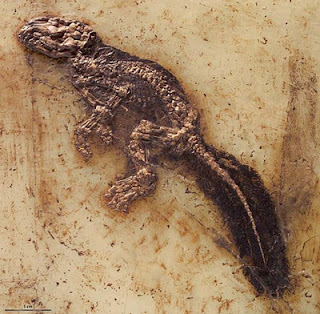
| Potamotherium |
Showing posts with label Dire wolf. Show all posts
Showing posts with label Dire wolf. Show all posts
Sunday, 17 December 2023
Prehistoric Mammal Discoveries 2023


Sunday, 19 December 2021
Prehistoric Mammal Discoveries 2021
 |
| Lesmesodon, a weasel-sized hyenadont. A new species from Early Eocene France was described this year |
Large Herbivores
When we think of vertebrate fossils, the first thing that pops to mind is almost certainly going to be a skeleton of some kind, or perhaps just part of one. But there are also such things as ichnofossils - fossilised remains of how an animal affected its environment that no longer include any physical part of the animal itself. Perhaps the most obvious of these are fossil trackways - footprints of long-gone animals preserved in mud or other soft material that has since turned to stone. A study published this year examined the tracks left by two species of fossil horse. One of them, a one-toed close relative of the living species inhabiting southern Canada during the Ice Ages, turned out to have been galloping at around 34 kph (21 mph), which is quite fast for its small size (perhaps it was running from something). More significantly, however, the three-toed Miocene horse Scaphohippus was using a relatively unusual gait called the "rack" typically only seen in specialised domestic breeds today.
Saturday, 30 November 2013
Pleistocene (Pt 12): Dire Wolf Redux

The dire wolf (Canis dirus) was a very close relative of the grey wolf that we're all familiar with today. Grey wolves, despite their broad modern distribution, first evolved in Europe and Asia. Indeed, the sudden appearance of the Etruscan wolf (Canis etruscus), thought to be a direct ancestor of the living wolf, in the so-called "Wolf Event" shortly before the dawn of the Pleistocene, had a dramatic effect on European wildlife. Modern wolves, however, while widespread in the Old World, did not enter the Americas until surprisingly late, and did not travel south of the Canadian Arctic until the Ice Ages were almost over, around 0.1 million years ago.
Dire wolves, however, were there much earlier. So where did they come from? Although there was some suggestion back in the 1980s that they were actually South American in origin, the more modern consensus is that they were native to the northern continent. The most popular theory seems to be that dire wolves evolved from Armbruster's wolf (Canis armbrusteri). In fact, the latter continued to survive in its original form alongside its descendant until about 0.3 million years ago, although it does appear to have been steadily pushed eastward and southward during this time.
Sunday, 17 June 2012
Dire Wolves and Direr Dogs
 |
| Reconstruction of a dire wolf |
We are all familiar with the idea that, for much of the Age of Mammals, there have been large, scary cats with enormous teeth. They died out relatively recently, and as a result, we know a fair bit about them, and they remain one of the most popular prehistoric mammals with the general public - although mammoths do pretty well, too.
But, while the sabre-tooth cats stalked the world, what were the dogs like?
Perhaps the best known prehistoric dog is the dire wolf (Canis dirus). Do a google image search for "dire wolf" and you'll find far more images than you will searching for "sabre tooth", let alone something more specific like "Smilodon". But a look through those images gives you some idea why, and it doesn't have much to do with real-world fossils. The term "dire wolf" has been co-opted by fantasy fiction and games, and many of the pictures show the animals as they appear in Dungeons & Dragons, World of Warcraft, or Game of Thrones. They are generally portrayed as immense wolves, at least the size of a small horse, and sometimes with sabre teeth of their own, or bizarre spikes on their bodies.
Subscribe to:
Posts (Atom)