Showing posts with label dogs. Show all posts

Sunday, 9 June 2024

Oligocene (Pt 9): Rise of the Dogs

Sunkahetanka
Many of the carnivorous mammals present in North America during the Oligocene were of types also found in Eurasia. However, this far back in time, they did not necessarily belong to any family of animals we would recognise. Cats, for example, first appeared in Europe at the end of the epoch and did not reach the Americas until much later. Other groups, such as raccoons, simply didn't exist yet. 

But we do, for example, have Palaeogale, an animal also known from Europe that looked somewhat like a polecat, but was actually more closely related to cats and mongooses without, so far as we can tell, being either. Corumictis looked similar, but analysis of the skull has shown that it much closer to true mustelids. About the size of a modern weasel, it lived in Oregon at least 29 million years ago, towards the middle of the epoch. It may make it the first mustelid to reach North America from Eurasia, home to the very similar, and slightly older, Plesictis. It's far enough back that it might, however, belong to an early musteloid group rather than to the modern family (that is to say, it may be equally related to mustelids and raccoons, and thus, strictly speaking, neither). Oaxacagale is almost as old, and lived in what is now Mexico; it's probably another close relative but, it too, has so many primitive features that it's hard to place precisely.

Sunday, 13 December 2015

The Dog Family: Fossil Dogs

Hesperocyon, the earliest known "dog"
Despite their variety, all dog species alive today are placed in a single subfamily of the wider historical dog family. Of course, what we consider a "subfamily", rather than some other taxonomic ranking, is entirely arbitrary, but it does indicate that what we have now represents just one branch of a much older family tree.

This living subfamily are the Caninae, and thus, strictly speaking, the term "canine" can be applied to all living dogs, even the foxes,  which are "vulpine" in more common parlance. The canines have been remarkably successful. Thanks to the existence of the dingo, dogs are one of the few terrestrial mammal families with wild representatives on every continent save Antarctica. (Although not the only one, of course... mice, in particular, get everywhere). That is, at it happens, entirely due to the canines, since the other forms of dog never left their continent of origin.

Saturday, 28 November 2015

The Dog Family: Raccoon Dogs and the Fate of the Warrah

Raccoon dog
The Wikipedia page on the dog family includes, on its attached discussion page, a complaint that the article includes a picture of a raccoon - an animal that is clearly not part of the Canidae. Except, of course that there isn't (and wasn't then) any such picture. The complainant was looking at a picture of a raccoon dog.

It's an understandable mistake. The raccoon dog (Nyctereutes procyonoides) does look remarkably like its partial namesake. Indeed, the second half of its scientific name, first given to it by John Edward Gray in 1834, actually means "raccoon-like". The effect is achieved primarily by that dark mask over the eyes, a feature we naturally associate with raccoons, although, aside from the lack of stripes on the tail, the rest of the animal is fairly raccoon-coloured as well.

Nonetheless, it is indisputably a dog, although quite how it was related to other dogs was long a source of puzzlement. Modern studies have shown that it appears to be related to the true foxes, albeit not very closely. Its closest relative may, in fact, be the bat-eared fox of Africa, although, again, I should stress that this isn't exactly what you'd call a close relationship... just closer than anything else happens to be.

Sunday, 15 November 2015

The Dog Family: South American Oddities

Maned wolf
Most of the living species of native dog in South America can broadly be described as "foxes", even if they are not directly related to the "true" foxes of the Old World and North America. There are, however, two exceptions, whose appearance is particularly un-fox-like. Analysis of their genes and blood chemistry shows that they do seem to be related to the South American foxes, but not very closely. Indeed, they appear to represent entirely separate colonisations of their continent, diverging from their fellows even before the crab-eating fox did much the same thing. It just so happens that their descendants in the North died out, perhaps under competition pressure from wolves and coyotes, while those in the South continued on to the present day.

The two species are, however, likely each other's closest relatives. Which is surprising when you consider how different they look.

By far the larger of the two is the maned wolf (Chrysocyon brachyurus), which is found in southern Brazil, and in neighbouring regions of Bolivia, Paraguay, Uruguay, and far northern Argentina. It is undeniably a distinctive animal, most obviously because of its remarkably long legs and slender, graceful body. Add to that its unusually long reddish-gold fur, large and mobile ears, and the black mane that runs from the nape of its neck part-way down its back, and we have something that's quite clearly a dog, but which perhaps resembles some domestic breeds more than it does any other wild species. It is also, at least in my entirely subjective opinion, the most beautiful of all the wild dogs.

Sunday, 25 October 2015

The Dog Family: Bat-eared and Crab-eating Foxes

Bat-eared fox
The species of the dog family can, broadly speaking, be placed into three main subgroups: the wolf-like dogs (including, for example, coyotes), the true foxes (that is, those related to the red fox of the Northern Hemisphere), and the South American, or "false" foxes. However, there are a few species whose placement in the family tree is rather less certain. One of these is the grey fox of the eastern US, but there's another that's so peculiar it was once placed in a subfamily all of its own, as if it weren't really a fox at all.

The bat-eared fox (Otocyon megalotis) lives in eastern and southern Africa, although, interestingly, not in between. They can, for instance, be found in far northern Zambia and Malawi, and in far southern Mozambique, but that's as close as the two populations get. Which, to save you the trouble of getting out a map, is a gap of about 1,000 miles or so. Given their complete lack of contact with one another, it is perhaps unsurprising that the two populations are considered separate subspecies.

Modern genetic analysis has shown that bat-eared foxes probably are real foxes, albeit ones whose ancestors diverged from the line that led to all the other true foxes very early on. It has to be said, though, that that isn't 100% certain, and it's possible that the divergence was so early that they just go at the base of the tree, not closely related to anything.

Saturday, 26 September 2015

The Dog Family: The Marks of Zorros

Culpeo
When North and South America collided towards the end of the Pliocene epoch a little over two million years ago, dogs were, for the first time, able to cross to the southern continent, a place that had previously been somewhat lacking in large mammalian carnivores. The dogs that crossed over all seem to have been related to wolves, rather than foxes. However, the fox body plan and lifestyle, with its high adaptability, proved so useful that most of the living descendants of these animals look just like foxes.

However, they are not "true" foxes, but rather, wolf-like animals that evolved into creatures that happened to closely resemble the members of the much older lineage that we find on the other continents (red foxes, Arctic foxes, the various kinds that we find in Africa, and so on). Recognising the distinction surprisingly early, some nineteenth century naturalists called them "fox-tailed wolves", and there has been a (largely unsuccessful) move to call the animals "zorros" in English, to distinguish them from the true foxes. That this didn't take off is perhaps due to the fact that "zorro" simply means "fox" in Spanish, and most of the researchers studying the animals are likely to be Spanish speakers... so it's not really a lot of help.

Sunday, 30 August 2015

The Dog Family: Arctic and Grey Foxes

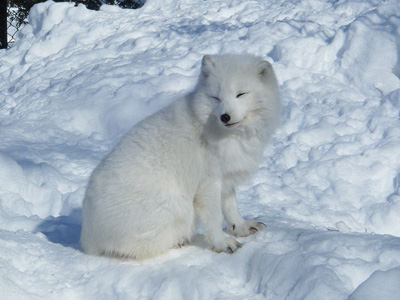
Arctic fox
The same generalist habits and adaptability that have allowed foxes to colonise the deserts have also allowed them to evolve to suit one of the other great barren ecosystems: the Arctic tundra. Here, where even wolves are not particularly common, we find what else but the Arctic fox (Alopex lagopus)?

Arctic foxes are truly creatures of cold and desolate habitats. In Europe, they are found only in Norway, Iceland, and the coasts of the White and Barent's seas in northern Russia. Indeed, it is one of only two species of land-dwelling mammal native to Iceland - the other is the wood mouse, although there are some human-introduced animals there as well. Elsewhere Arctic foxes are found right round the coasts of the Arctic Ocean, in northern Siberia, in northern and western Alaska, northern Canada and its islands, and even in Greenland. Despite this wide, multi-continental, distribution, most belong to just one subspecies, although those living in Iceland, Greenland, and Svalbard form one or two distinct subspecies between them, and there are also distinct subspecies on the isolated Pribilof and Commander Islands in the Bering Sea.

Saturday, 1 August 2015

The Dog Family: Foxes of Africa

Fennec fox
The fact that foxes will eat pretty well anything that's small enough has meant that some species have been able to colonise surprisingly harsh environments. The kit fox, for example, inhabits the desert shrublands of much of the western US, while Blanford's fox lives in the dry hills of the Middle East and south-central Asia. No fox, however, is more desert adapted than the fennec fox (Vulpes zerda) of North Africa.

Fennec foxes (sometimes simply called "fennecs") are also among the most distinctive of foxes. For one thing, they're the smallest wild members of the dog family, with particularly small adults as little as 33 cm (13 inches) in length, plus tail, and weighing just 800 g (28 oz.)  They have pale sandy-and-white fur, which is unusually long and soft - they even have fur on the pads of their feet, to give them some protection from baking hot sand. And, of course, there are the huge ears, quite out of proportion to the rest of the animal, which help to radiate away heat in an animal that would rather not lose too much water by panting.

Fennec foxes live across almost the whole of the Sahara Desert, from the Atlantic coast to the Nile valley. They are not typically found east of the Nile, where the closely related Blanford's foxes are found instead, but there are a few exceptions, and, for example, both species inhabit the Sinai. In fact, fennec foxes actually prefer the open sand dunes of the desert interior, an exceptionally harsh and arid environment.

Sunday, 5 July 2015

The Dog Family: Foxes of the American West

Swift fox (in summer coat)
There are six living species of fox native to the North American continent. One of those is the red fox, which is also found through much of Asia and Europe. Three others, including the grey fox of the southern US, are not traditionally considered to belong to the genus Vulpes, and I will be returning to these at a later date. Which leaves two close relatives of the red fox that are unique to the continent. Both, as it happens, live out in the wilds of the American West.

Heading out into the west, the first of these two species we come to is the swift fox (Vulpes velox). The native range of this animal happens to line pretty up well with a series of interstate borders, and it's found from northwestern Texas/eastern New Mexico in the south to western South Dakota/eastern Wyoming in the north.

As one might imagine, given this area, they like flat, wide open short grass prairie, and apparently avoid everything else, although they don't seem to have a great problem with cropland. They are small foxes, standing only about 30 cm (one foot) high, similar in height to a small terrier or a King Charles spaniel, although, due to a slim build, they are also considerably lighter than those dog breeds. During the winter, they have a dark grizzled grey back with tan markings on the flanks and legs, but, aside from the black tip to the tail and the pale belly, the whole animal takes on a browner hue in the summer, when it sheds its thick pelt.

Sunday, 7 June 2015

The Dog Family: Foxes of Asia

Blanford's fox
Asia is a large and varied continent, home to no less than seven species of fox, even using the most narrow of definitions for that term. Three of these, the red, Arctic, and Rüppell's foxes, are also widespread on other continents; the red foxes of Japan, for instance, belong to the same species as those found in Britain and North America. Of the four that are (mostly) confined to Asia, I have already covered the corsac fox of the central steppe lands, but three still remain.

Heading east from Europe the first such species we come to is Blanford's fox (Vulpes cana). This is named for William Thomas Blanford, who first described it as a unique species in 1877 while working for the Geological Survey of India. Blanford, who discovered the animal in what is now Pakistan, seems to have been somewhat surprised that he was first European naturalist to notice it. He may have had a point, since it's fairly distinctive.

Sunday, 3 May 2015

The Dog Family: Red and Corsac Foxes

Red fox
Most members of the dog family can be described, broadly speaking, as "foxes". The term "fox" no longer has a strict scientific meaning, since it encompasses two separate lines of evolution that aren't directly related to one another. Furthermore, as we'll see in a few month's time, there are some animals within those lineages that really aren't foxes at all, as we'd normally think of the word.

Nonetheless, it's a term that's widely used, and is taken to refer to small to medium-sized canids that have have bushy tails, prominent ears, pointed snouts, moderately long legs, and so on. The archetypal such animal, and the one that most people in the Northern Hemisphere likely think of first when the term "fox" is used without any further qualification, is the red fox (Vulpes vulpes).

The red fox is, in fact, the largest of the "true" foxes (as opposed to those of the second, younger, evolutionary line, which are actually more related to wolves). It is also perhaps the most brightly coloured of all foxes, although there is some variation in the coat colour, with brown, yellowish, and even silvery-grey individuals. None of these match directly to any of the more than forty subspecies that have been identified over the years, although it's likely that many of those represent rather finer hair-splitting than is actually required.

Sunday, 5 April 2015

The Dog Family: African and Asian Wild Dogs

African wild dog
So far, my survey of the dog family has looked at the "wolf-like" dogs, rather than the foxes and their kin. Most of these are either wolves, coyotes, or jackals, but there are two species that stand slightly apart, although modern genetic analysis has shown that they are, indeed, more closely related to wolves than they are to foxes.

The more distinctive, and probably the better known, of the two species (Lycaon pictus) has a wide number of different names. I'm going to call it the African wild dog here, but it is also known as the "African hunting dog", the "painted dog", or by some combination of these terms. (In French, Spanish, and Italian, it's simply the "lycaon", or some spelling variant thereof. The word commemorates a character from Greek mythology, who Zeus turns into a wolf).

Whatever it's called, the African wild dog is a distinctive animal. The large rounded ears and the slender, athletic body are noticeable enough in themselves, but it's the coat pattern that really makes it hard to mistake for anything else. The exact pattern varies tremendously - every animal is unique, and they can readily be distinguished one from another. Once found throughout almost the whole of sub-Saharan Africa, animals from the north tend to be dark with white and yellow patches, while those from further south are generally pale, with a few black patches. It was once thought that these might represent different subspecies, but they seem to blend into one another gradually as you cross the continent, which would rule that out. African wild dogs are adapted for running, and shedding the heat that results from doing so. They also, for less clear reasons, have no dewclaws on their front feet, as all other dogs do.

Sunday, 8 March 2015

The Dog Family: Three Jackals and a Wolf

Black-backed jackal
The genus Canis groups together all the most wolf-like of the wolf-like dogs. It includes the grey wolf (which itself includes both the domestic dog and the dingo), the coyote, and, assuming we recognise it as distinct, the red wolf. All of the other living species in the genus have, at one point or another, been called "jackals". Biologically speaking, then, the term "jackal" doesn't really mean anything - it's just what you've got left over once you've left out the wolves and coyotes. But, it has to be said that the three species we still call jackals today do have a certain physical similarity, and it's not hard to see why the fine details of their genetic relationship had us fooled.

Perhaps the most visibly distinctive of the jackals is the black-backed jackal (Canis mesomelas), sometimes called the "silver-backed jackal", since, aside from a stripe down each flank, the back can hardly be described as pure black. Black-backed jackals have a somewhat odd distribution. They are common in southern Africa, from southern Angola and Mozambique down to the Cape region, but they're also found in eastern Africa, from Tanzania to Eritrea, and throughout the Horn of Africa.

Sunday, 8 February 2015

The Dog Family: Coyotes and Red Wolves

Coyote
Grey wolves are found across the Northern Hemisphere, but they originated in Asia, only reaching the Americas via the Bering land bridge when sea levels were low. Most of their close relatives are also found in the Old World, but there are one or two very closely related species in North America. Of these, by far the more common and better known is the coyote (Canis latrans).

Coyotes first evolved, in North America, during, or shortly before, the Ice Ages, almost certainly from the now-extinct Pliocene species Canis lepophagus. Today, they are found throughout almost the whole of North America, from Alaska to Panama, being absent only from eastern Canada, the Caribbean coast of Central America, and a number of islands. In this respect, they have actually benefited from the presence of humans; before the arrival of Europeans, coyotes did not live anywhere along the east coast of America, and only moved in once we started chopping trees down to make way for cities and farmland.

Sunday, 11 January 2015

The Dog Family: Wolves, Dogs, and Dingoes

Eurasian wolf
The best known and most familiar of the species in the dog family is surely the grey wolf (Canis lupus). This is not least because it is the one that we happen to have domesticated, and which most of us see just about every day. Even the wild form is so familiar that there are a great many wildlife documentaries and web pages out there that cover the species better than I can in one blog post, and I don't want to go too much over that ground. But nonetheless, for the sake of completeness, at least some sort of overview is needed here.

The term "grey wolf" is the generally accepted one for the species as a whole. While there are other species that are referred to as wolves, this is the one that we generally mean when we say the word "wolf" without qualification. Most other terms, such as "timber wolf", "steppe wolf", and so on, refer either to groups of one or more subspecies, or are simply alternative terms for the same animal. Once being spread throughout almost the entire Northern Hemisphere (albeit to only a limited extent in Africa), it is unsurprising that there are rather a lot of subspecies.

But how many? That's a question of some debate. I have talked before about how difficult it can be, in practice, to separate one species from another; the problem is even worse when you're trying to count subspecies. One scheme, for instance, has as many as 24 subspecies in North America alone, while another, more conservative, scheme recognises just twelve worldwide. There are a great many opinions that lie somewhere in between.

Saturday, 30 November 2013

Pleistocene (Pt 12): Dire Wolf Redux

I have previously discussed the dire wolves of Pleistocene North America, but really only in the context of how even earlier dogs were much scarier. Those earlier, bone-crushing, dogs were still around in the early Pleistocene, but they didn't survive the early Ice Ages, possibly because they were too specialised to cope as the climate changed. The dire wolf, on the other hand, first appeared at around this time, and survived long enough to live alongside humans.

The dire wolf (Canis dirus) was a very close relative of the grey wolf that we're all familiar with today. Grey wolves, despite their broad modern distribution, first evolved in Europe and Asia. Indeed, the sudden appearance of the Etruscan wolf (Canis etruscus), thought to be a direct ancestor of the living wolf, in the so-called "Wolf Event" shortly before the dawn of the Pleistocene, had a dramatic effect on European wildlife. Modern wolves, however, while widespread in the Old World, did not enter the Americas until surprisingly late, and did not travel south of the Canadian Arctic until the Ice Ages were almost over, around 0.1 million years ago.

Dire wolves, however, were there much earlier. So where did they come from? Although there was some suggestion back in the 1980s that they were actually South American in origin, the more modern consensus is that they were native to the northern continent. The most popular theory seems to be that dire wolves evolved from Armbruster's wolf (Canis armbrusteri). In fact, the latter continued to survive in its original form alongside its descendant until about 0.3 million years ago, although it does appear to have been steadily pushed eastward and southward during this time.

Sunday, 3 November 2013

Spanish Painted Dogs (and What They Can Tell Us)

Members of the dog family can be broadly divided into two groups. One goup are the vulpines, including such familiar animals as the red fox and its Arctic relative. The other are the true canines, a rather more diverse group found wild on every continent bar Antarctica. While species in the first group are all basically fox-like, those in the latter are not necessarily "wolf-like". Indeed, the second group includes the zorros, or South American foxes, which descend from a more wolf-like animal that nipped south when the two American continents collided.

Still, the second group does include animals that are more obviously wolf-like, such as the wolves themselves, along with coyotes, jackals, dingos, and so on. But there are also a number of species that are more distinctive, and while (in most cases) clearly dogs of some kind, aren't that much like our normal ideas of either wolves or foxes.