.jpg)
Showing posts with label foxes. Show all posts
Showing posts with label foxes. Show all posts
Sunday, 27 April 2025
Cheating Little Vixens


Sunday, 21 February 2021
The Crab-Eating Fox That Wasn't

The dog family has its origins in North America and it seems clear that what happened here is that some wolf-relative that happened to look a bit like a fox headed south at some point, where all of its remaining descendants live today. North and South America joined up relatively recently, geologically speaking, so it's likely that the origins of the South American foxes actually lie in the North, already looking somewhat like their modern form before they made the trip.
Sunday, 1 December 2019
Miocene (Pt 17): A Diversity of Dogs
 |
| Eucyon |
There were two particularly significant changes among the North American mammalian carnivores that took place around this time. One was the extinction of the bear-dogs, a group with a long history on the continent that was, by this time, typified by relatively large animals that would have looked more like bears than dogs (although they were neither). Over in Europe and Asia, the bear-dogs survived for rather longer, although even there they struggled... but in North America, the changes were too extreme for them to cope with, and they died out as the Late Miocene dawned.
Sunday, 25 October 2015
The Dog Family: Bat-eared and Crab-eating Foxes
 |
| Bat-eared fox |
The bat-eared fox (Otocyon megalotis) lives in eastern and southern Africa, although, interestingly, not in between. They can, for instance, be found in far northern Zambia and Malawi, and in far southern Mozambique, but that's as close as the two populations get. Which, to save you the trouble of getting out a map, is a gap of about 1,000 miles or so. Given their complete lack of contact with one another, it is perhaps unsurprising that the two populations are considered separate subspecies.
Modern genetic analysis has shown that bat-eared foxes probably are real foxes, albeit ones whose ancestors diverged from the line that led to all the other true foxes very early on. It has to be said, though, that that isn't 100% certain, and it's possible that the divergence was so early that they just go at the base of the tree, not closely related to anything.
Saturday, 26 September 2015
The Dog Family: The Marks of Zorros
 |
| Culpeo |
However, they are not "true" foxes, but rather, wolf-like animals that evolved into creatures that happened to closely resemble the members of the much older lineage that we find on the other continents (red foxes, Arctic foxes, the various kinds that we find in Africa, and so on). Recognising the distinction surprisingly early, some nineteenth century naturalists called them "fox-tailed wolves", and there has been a (largely unsuccessful) move to call the animals "zorros" in English, to distinguish them from the true foxes. That this didn't take off is perhaps due to the fact that "zorro" simply means "fox" in Spanish, and most of the researchers studying the animals are likely to be Spanish speakers... so it's not really a lot of help.
Sunday, 30 August 2015
The Dog Family: Arctic and Grey Foxes
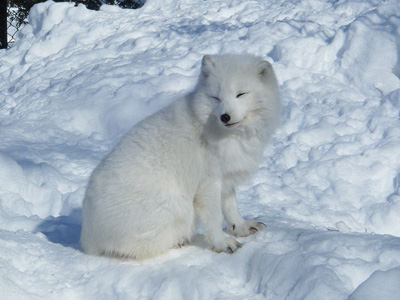 |
| Arctic fox |
Arctic foxes are truly creatures of cold and desolate habitats. In Europe, they are found only in Norway, Iceland, and the coasts of the White and Barent's seas in northern Russia. Indeed, it is one of only two species of land-dwelling mammal native to Iceland - the other is the wood mouse, although there are some human-introduced animals there as well. Elsewhere Arctic foxes are found right round the coasts of the Arctic Ocean, in northern Siberia, in northern and western Alaska, northern Canada and its islands, and even in Greenland. Despite this wide, multi-continental, distribution, most belong to just one subspecies, although those living in Iceland, Greenland, and Svalbard form one or two distinct subspecies between them, and there are also distinct subspecies on the isolated Pribilof and Commander Islands in the Bering Sea.
Saturday, 1 August 2015
The Dog Family: Foxes of Africa
 |
| Fennec fox |
Fennec foxes (sometimes simply called "fennecs") are also among the most distinctive of foxes. For one thing, they're the smallest wild members of the dog family, with particularly small adults as little as 33 cm (13 inches) in length, plus tail, and weighing just 800 g (28 oz.) They have pale sandy-and-white fur, which is unusually long and soft - they even have fur on the pads of their feet, to give them some protection from baking hot sand. And, of course, there are the huge ears, quite out of proportion to the rest of the animal, which help to radiate away heat in an animal that would rather not lose too much water by panting.
Fennec foxes live across almost the whole of the Sahara Desert, from the Atlantic coast to the Nile valley. They are not typically found east of the Nile, where the closely related Blanford's foxes are found instead, but there are a few exceptions, and, for example, both species inhabit the Sinai. In fact, fennec foxes actually prefer the open sand dunes of the desert interior, an exceptionally harsh and arid environment.
Sunday, 5 July 2015
The Dog Family: Foxes of the American West
 |
| Swift fox (in summer coat) |
Heading out into the west, the first of these two species we come to is the swift fox (Vulpes velox). The native range of this animal happens to line pretty up well with a series of interstate borders, and it's found from northwestern Texas/eastern New Mexico in the south to western South Dakota/eastern Wyoming in the north.
As one might imagine, given this area, they like flat, wide open short grass prairie, and apparently avoid everything else, although they don't seem to have a great problem with cropland. They are small foxes, standing only about 30 cm (one foot) high, similar in height to a small terrier or a King Charles spaniel, although, due to a slim build, they are also considerably lighter than those dog breeds. During the winter, they have a dark grizzled grey back with tan markings on the flanks and legs, but, aside from the black tip to the tail and the pale belly, the whole animal takes on a browner hue in the summer, when it sheds its thick pelt.
Sunday, 7 June 2015
The Dog Family: Foxes of Asia
 |
| Blanford's fox |
Heading east from Europe the first such species we come to is Blanford's fox (Vulpes cana). This is named for William Thomas Blanford, who first described it as a unique species in 1877 while working for the Geological Survey of India. Blanford, who discovered the animal in what is now Pakistan, seems to have been somewhat surprised that he was first European naturalist to notice it. He may have had a point, since it's fairly distinctive.
Sunday, 3 May 2015
The Dog Family: Red and Corsac Foxes
 |
| Red fox |
Nonetheless, it's a term that's widely used, and is taken to refer to small to medium-sized canids that have have bushy tails, prominent ears, pointed snouts, moderately long legs, and so on. The archetypal such animal, and the one that most people in the Northern Hemisphere likely think of first when the term "fox" is used without any further qualification, is the red fox (Vulpes vulpes).
The red fox is, in fact, the largest of the "true" foxes (as opposed to those of the second, younger, evolutionary line, which are actually more related to wolves). It is also perhaps the most brightly coloured of all foxes, although there is some variation in the coat colour, with brown, yellowish, and even silvery-grey individuals. None of these match directly to any of the more than forty subspecies that have been identified over the years, although it's likely that many of those represent rather finer hair-splitting than is actually required.
Subscribe to:
Posts (Atom)