Showing posts with label Oligocene series. Show all posts

Sunday, 26 October 2025

Oligocene (Pt 18): Sawfish-Dolphins and Baleen Whales with Teeth

Olympicetus, a simocetid whale
Although the oldest fossils of seal-like animals may date back to the end of the Oligocene, there are very few of these, and the dating may not be wholly reliable. Whales, however, are a different matter and were already well established even at the beginning of the epoch, 33 million years ago. In fact, the Oligocene marks an important phase in their evolution, since it was at this time that the oldest living groups first appeared and that, potentially, the last common ancestor of all living whales roamed the seas.

Even so, especially towards the end of the epoch, it is possible to place some Oligocene cetaceans into groups we are familiar with today. For example, there was Kentriodon, which is better known from the Miocene, but first appeared in the southern oceans at the tail end of the Oligocene. Although it is not placed in any living family, it is the oldest member of a branch that diverged from the common ancestor of dolphins and porpoises around this time. It likely looked rather similar and had a similar fish-and-squid-based diet.

Sunday, 31 August 2025

Oligocene (Pt 17): Dawn of the Kangaroos

Ekaltadeta
Kangaroos are perhaps the single most iconic Australian mammals. As marsupials, we tend to think of them as lost relics of an earlier evolutionary period, and, indeed, they have been around for a long time. Of course, they have been evolving during that time, rather than standing still, but if we had a time machine, we could go back millions of years into Australia's past, and still find animals that were, more or less, kangaroos. But, obviously, there is a limit.

Exactly how far back that limit is partly depends on how kangaroo-like you want your kangaroos to be. But even then, there are some gaps in our knowledge that don't have direct counterparts on other continents. The obvious place to start is with the fossil record, and, here, at least, we can provide a clear answer. The oldest known fossil kangaroos date to around 28 million years ago, towards the end of the Oligocene.

Sunday, 6 July 2025

Oligocene (Pt 16): The First Monkeys in South America

A modern South American monkey
Much like the rodents, the presence of monkeys in South America has long been a puzzle. We know that monkeys evolved in Africa and that the monkeys still living in the Old World share a common ancestor distinct from, but related to, the common ancestor of the American sort. Genetic evidence shows that the split between the two lineages, which must have happened in Africa, happened a very long time ago. At some point then, early monkeys from what we now call the 'New World' group must have crossed the Atlantic, likely rafting on a floating patch of vegetation.

The Atlantic was narrower then than it was now, and ocean currents were different, but it's still a remarkable feat. It may also have been a lucky escape, since the African relatives of this first American migrant died out not long after, perhaps outcompeted by the ancestors of today's langurs, baboons, macaques, and apes. In South America, however, its descendants got almost free rein, diversifying into the five families we have today.

Sunday, 11 May 2025

Oligocene (pt 15): Land of the Fire-Beasts

Pyrotherium
Even at the dawn of the Oligocene, South America had already long been isolated from the northern continents, giving it the opportunity to evolve its own distinct mammalian fauna, with many animals quite unlike those seen elsewhere. Most of these strange animals would die out millions of years later when the Isthmus of Panama finally formed. The armadillos are among the exceptions.

Armadillos first evolved on the continent during the previous epoch, if not earlier, but most of the older fossils are incomplete, making it difficult to trace their detailed relationships. The oldest reasonably complete armadillo skulls belong to Kuntinaru, first described in 2011. This lived in Bolivia towards the end of the Oligocene, around 27 million years ago and would already have looked much like modern armadillos, albeit somewhat smaller than the species most familiar to North Americans. 

Sunday, 16 March 2025

Oligocene (Pt 14): The Southern Horses That Weren't

Scarritia
30 million years ago, South America obviously lacked horses, since those (still three-toed at the time) originated in the north, and the southern continents had long been isolated from their homeland. What it did have, however, were a group of mammals called the notohippids, a name that literally translates as "southern horses". While they might not be closely related, the name might lead one to suspect that they had at least a resemblance to the modern animals.

They didn't.

Well, not much. When the name was originally coined, for the Miocene genus Notohippus, back in 1891, it was assumed that they really were horses, or at least closely related. This is because of the shape of their teeth which, did indeed resemble those of equines. It only took until 1914 to realise that, teeth aside, they weren't very horse-like. That their teeth were similar suggests a similar diet with plenty of tough vegetation, and their head was elongated in an almost horse-like fashion to accommodate them... but that's pretty much where the resemblance ends. For one thing, they had claws, not hooves; their bodies were also stockier, albeit with long limbs that may have given them a certain agility.

Sunday, 19 January 2025

Oligocene (Pt 13): The First Porcupines

Prosotherium
The dawn of the Oligocene is marked, in part, by the formation of a deep water channel between South America and Antarctica. To what extent there had been a true land bridge between the two continents in the preceding epoch is debatable, but the separation was certainly more complete than it had been previously, beginning a long period of isolation that allowed unique animals to evolve and flourish. Furthermore, most of the large mammal groups we are familiar with today originated on the northern continents, so much of the fauna of South America was already strange to modern eyes.
 
Much of it, but not all. The exact date of the oldest rodent fossil from South America has been disputed, but recent analysis suggests that it may have lived shortly after the beginning of the Oligocene. How it reached the continent is also unclear. Logically, it must have made a long sea journey, presumably clinging to some storm-tossed piece of debris, either from North America or Africa (the Atlantic being narrower then than it is now). The latter seems the more likely, since South American rodents are more closely related to the African sort than to their equivalent northern counterparts.

Sunday, 24 November 2024

Oligocene (Pt 12): Reign of the Hyena-Cats

Apterodon

In most parts of the world today, all large, carnivorous, land-dwelling mammals are members of the order called, appropriately enough, the Carnivora. This is the group to which cats, dogs, and bears belong, along with many other animals from weasels to seals. If we go back far enough in time, we find that this group originated on the northern continents and was unable to reach the then-isolated southern ones until much later. During the Oligocene, therefore, there were no carnivorans in Africa.

Which isn't to say that there were no carnivorous mammals at all; absent some non-mammalian predator to out-compete them, it's just too useful a niche for nothing to evolve to make use of it. But those mammals were not close relatives of the lions and hyenas that live there today, belonging to different branches of the mammalian family tree.

Saturday, 28 September 2024

Oligocene (Pt 11): Early Monkeys and Two-Ton Herbivores

Arsinoitherium
Because the Oligocene is so much further back in time than the later epochs, especially the Pliocene and Pleistocene, there are more gaps in our knowledge of it. That it's also much shorter than the epochs to either side of it means that those gaps can, proportionately speaking, occupy far more of its length. One of the places where such a gap is particularly noticeable is the history of primates.

Monkeys first appeared in Africa in the latter half of the preceding epoch, but their early record is patchy. This is likely because many of the earliest monkeys lived in areas that simply weren't conducive to forming fossils - although the fact that many parts of Africa have not had the same detailed paleontological surveys that other continents have may also be a factor. Much of the history of the primates during the epoch is a blank... but not entirely.

Sunday, 4 August 2024

Oligocene (Pt 10): The First Elephants with Trunks

Barytherium
During the Oligocene, Africa remained an island continent, separated from Asia by the Tethys Sea that ran from the Atlantic, through what is now the Mediterranean, and then south of the Zagros Mountains to connect with today's Persian Gulf. The Tethys was narrower in the Oligocene than it had been in the preceding epoch, due both to Africa's slow northward movement and the fact that sea levels were lower, but it was still substantial. As a result, the large herbivores of Eurasia, such as pigs and rhinos, had yet to enter Africa, resulting in quite a different fauna there.

The same was not, however, necessarily true of smaller mammals, some of which had been there for some time, more able, perhaps, to be accidentally carried across on floating vegetation. (A rare event, to be sure, but tens of millions of years gives a lot of opportunities to get it right). There may not have been antelopes in Africa yet, but there were certainly rodents.

Sunday, 9 June 2024

Oligocene (Pt 9): Rise of the Dogs

Sunkahetanka
Many of the carnivorous mammals present in North America during the Oligocene were of types also found in Eurasia. However, this far back in time, they did not necessarily belong to any family of animals we would recognise. Cats, for example, first appeared in Europe at the end of the epoch and did not reach the Americas until much later. Other groups, such as raccoons, simply didn't exist yet. 

But we do, for example, have Palaeogale, an animal also known from Europe that looked somewhat like a polecat, but was actually more closely related to cats and mongooses without, so far as we can tell, being either. Corumictis looked similar, but analysis of the skull has shown that it much closer to true mustelids. About the size of a modern weasel, it lived in Oregon at least 29 million years ago, towards the middle of the epoch. It may make it the first mustelid to reach North America from Eurasia, home to the very similar, and slightly older, Plesictis. It's far enough back that it might, however, belong to an early musteloid group rather than to the modern family (that is to say, it may be equally related to mustelids and raccoons, and thus, strictly speaking, neither). Oaxacagale is almost as old, and lived in what is now Mexico; it's probably another close relative but, it too, has so many primitive features that it's hard to place precisely.

Sunday, 14 April 2024

Oligocene (Pt 8): The First Tapir and the Last Hoofless Horse

Miohippus
A close look at the evolutionary history of horses reveals that it's more complicated than sometimes presented, with numerous side branches forming a bushy tree of different species, many of which ultimately died out without descendants. This applies both to the origins of the group in its early days and its period of great diversification through the Miocene and Pliocene epochs. In the Oligocene, however, the picture, at least so far as we can tell, was rather simpler.

We know of two genera of horse that made it into the Oligocene from the preceding epoch. Mesohippus had been around for a while, Miohippus was a relative newcomer, appearing towards the very end of the Eocene. The two are rather similar, to the point that it has been argued they should be treated as different species of the same genus (which would be Miohippus, as that was named first) and they are both found in fossil beds across the United States and southern Canada, with Miohippus being known from Washington state to Florida and Mesohippus primarily in the west. The similarity also led to proposals early on that the one directly evolved into the other, but it's now clear that they lived alongside one another for millions of years, which scuppers that idea.

Sunday, 18 February 2024

Oligocene (Pt 7): Not Quite Camels, Not Quite Pigs

Protoceras
While the ruminants of Oligocene North America would have looked similar to the musk deer of today, some of the other cloven-hoofed mammals inhabiting the continent at the time were more distinctive. Protoceratids no longer survive, but they had already been around for millions of years at the dawn of the Oligocene, and would survive throughout the whole of the following epoch and a little way into the one after that - an impressive record. Despite this, they never seem to have been very common, and the only undoubted Oligocene example is Protoceras, known primarily from Nebraska, Wyoming, and South Dakota.

It remains unclear exactly what protoceratids were, beyond the fact that they were obviously related to other cloven-hoofed animals. Some features suggest that they were closely related to ruminants (as was assumed when they were first discovered in the 19th century) while others indicate a close relationship to camels; it may even be that they are some early branch that doesn't fit well with either. Despite being the animal for which the group is named, Protoceras is not so well known as its later relatives, many of which notable for possessing a third horn on their snouts in addition to those in the place we'd expect to find horns on a goat or antelope. 

Sunday, 10 December 2023

Oligocene (Pt 6): Devil's Corkscrews and the Grasseater That Wasn't

Leptomeryx
The Grande Coupure was, strictly defined, an event unique to Europe, caused by the drying up of the water channels separating it from Asia. However, it was compounded by a dramatic worldwide cooling event, and, if the Coupure itself didn't affect more distant lands, the climate changes certainly did. Due to some particularly well-preserved geological deposits of the right age, as well as the obvious convenience for Western researchers, this is particularly well-studied in North America.

Deposits across the continent show a sudden change in the climate at around the dawn of the Oligocene. By 'sudden' in this context, we mean over the course of hundreds of thousands of years, so it's hardly something you would have noticed had you been there at the time, but it's still rapid as such things go. The exact nature of the changes, and the speed at which they appear to have happened, depend on which part of the continent we're talking about, but nowhere was unaffected.

Sunday, 29 October 2023

Oligocene (Pt 5): The First Cats

Proailurus
As new herbivores entered Europe at the Grande Coupure, carnivores were bound to follow. As with their prey, these Asian newcomers seem to have rapidly outcompeted the native European forms, leading to a sudden turnover in the types of animals we find on the continent. Although we can say that these newcomers were "carnivorans" - the sort of mammalian carnivores we're mostly familiar with today - where exactly they place relative to the living families is harder to say.

Plesictis is an example here. It looked, so far as we can tell, rather like a polecat and was about the same size, so for much of the 20th century it was thought to be an early example of a mustelid, albeit one no more closely related to actual polecats than, say, badgers or otters are. More modern analyses are more circumspect; it may look like a mustelid in some respects, but it probably lived before those animals diverged from the raccoons and so can't be quite either. Palaeogale, which looked rather similar and was also originally assumed to be a mustelid, in fact turns out to be more related to cats and mongooses, but probably so far down the family tree that it's not yet possible to say much more than that.

Sunday, 3 September 2023

Oligocene (Pt 4): Time of the Giants

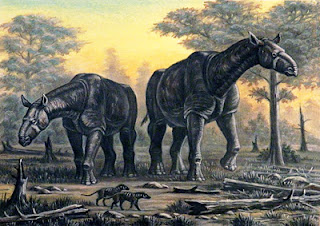
Paraceratherium
The Grande Coupure saw many new animals pouring across from Asia into Europe. Whether or not the tapirs were among them is not immediately obvious. The oldest tapir that we know of is a fossil discovered in Germany and dated to the early Oligocene, not long after the Coupure. Named Protapirus, we know that it, or its very close relatives were found not only in Asia, but also North America, by the second half of the epoch and managed to survive, with relatively little change, into the Early Miocene that followed, dying out about 20 million years ago. 

At first glance, since the oldest fossil is German, it appears that tapirs originated in Europe and then spread east, and it's purely a coincidence that they happened to do so after the Coupure - which, after all, was a time of climatic change. The problem is, there wasn't anything remotely tapir-like living in Europe before the Coupure, but there were plenty of potential ancestors elsewhere. So it's perhaps more likely that the first true tapirs were Asian, and we simply haven't found their fossils yet. Even so, we can at least say that Protapirus, and its later relative Paratapirus (which never seems to have left Europe) really were tapirs, rather than some close relative. A key feature here is that, unlike their earlier relatives, they already had the modifications to the nasal bones that suggest the presence of the short trunk that modern tapirs have, although it was probably less prominent than in current species.

Sunday, 9 July 2023

Oligocene (Pt 3): From Musk Deer to Hell-Pigs

Entelodon
The Grande Coupure that marked the beginning of the Oligocene in Europe did not have as dramatic an effect on the cloven-hoofed animals as it did on some other mammalian groups. But the change was nonetheless noticeable, with several primitive forms that had once inhabited the continent suddenly dying out as it merged with Asia. Others, however, survived through the break, and the absence of their earlier competitors may even have helped them prosper.

These include the gelocids, which first appeared close to the end of the previous epoch. Few of the known fossils of these animals are in good condition, and there is some debate as to whether they are a true group of animals at all, or just a vague term used to collect similar-looking creatures that we can't place elsewhere. That aside, we can at least say that they physically resembled (but were probably not related to) musk deer. That is, they were relatively small, hornless animals with long legs suited for running fast, but lacking the large fang/tusks that mark true musk deer. They did well enough that some, such as Pseudogelocus, are known not only from France and Germany, but also Mongolia, suggesting that they crossed over in the opposite direction to most other mammal groups.

Sunday, 14 May 2023

Oligocene (Pt 2): Europe's Big Break

Eomys
The dawn of the Oligocene is marked by a sudden cooling of the Earth's climate, of which the most obvious consequence was the creation of the Antarctic ice sheets. These locked up so much water that sea levels dropped worldwide, reshaping coastlines. Nowhere were the consequences of this more apparent than Europe, despite its great distance from Antarctica.

Prior to the Oligocene, it would have been possible for a hypothetical traveller to sail from what is now the eastern Mediterranean, through the Paratethys Sea (now the Black and Caspian Seas) due north and into the Arctic Ocean. The body of water that made this possible, the Turgai Strait, was already becoming shallower and narrower as the Oligocene approached, and the sudden dip in sea level finished it off altogether, closing off the sea route that had once run along the eastern flank of the Ural Mountains. 

Sunday, 19 March 2023

Age of Mammals: The Oligocene (Pt 1)

It's been over a decade since I started including bimonthly looks at specific slices of Earth's past in this blog. In that time, I have covered three epochs: the Pleistocene, Pliocene, and Miocene. Together with the current Holocene epoch, these comprise what we currently consider to be two "periods": the Quaternary and Neogene. Both of these are dominated, more or less, by mammals of the sort we'd generally recognise today, even if the details are different. All of the earlier chunks of time since the extinction of the non-avian dinosaurs, however, constitute a different period, the Paleogene, where this was much less true.

When Charles Lyell devised the current system of dividing the "Age of Mammals" into epochs in 1833, he originally defined four. A few years later, he revised this to five, but even then, the entirety of what we'd now call the Paleogene was placed into a single epoch, the Eocene. In 1854, however, German palaeontologist Heinrich Beyrich, split off the later part of the Eocene into a new epoch, which he saw as a distinct period of transition in the development of fossil seashells. He called this the Oligocene, and it proved useful beyond his original mollusc-based definition, and so has remained in use to this day. (Beyrich's wife, incidentally, was a children's author, and made the unusual step of favourably commenting on the work of Charles Darwin in a novel for young girls at a time when it was still controversial).