Showing posts with label chalicothere. Show all posts

Sunday, 3 September 2023

Oligocene (Pt 4): Time of the Giants

Paraceratherium
The Grande Coupure saw many new animals pouring across from Asia into Europe. Whether or not the tapirs were among them is not immediately obvious. The oldest tapir that we know of is a fossil discovered in Germany and dated to the early Oligocene, not long after the Coupure. Named Protapirus, we know that it, or its very close relatives were found not only in Asia, but also North America, by the second half of the epoch and managed to survive, with relatively little change, into the Early Miocene that followed, dying out about 20 million years ago. 

At first glance, since the oldest fossil is German, it appears that tapirs originated in Europe and then spread east, and it's purely a coincidence that they happened to do so after the Coupure - which, after all, was a time of climatic change. The problem is, there wasn't anything remotely tapir-like living in Europe before the Coupure, but there were plenty of potential ancestors elsewhere. So it's perhaps more likely that the first true tapirs were Asian, and we simply haven't found their fossils yet. Even so, we can at least say that Protapirus, and its later relative Paratapirus (which never seems to have left Europe) really were tapirs, rather than some close relative. A key feature here is that, unlike their earlier relatives, they already had the modifications to the nasal bones that suggest the presence of the short trunk that modern tapirs have, although it was probably less prominent than in current species.

Sunday, 17 April 2022

Miocene (Pt 32): Time of the Sea-Sloths

Pronothrotherium
In the absence of the sorts of herbivore more familiar to us today - and already current in the Northern Hemisphere of the day - the large herbivores of Late Miocene South America were nonetheless varied. Many took up habits similar to those of their northern counterparts, so that, at a brief glance, they would not necessarily have appeared so odd to a passing time traveller. 

The mesotheres are a possible case in point. They were a group of notoungulates, one of the two orders of native hoofed mammal that had survived into the Late Miocene along with the litopterns. Earlier in the Miocene, they had perhaps looked even less remarkable, digging herbivores of a similar size and shape to wombats. But as the epoch wore on, they gradually increased in size, while still retaining the adaptations to digging, which they would likely have used to get at tasty roots, and possibly for constructing burrows in which to live.

Sunday, 17 February 2019

Miocene (Pt 12): American Rhinos and Horse-Headed Lopers

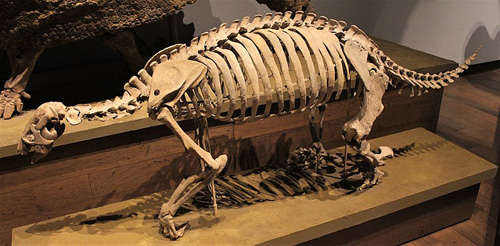
Moropus
The warming climate of Early Miocene North America was host to a variety of animals, both familiar and unfamiliar. Even in the former category, some of the creatures would have looked a little odd too modern eyes, but we can still say that a three-toed horse is, at least in general terms, still a horse. One group of animals that would be a little harder to place were the oreodonts (or, more technically, "merycoidodontids"), which were already fairly diverse when the Miocene dawned.

These creatures were unique to the continent and were medium-sized herbivores. They would have looked vaguely like pigs, although without the flattened nose-disc of those animals, and with four functional toes on each foot. As far as we can tell from their teeth, they were mostly browsing animals and were spread quite widely across the continent.

Saturday, 30 September 2017

Miocene (Pt 3): The Elephants Reach Europe

Gomphotherium angustidens
At the dawn of the Miocene, Europe was still relatively isolated from much of the rest of the world. The only other continent to which is was attached by land was Asia, and even with that, perhaps due to the higher sea levels and narrower land bridges of the day, there was less exchange of animals than one might expect. As a result, for a few million years at the dawn of the epoch, Europe remained a haven for animals that had died out elsewhere, or at least retreated. Tapirs, for example, were still common; today they are restricted to South East Asia and the Americas. The European rhinos of the day were also relatively small and primitive.

While the millions of years that they survived might actually have been quite notable, had we been talking about the much shorter, later epochs, in the grand sweep of the Miocene, we can say that they were quite rapidly replaced by immigrants from the east. The early tapirs were gone (although more modern forms did return for a while, much later), but the rhinos were instead replaced by larger and more sturdy, distinctly Miocene species.

Sunday, 12 June 2016

Pliocene (Pt 11): A Profusion of Pigs

Probably the most numerous large mammals in Africa today are the antelopes, of which there are a great many species. In this respect, the Pliocene was not much different, with antelopes providing a large part of the diet of the various carnivores that lived before the Ice Ages, from lions and hyenas to sabretooth cats. However, the mix of antelope species was different then that it is now, not least because of the generally lusher environment that existed in Africa during the earlier part of the epoch.

Even so, most of the antelopes of the day were related to species that we would recognise today. For example, even at the very beginning of the epoch, around 5 million years ago, South Africa boasted a gazelle similar in size to a modern springbok. Indeed, springboks proper appeared around 3 million years ago in the same general locality, where they were represented by at least two extinct species until one of them (probably Antidorcas recki) evolved into the iconic modern animal.

The gazelles of the early Pliocene were likely different in their habits from the modern sort, being more adapted to woodland than open plains, but, moreover, they were not as common, comparatively speaking, as they are now. Instead, it appears that, at least in East Africa, a group known as the spiral-horned antelopes (about which I will have a lot to say elsewhere on this blog over the coming months) were rather more numerous.