But it isn't just the smaller cloven-hoofed mammals that can lack sophisticated social lives, because the same also seems to be true of the largest of all such animals: the giraffe (Giraffa camelopardalis). At which point, I should probably take a brief diversion to explain what a giraffe is, and where it fits in the larger mammalian family tree.
Showing posts with label giraffe. Show all posts
Sunday, 9 January 2022
The Social Lives of Giraffes
Many of the cloven-hoofed mammals are herd animals, living in large groups that typically have dominance hierarchies and other relatively complex internal structure. We see this in both of the main families of such animals: the deer and the "cattle family" (which includes goats, sheep, and antelopes besides the obvious). On the other hand, there are certainly plenty of exceptions. Smaller deer, such as muntjacs, for instance, tend to be relatively asocial, apparently gaining more benefit by hiding from predators than they would from living in large and watchful, but visibly obvious, herds.
Saturday, 28 November 2020
Miocene (Pt 23): Giraffes Become Tall, Hippos Stay Dry, and Antelopes... Get Eaten
![]() |
| Palaeotragus, a short-necked giraffe |
These changes in climate also affected the animal life on the continent, to the benefit of some and the detriment of others. Pigs are omnivorous animals, and one might expect them to have survived such changes relatively unscathed. In a sense, this is true, since they remained common on the continent, but the nature of particular species living there did change.
Sunday, 3 May 2020
Let's Split the Party!
Last week, I described how, over the last few decades, populations of gray seals have recovered from a near-total local extinction in US waters. Clearly, other species facing similar threats, across the world, have not been so lucky. The rapid pace of human expansion simply overwhelms the ability of some species to cope, whether it be through direct effects (expansion of agriculture, cities, transport networks, and so on) or indirect ones (climate change, most obviously).
In the millions of years before humans appeared on the scene the world was changing at a slow enough pace that it was possible for mammal species to evolve their way out of a problem. Many didn't, of course, and went extinct, but others gave rise to newer species that outlived them. Today, it's not just the scale of the changes humans are making that has caused problems for some species, but also their speed.
When it comes to dealing with very rapid changes in the environment - whether human-caused or otherwise - mammals have both advantages and disadvantages compared to some other species. On the negative front, mammals, especially the larger ones, have long generation times, meaning that any effect of evolution, even on a relatively minor scale, is inevitably going to be slow.
In the millions of years before humans appeared on the scene the world was changing at a slow enough pace that it was possible for mammal species to evolve their way out of a problem. Many didn't, of course, and went extinct, but others gave rise to newer species that outlived them. Today, it's not just the scale of the changes humans are making that has caused problems for some species, but also their speed.
When it comes to dealing with very rapid changes in the environment - whether human-caused or otherwise - mammals have both advantages and disadvantages compared to some other species. On the negative front, mammals, especially the larger ones, have long generation times, meaning that any effect of evolution, even on a relatively minor scale, is inevitably going to be slow.
Sunday, 12 April 2020
Miocene (Pt 19): When Rhinos and Giraffes Went South
![]() |
| Prolibytherium |
More significantly, perhaps, Africa was still an island continent, separated from Eurasia by a body of water called the Tethys Seaway. It had been like this, isolated from the rest of the world, for millions of years, during which time it had developed its own unique animal life, quite different from that elsewhere. At the time, the same was true of South America (and it still is for Australia), but that continent retained its unusual animals for much longer, not contacting the north until as recently as 2.5 million years ago, shortly before the first of the Ice Ages. When that did eventually happen, it led to the Great American Interchange, which set the scene for much of the American fauna we see today.
Saturday, 17 March 2018
Miocene (Pt 6): The Coming of the Mice
![]() |
| Palaeotragus |
By 10 million years ago, however, the colder, drier climate had become locked in for the long term. We know that the forests of Europe changed dramatically at this time, the old subtropical trees, such as figs and palms, being replaced by oak, alder, and elm. Likely as a result of this change in the available food supply, most of the dormice died out, leaving only a few close relatives of the relatively small number of species we have today.
Sunday, 10 December 2017
Short-Necked Giraffes of Spain
The giraffe family is a classic example of a mammal 'family' that consists of very few living species. Giraffes are sufficiently distinctive, and, arguably, odd, that they clearly deserve a family of their own, yet there just aren't very many of them. Exactly how many living species there are in the family is currently the subject of a dispute, since there is good reason to suppose that the animal we actually know as "a giraffe" represents multiple species, but many researchers feel that the hard evidence for that supposition is lacking. What we can say is that, apart from the giraffes proper, there is only one other living species in the family - the okapi.Fortunately, being large creatures, prehistoric giraffes tended to leave reasonably decent skeletons behind. They're distinctive in more ways than you might think, too, having, for example, a particularly odd canine tooth that ends in two or three (admittedly small) points, rather than just the one. So our knowledge of fossil giraffes is fairly good, and it turns out that there were a lot more species of them in the past than there are today - they were once a larger, and more widespread group.
Sunday, 18 December 2016
New Mammal Species 2016
![]() |
| Reticulated giraffes |
But that debate doesn't belong here, instead, as the year draws to a close, it's time to take a survey of the species of mammal that have been newly discovered this year. Or, more accurately, newly named, since what we generally do these days is find some population of a previously known species that turns out not to belong to it, and to be something else instead. There have, as always, been a fair number of them this year, and there's no guarantee that they'll all stand the test of time, and still be considered valid species in, say, 2026.
My survey is, therefore, inevitably biased, with a just a semi-random sample of some of the species announcements I happen to have come across. Most of them are going to be small animals, since they're easier to overlook in the first place, but there are a couple of quite large ones. And, by "large", I don't mean just "wolf-sized", either.
Sunday, 12 June 2016
Pliocene (Pt 11): A Profusion of Pigs
Probably the most numerous large mammals in Africa today are the antelopes, of which there are a great many species. In this respect, the Pliocene was not much different, with antelopes providing a large part of the diet of the various carnivores that lived before the Ice Ages, from lions and hyenas to sabretooth cats. However, the mix of antelope species was different then that it is now, not least because of the generally lusher environment that existed in Africa during the earlier part of the epoch.
Even so, most of the antelopes of the day were related to species that we would recognise today. For example, even at the very beginning of the epoch, around 5 million years ago, South Africa boasted a gazelle similar in size to a modern springbok. Indeed, springboks proper appeared around 3 million years ago in the same general locality, where they were represented by at least two extinct species until one of them (probably Antidorcas recki) evolved into the iconic modern animal.
The gazelles of the early Pliocene were likely different in their habits from the modern sort, being more adapted to woodland than open plains, but, moreover, they were not as common, comparatively speaking, as they are now. Instead, it appears that, at least in East Africa, a group known as the spiral-horned antelopes (about which I will have a lot to say elsewhere on this blog over the coming months) were rather more numerous.
Even so, most of the antelopes of the day were related to species that we would recognise today. For example, even at the very beginning of the epoch, around 5 million years ago, South Africa boasted a gazelle similar in size to a modern springbok. Indeed, springboks proper appeared around 3 million years ago in the same general locality, where they were represented by at least two extinct species until one of them (probably Antidorcas recki) evolved into the iconic modern animal.
The gazelles of the early Pliocene were likely different in their habits from the modern sort, being more adapted to woodland than open plains, but, moreover, they were not as common, comparatively speaking, as they are now. Instead, it appears that, at least in East Africa, a group known as the spiral-horned antelopes (about which I will have a lot to say elsewhere on this blog over the coming months) were rather more numerous.
Sunday, 19 May 2013
Fossil Giraffes of Ethiopia
![]() |
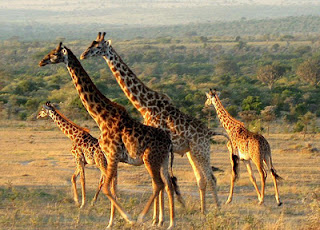
| Giraffes on the Serengeti |
Looking slightly further afield, the entire giraffe family contains just one other living species - the okapi. Superficially, okapis may not look much like giraffes, but that's largely because, when we think 'giraffe' we tend to focus on the incredibly long legs and neck, and, perhaps, on the crazy-paving coat pattern. An okapi is quite different in both of these respects, but, when you look at the head alone, its resemblance to giraffes is much clearer.
Still, an okapi is not an actual giraffe, any more than a fox is a wolf. There may, therefore, only be one species of true giraffe alive today. But, as is so often the case with these small groups of animals, the family becomes rather larger once we include in all the extinct species. True, giraffes have never been as numerous as some other kinds of large herbivore, and the total number of species that we know of is far less than we have of, say, bovines. But it's certainly more than one.
Perhaps one of the most important questions we'd like such fossils to help us answer is why giraffes are so tall when okapis, for example, are not. This isn't as easy as it might appear. If you visit somewhere like the British Natural History Museum, or the Smithsonian, you'll see huge articulated skeletons of dinosaurs on display. It's perhaps natural to assume that what you see is more or less what somebody dug out of the ground. Sure, the original may have been squashed or distorted a bit, but generally speaking what they found was a single skeleton. Right?
Subscribe to:
Posts (Atom)


