 |
| Peccaries from South America |
Showing posts with label pigs. Show all posts
Showing posts with label pigs. Show all posts
Sunday, 13 April 2025
The Diets of Parallel Pigs


Sunday, 9 July 2023
Oligocene (Pt 3): From Musk Deer to Hell-Pigs
 |
| Entelodon |
These include the gelocids, which first appeared close to the end of the previous epoch. Few of the known fossils of these animals are in good condition, and there is some debate as to whether they are a true group of animals at all, or just a vague term used to collect similar-looking creatures that we can't place elsewhere. That aside, we can at least say that they physically resembled (but were probably not related to) musk deer. That is, they were relatively small, hornless animals with long legs suited for running fast, but lacking the large fang/tusks that mark true musk deer. They did well enough that some, such as Pseudogelocus, are known not only from France and Germany, but also Mongolia, suggesting that they crossed over in the opposite direction to most other mammal groups.
Sunday, 13 February 2022
Are Animals Darker in the Tropics?
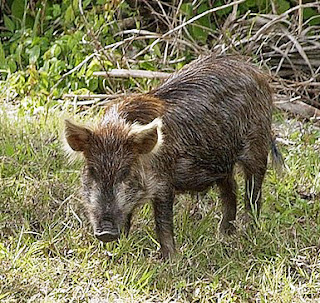
Crucially for this blog, it seemed to be true of the skin and hair of mammals as well. This observation raises a number of questions, of which the first is clearly "is it true?"
Saturday, 28 November 2020
Miocene (Pt 23): Giraffes Become Tall, Hippos Stay Dry, and Antelopes... Get Eaten
 |
| Palaeotragus, a short-necked giraffe |
These changes in climate also affected the animal life on the continent, to the benefit of some and the detriment of others. Pigs are omnivorous animals, and one might expect them to have survived such changes relatively unscathed. In a sense, this is true, since they remained common on the continent, but the nature of particular species living there did change.
Sunday, 4 October 2020
Like a Hole in the Head: What's the Point of Sinuses?

The existence of these passages is important, ensuring that the sinuses are drained of mucus and filled with air... and also allowing any germs that you might have breathed to get into them and make what would otherwise only affect your nose into something worse. But why do we have sinuses at all?
Sunday, 7 June 2020
Miocene (Pt 20): Unicorn-Pigs and the First Hippos
 |
| Prodeinotherium |
Because of these primitive features, determining exactly where they fit in the pig family tree isn't a simple matter, but they are often placed with a group called the kubanochoerines. Assuming this is correct (and it's far from settled) they must have evolved fairly rapidly into much larger and more distinctive animals. The best-known member of the group is the giant "unicorn-pig" Kubanochoerus, which lived in China during the Late Miocene. This was an exceptionally large, long-legged animal, perhaps standing 120 cm (4 feet) high at the shoulder and - even more dramatically - sporting a long pointed horn that projected from the centre of its forehead.
Saturday, 1 December 2018
Not the Pig Family: Fossil Peccaries and More
 |
| Mylohyus |
While pigs date back, at the best, to the end of the Oligocene epoch, the oldest known peccary fossil dates from the end of the epoch before that, the Eocene. This implies that the ancestors of the peccaries entered North America from Asia between 36 and 34 million years ago. The fossil in question belongs to a species known as Perchoerus minor, and it's also worth noting that it is also the smallest peccary known... in fact, it was about the size of a typical house cat.
Sunday, 4 November 2018
The Pig Family: Fossil Pigs
 |
| Kubanochoerus, the unicorn-pig |
Indeed, in some respects, the pig family as it exists today is a shadow of its former self. Pigs have always been reasonably successful animals (at least, without human interference), given their adaptability, moderate intelligence, and willingness to eat just about anything. But, in the past, they were more varied than today. In total, there are five generally recognised subfamilies within the overarching pig family - and all but one of them are known only from fossils.
Sunday, 9 September 2018
The Pig Family: Peccaries Are Not Pigs

The reason I haven't mentioned them so far is, as the title of the post makes apparent, that they aren't actually pigs. So why the heck not, and what are they, if they're not pigs?
Sunday, 12 August 2018
The Pig Family: The Strange Case of the Sulawesi Pig-Deer
 |
| Sulawesi babirusa |
These strange looking pigs inhabit the island of Sulawesi in Indonesia. Unlike most of the others in the group, this has been an island for far longer than pigs have been in existence - when sea levels were lower, most islands to the west were joined with Asia, and those to the east with Australia, but the waters around Sulawesi are so deep that it remained isolated. I've mentioned this before, in the context of warty pigs, so it's interesting to note that those channels must have been crossed by wild pigs on no less than three occasions (the third sort of Sulawesian pig, Celebochoerus, died out in the Ice Ages).
Sunday, 15 July 2018
The Pig Family: Warthogs
 |
| Common warthog |
The common warthog (Phacochoerus africanus) is widespread across sub-Saharan Africa, and is currently thought to have four different subspecies. Unlike other African hogs, they inhabit lush grasslands and open savanna, country dotted with trees and waterways, but neither densely forested nor the truly arid terrain of veldt or desert. Two subspecies live in the north, in the Sahel belt that separates the Congo rainforest from the Sahara, and are found right from the Atlantic coast of Mauritania to the shores of the Red Sea in Eritrea. The others are found across East Africa and pretty much the entire south of the continent outside the deserts, reaching as far as South Africa.
Sunday, 17 June 2018
The Pig Family: Bush Pig, Bushpig, Red River Hog
 |
| Red river hog (boar) |
In fact, over time, we can sense something of a trend here. Beginning with Linnaeus in 1758, several new species are named, often by naturalists unaware, in the days before fully up-to-date reference libraries, let alone the internet, that somebody else had already given a name to the same thing. That process continues through the 19th century, with minor differences being seized on as evidence of speciation, even where it was possible to make decent comparisons. Through the 20th century, the number of genuinely new species being discovered dramatically tails off (at least, for mammals), but there's also a tendency to tidy up the great mass of inherited names from the past, merging similar animals together. Finally, from the late 20th century onwards, an increasing understanding of genetics results in numerous subspecies being promoted, often with our Victorian predecessors turning out to have been right all along.
Sunday, 20 May 2018
The Pig Family: The World's Largest and Smallest Pigs
 |
| Pygmy hog |
But these are not the only pig-like animals to inhabit Asia. In 1847, Brian Hodgson, a naturalist and former colonial administrator who was living in Darjeeling at the time, described and named the pygmy hog (Porcula salvania), an animal he considered so different from regular pigs in the shape of its teeth and feet that he placed it in its own, newly defined, genus, Porcula. (The scientific name, incidentally, translates as "piglet from the Sal Van", the latter being a forest that only coincidentally sounds like the Latin "silvae" meaning "woodland").
Sunday, 22 April 2018
The Pig Family: Threatened Pigs of the Philippines
 |
| Visayan warty pig (female) |
And so things remained for a hundred years, until scientists began to look more closely at the animal's genetics. When they did so, they discovered something fairly surprising. Pigs typically have 38 chromosomes (compared with 48 in humans), but it turned out that the warty pigs from the Philippines had only 36 - an entire pair had disappeared, its genetic material shuffled around elsewhere in the genome.
Saturday, 24 March 2018
The Pig Family: Wild Pigs of Indonesia
 |
| Bearded pig |
The largest such island, and, indeed, the third largest island in the world, is Borneo. This is home to the bearded pig (Sus barbatus), which is also found, not only on the neighbouring island of Sumatra, but also on the Malaysian mainland. The Bornean and Sumatran forms of the animal are widely regarded as different subspecies - the latter going by the rather brilliant name of S. b. oi - although quite which of these two the Malaysian pigs belong to has been a matter of mild controversy.
Saturday, 17 March 2018
Miocene (Pt 6): The Coming of the Mice
 |
| Palaeotragus |
By 10 million years ago, however, the colder, drier climate had become locked in for the long term. We know that the forests of Europe changed dramatically at this time, the old subtropical trees, such as figs and palms, being replaced by oak, alder, and elm. Likely as a result of this change in the available food supply, most of the dormice died out, leaving only a few close relatives of the relatively small number of species we have today.
Sunday, 25 February 2018
The Pig Family: Wild Boar and the Domestication of Pigs
 |
| European wild boar |
Indeed, only two wild ancestors of widely domesticated herbivore are doing well: chickens and pigs. (This may, of course, depend on your definition of "widely"; I'm ignoring, say, rabbits). Indeed, the wild ancestor of the domestic pig is not only reasonably common, it's the single most widespread of any species of wild pig.
Saturday, 27 January 2018
The Pig Family: Suids, Suines, and Swine
 The pigs occupy an an interesting position in the mammalian family tree. The pig family, or Suidae, belongs to the order Artiodactyla, consisting of the cloven-footed mammals and a few of their closest relatives. (I will, at this point, note that I'm going to be using "artiodactyl" in the traditional, non-molecular sense, in this post. Paraphyly be damned, at least for today.)
This is unsurprising, given that pigs do, indeed, have cloven hooves. However, there are other features that almost all artiodactyls have in common, most significantly, that they are purely herbivorous animals with multi-chambered stomachs that they use to "chew the cud". Pigs, however, do not, and while they may not be the only non-ruminating artiodactyls, they are by far the most species-rich group to fit this description.
Traditionally, this was thought to be because they are more "primitive", having evolved before their relatives got round to developing more complex digestive systems. In a more modern way of looking at things, we'd instead note that, compared with other artiodactyls, pigs are omnivorous; they haven't developed more efficient ways of digesting tough plant matter because they don't need to. That they've survived as well as they have, evolving over many millions of years without ever being wiped out, shows that this has been a pretty successful tactic for them.
Sunday, 30 July 2017
Miocene (Pt 2): Before There Were Mice
 |
| Heteroprox |
This rich and verdant landscape was home to a wide range of animals, many of them survivors of even earlier times. Many of these, such as the tapirs, didn't survive long in Europe, but a great many did, with musk deer, pigs, and rhinos dominating the herbivorous fauna, and animals less familiar to modern eyes taking the lead among the large carnivores.
But then, as now, the great majority of mammal species were small. While the sight of Diaceratherium rhinos wallowing in the lush swamps of the Swiss shoreline is the sort of thing that would draw the immediate attention of a time-travelling tourist, there was also plenty going on underfoot. Yet the two most common groups of small non-flying mammals that we have in Europe today - the mice and the voles - did not yet exist. So what was there?
Sunday, 25 June 2017
Rain Down on Me: Wild Boar and the Weather

This is in part because the influence of wild boars on humans is mixed. On the one hand, they can be quite a nuisance. They cause significant damage to crops, can spread diseases to farm animals (most obviously, pigs), and caused almost a thousand traffic accidents a year in northwestern Spain. Clearly, these are all good reasons to keep their numbers down, at least in places where humans are common - which, let's face it, mean pretty much the whole of Europe. On the other hand, wild boar are generally regarded as quite tasty, which, while it's not a great thing to be from the boar's point of view, does at least mean that hunters don't want to drive them away into really remote and inaccessible areas.
Subscribe to:
Posts (Atom)