These were the cats, dogs, bears, weasels, seals, and a sixth group that he called (in Latin) "ferrets".
Sunday, 19 October 2025
Viverrids: Rise and Fall of a Wastebasket
Sunday, 26 January 2025
Delphinid Dolphins
Technically known as the Delphinidae, this was named by John Edward Gray in 1821 as part of one of the earliest formal lists of mammal families. Gray's original definition basically included all toothed cetaceans other than narwhals and sperm whales, encompassing four genera, only one of which is still placed in the family today - Delphinus, from which it takes its name. He didn't list how many species he thought that genus contained, but it would certainly have included the two named by Linnaeus in 1758, and probably at least three others that had been described in the interim. Over the following decades, the number expanded considerably, with Gray himself identifying several of them, notably when he catalogued the observations and specimens collected by the Ross Expedition of 1839-43.
Saturday, 27 January 2024
No Such Thing as an Antelope
Or at least that's true in the same sense that there's "no such thing as a fish". Which is to say that, obviously, antelopes exist but they aren't a scientifically definable group of animals. Or that, if they were, that group wouldn't map closely to what the regular English word "antelope" is supposed to mean.
The word entered English during the Rennaissance, and descends, via Latin, from the Greek "ανθολοψ". That first appears in the 4th century (so not old enough to be Ancient Greek, as such) and referred at the time to a mythical beast said to live along the Euphrates that had horns so sharp and serrated that it used them to cut down trees. We don't know why the Byzantine Greeks called it this, but there's not some "lope" that it's "ante" to (nor, to use most other European languages, is it an anti-lope); it's just a coincidence that the word sounds that way. For all we know, they were borrowing a word from some other, older language spoken somewhere out east.
Sunday, 3 December 2023
The Other One: Red Pandas
Sunday, 16 July 2023
The Stinky Family: Skunks
Saturday, 28 January 2023
The Raccoon Family
The scientific classification of living organisms we use today has its origins in the 1758 edition of Systema Naturae, by Carl Linnaeus. Raccoons live only in the Americas, but even in 1758, Linnaeus was aware of the existence of raccoons, having heard about them from his friend Peter Kalm, who had observed them in what were then the colonies of Pennsylvania and New Jersey. Based on Kalm's description, Linnaeus named this new species Ursus lotor - the "washing bear". It was one of four species of "bear" that he identified in that work, only one of which we'd still consider to be such today.
Saturday, 29 January 2022
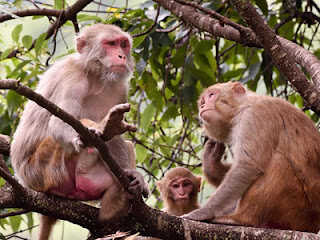
Monkeys with Many Stomachs
| Rhesus monkeys have entirely normal stomachs |
This is due to the rule, often mentioned on this blog, that the members of any scientifically defined group of animals have to be more closely related to all the other members of that group than they are to anything else. The diagram further down this post showing how all the major groups of simian are related illustrates why this is. At the top, we have the macaques and the leaf monkeys, both of which are indisputably monkeys. But their closest relatives are the apes (which, of course, includes gibbons as well as "great apes"). Only then do we get to the other monkeys, which means that, for example, a macaque is more closely related to a gorilla than it is to a marmoset.
Saturday, 30 January 2021
The Deer Family
![]() |
| Doe (a deer, a female deer) |
Antlers are, of course, the key defining feature of the deer family, the Cervidae. They are found on (almost) every species in the family, although (almost) only on the males. A large stag with branching antlers is instantly identifiable as a deer, but it may be fair to say that some of the species with unbranched antlers do have a certain resemblance to some of the smaller species of antelope.
Sunday, 26 January 2020
The Cat Family: Felidae
In fact, the reason that I haven't looked at cats so far in my annual surveys of mammal families is precisely because, if there's one group of mammals that has substantial coverage on the internet already, it's cats. Lions, leopards, and so on are also amongst the most popular of subjects for TV wildlife documentaries, and it's hard to see that I have much to add. But, nonetheless, and while I have, of course, covered cats before in individual posts, exploring the family is a gap that I eventually had to fill. So here we go.
Compared with some, more diverse, mammal families, members of the cat family, Felidae, are all readily identifiable as such. Cats have short faces, lacking the long snout of dogs, with large eyes and ears, and prominent whiskers. Their bodies are generally sleek, usually (although not always) with long tails, and they have muscular limbs and sharp claws. Indeed, apart from size and coat colour, most species of cat are remarkably similar in physical appearance. If you removed the skins of a lion and a tiger, only a real expert would have any chance of telling them apart.
Saturday, 27 January 2018
The Pig Family: Suids, Suines, and Swine
The pigs occupy an an interesting position in the mammalian family tree. The pig family, or Suidae, belongs to the order Artiodactyla, consisting of the cloven-footed mammals and a few of their closest relatives. (I will, at this point, note that I'm going to be using "artiodactyl" in the traditional, non-molecular sense, in this post. Paraphyly be damned, at least for today.)This is unsurprising, given that pigs do, indeed, have cloven hooves. However, there are other features that almost all artiodactyls have in common, most significantly, that they are purely herbivorous animals with multi-chambered stomachs that they use to "chew the cud". Pigs, however, do not, and while they may not be the only non-ruminating artiodactyls, they are by far the most species-rich group to fit this description.
Traditionally, this was thought to be because they are more "primitive", having evolved before their relatives got round to developing more complex digestive systems. In a more modern way of looking at things, we'd instead note that, compared with other artiodactyls, pigs are omnivorous; they haven't developed more efficient ways of digesting tough plant matter because they don't need to. That they've survived as well as they have, evolving over many millions of years without ever being wiped out, shows that this has been a pretty successful tactic for them.
Sunday, 29 January 2017
Pinnipeds: The Difference Between Seals and Sea Lions
![]() | |
| Otariid (above) and Phocid (below) |
There are three recognised families of pinniped alive today: seals, sea lions, and another that includes only the walrus. All are distinguished by having flippers instead of feet, and a lifestyle that requires them to climb out of the water in order to breed and raise their young.
Leaving the walrus aside, the names I've just given to the other two families (and thus the title of the post) are really a bit misleading. This is because a group of animals called "fur seals" actually belong to what I'm calling the "sea lion family" (technically the Otariidae), and in casual usage, the term "seal" is often extended to pinnipeds in general. As a result, if we really want to be accurate, we need some term to distinguish members of the other family from seals more generally. The technical term for these animals is "phocids", but other commonly used terms include "true seals" and "earless seals".
Saturday, 30 January 2016
Bovids and Bovines - What Makes a Cow?
However, opinions have differed as to quite how this should be done. How many significant sub-groups are there, which of them are deserving of the rank of "subfamily", and which animals go with which? Even with modern techniques for analysing genetics and coming up with computer-generated metrics of relatedness, the answers to these questions are not entirely clear. Partly that's because the first two questions at least are essentially arbitrary, and partly because we haven't really got enough samples from some of the more obscure species to really nail the family tree down. There could be anything up to sixteen subfamilies, or just two, or somewhere in between.
Saturday, 29 November 2014
The Dog Family: Canidae
![]() |
| A wolf |
With, perhaps, one or two exceptions, most members of the dog family are instantly recognisable as such. Ignoring the domestic breeds, they typically have muscular bodies, long legs, large, mobile, ears, heads that are broadly triangular in shape, and bushy tails.
Their legs are the shape they are because they're adapted to chasing prey, and most dogs are therefore pretty good at running. They have four toes on each of the hind feet, and, while most of them do have the full set of five on the front feet, the thumb (or "dewclaw") doesn't reach the ground. Their snout is the length and shape it is, partly to get in a large and sensitive nose, and partly to fit in an array of teeth that don't restrict them purely to eating meat.
Sunday, 8 December 2013
The Beautiful Haired Monkeys
The Concise Oxford English Dictionary defines a monkey as "a small to medium-sized primate typically having a long tail and living in tropical countries." While perfectly good for everyday speech, that's not a viable scientific definition, for two reasons. For a start, you can't just say "typically" - you have to define exactly what you're talking about.The other problem, though, is more subtle, and relates to how we define groups of animals. As I've mentioned many times before, a natural group of animals is one that includes a single common ancestor and all of its descendants. Apes are descended from monkeys, so, scientifically speaking, either apes are a special kind of monkey, or there is no such thing as a "monkey". You can take your pick, but scientists more commonly use the former option. A gorilla, therefore, is a kind of monkey, and it manifestly doesn't fit the definition given above.
Sunday, 6 January 2013
Caprines: Goats, Horns, and Antlers
So, instead, I am going to look at just one subfamily within the group. After the gazelles, it's the second largest cattle subfamily, with the bovines down in third place. These, as you'll have guessed from the title of the post, are the goats.
Or, more accurately, "caprines". Just as many members of the weasel family aren't literally weasels, many members of the goat subfamily aren't goats in the usual sense of the word. If you've never really looked at mammalian taxonomy, there will probably be at least a couple of species I'm going to cover over the coming months that will surprise you, and likely a few you've never heard of. One collective term for all of these animals is "goat-antelopes", but it's hardly common usage, and I don't actually find it very useful - not least because most of them don't look much like the regular image of an antelope, either. So I'll stick with the technical term of "caprines", or sometimes just call them goats, and you'll have to accept that I mean that in an unusually broad sense.
Sunday, 11 September 2011
The World of Weasels
![]() |
| The common, European, weasel, Mustela nivalis |
The weasel family is also, arguably, the most diverse of the carnivoran families. Nobody would doubt that a tiger is a kind of cat, and its hardly surprising to learn that foxes are members of the dog family, but the majority of members of the weasel family are not animals that, in everyday speech, we would call weasels. True, ferrets, for example, do look rather like out-sized weasels, but its probably less obvious that the family includes such animals as badgers, otters, and wolverines.
But what, exactly is a family of animals? The latest edition of Mammal Species of the World lists 144 families of mammal, 121 of which are placentals, but such a list can never be truly definitive. The modern rules for defining any natural group of animals, whether it be a family, subfamily, order, or anything else, is that all the species in that group must be more closely related to each other than to anything outside the group. This means that a family, like any other meaningful group of species, includes a single common ancestor and all of its living descendants.
.jpg)


