But there comes a point where any mammal has to be weaned and make its way in the wider world. Even then, the maternal investment doesn't necessarily end with the mother continuing to raise and train her offspring for what can be an extended period. Brown bears, for example, are weaned at around six months, but they commonly stay with their mothers for at least another year, and often for two or more. We can see similar patterns in other mammals including, perhaps most obviously, primates.
Sunday, 19 November 2023
Learning to Hunt at Sea
Saturday, 26 November 2022
Miocene (Pt 36): Dawn of the Seals
![]() |
| Allodesmus |
Today, the seals are divided into two subfamilies (I have reviewed all living species of seal here): the phocine or "northern" seals, which live in the Northern Hemisphere, and the monachine or "southern" seals, which are primarily found in the Southern Hemisphere, but do include three living species in the north.
Sunday, 10 October 2021
Baby's First Dive
At some point, however, the infant has to survive on its own. Before it can truly leave home it needs to be able to find its own food, so there's going to be a period between it feeding entirely on milk and it becoming fully independent during which it's learning the necessary techniques of foraging or hunting. We see something similar in birds; while they obviously don't produce mammalian milk, young birds do necessarily rely on their parents for food until, as a minimum, they get the hang of flying. (It seems plausible that the same was true of pterosaurs, although there is evidence that at least some species learned to fly very quickly and that the period of dependence was correspondingly short).
While the reliance on suckling means that all mammals do this to some extent, the closest obvious analogy to birds would be bats - and, indeed, it does take them time to learn how to fly. But another group of mammals that has to learn how to do something nearly as dramatic before becoming self-sufficient are the pinnipeds (seals and their relatives).
Sunday, 8 November 2020
Last Gasp of the Australian Seals
![]() |
| Today, true seals only live much further south |
For simplicity, I'm going to refer to these two groups as "true seals" and "sea lions" in this post, although you should be aware that the so-called fur seals fall into the latter group. We've long known that "fur seals" aren't really a specific type of animal, but are at least two different kinds of sea lion that coincidentally look a little different from their relatives.
Sunday, 26 April 2020
Grey Seals on the Rebound
Partly that's because we're getting better at evaluating such things, and identifying species as being at risk when we previously knew little about them - or, in many cases, didn't even know they were separate species. But it's also a consequence of mankind's ever-expanding ecological footprint, as some species become threatened that weren't previously.
Sunday, 9 February 2020
Male Chauvinist Seals
In polygynous systems, one male mates with multiple females, to maximise the number of offspring he can sire. In the polyandrous system, it's the other way round, with a single female mating with multiple males (some mole rats do this, but it's rare in mammals). The final option is a promiscuous system, where both sexes have multiple partners.
Sunday, 5 November 2017
Pinnipeds: The Evolution of Seals
![]() |
| Acrophoca |
Early attempts to deduce how these various species relate to one another identified a number of different sub-groups among the seals, based largely on anatomical resemblances. On this basis, it was thought for a while that the Arctic and Antarctic seals were each others' closest relatives, with the more temperate species representing older, and perhaps more ancestral, forms. But this picture began to change in the 1990s, and its replacement has subsequently been confirmed by a number of different genetic analyses. While the exact details have still not been fully settled, we do now know the broad pattern of what happened, and I've provided one consensus family tree below. Using estimated rates of evolutionary change, calibrated with the age of known fossils, we can also get a rough idea of when some of the key events in this history unfolded.
Sunday, 8 October 2017
Pinnipeds: Killer Seals of the Antarctic
![]() |
| Leopard seal |
Leopard seals (Hydrurga leptonyx) are among the larger seals, with full-grown adults ranging from about 240 to 320 cm (8 to 10½ feet) in length. While this is still quite a bit smaller than elephant seals, the largest females - which are, unusually, larger than the males - can still weigh over half a tonne. They typically inhabit frozen waters far to the south, moving over the course of the year as the ice front expands and contracts with the changing seasons. Younger individuals seem to travel further north than full grown adults, and, while the winter range normally extends only as far as the various subantarctic islands, the Falklands, and Tierra del Fuego, they are occasional visitors to continental Chile, Tasmania, and some points even further north. A couple of reports from the middle of the last century, supported by actual skeletal remains, even refer to lone individuals getting as far north as the Cook Islands in Polynesia.
Sunday, 10 September 2017
Pinnipeds: Ross and Weddell Seals
![]() |
| Weddell seal |
The Weddell seal (Leptonychotes weddellii) is a typical example. With fully-gorwn males up to 3 metres (10 feet) in length, and weighing about half a ton, they are noticeably smaller than elephant seals, but still pretty large by the standards of seals in the north. They were first discovered during the expeditions of navigator James Weddell, who, in the 1820s, sailed further south than anyone had previously travelled, into the sea that now also bears his name. Since the seals are named for him, rather than for the body of water where they were first found, it's perhaps unsurprising that they are not unique to that sea, and are equally common right round the frozen continent. During the winter, they can travel as far north as South Georgia and other islands of the extreme South Atlantic, but they don't normally reach (for example) the Cape Horn at the southern tip of South America.
Sunday, 16 July 2017
Pinnipeds: Decline of the Monk Seals
![]() |
| Mediterranean monk seal (museum specimen) |
It's not actually known why these animals are called "monk" seals. The oldest known reference to the term comes from Johann Hermann in 1779, when he wrote the first scientific description of the Mediterranean monk seal (Monachus monachus), and gave it its scientific name. The only reason he gave for doing so was that he'd heard that the animal was called that in France, and thought that maybe that was because, seen from behind, the head and shoulders looked a bit like a robed and hooded man. But he was guessing about that latter part, and there doesn't seem to be any independent corroboration that the animal really was called a "monk seal" in France (or, indeed, anywhere else) prior to his naming of it. Presumably, he'd got the name from somewhere, but, for all we know, he might have misremembered the details.
Sunday, 14 May 2017
Pinnipeds: Freshwater Seals
![]() |
| Caspian seal |
However, two other populations of ringed seals (or their immediate ancestor), became separated from their kin at a much earlier date. Unlike the Ladoga and Saimaa populations, they had the time and isolation to develop into entirely new species, notably different from their relatives out in the ocean.
Sunday, 23 April 2017
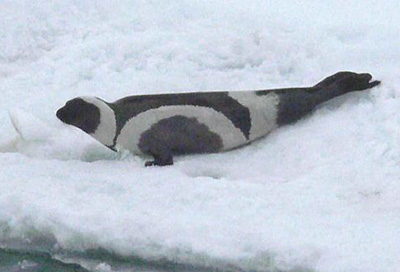
Pinnipeds: Ribbon and Ringed Seals
![]() |
| Ribbon seal (male) |
Male ribbon seals are black, or very dark brown, with clear, wide bands of pure white fur around their necks, shoulders, and just above the hips. Females are medium-brown with light tan stripes, so the pattern is less striking, but it's still present, and in the same shape. Neither sex is born like this; even once baby ribbon seals shed their pure white fur at around a month of age, they are initially plain in colour, only fully developing the stripes by the time they are two years old.
Sunday, 26 March 2017
Pinnipeds: Grey and Harp Seals
![]() |
| Grey seal |
The last of the four to be split off was the animal we now know as the grey seal (Halichoerus grypus), in 1791. While that's still fairly early as such things go, the fact that it was the last of the local seals to be formally identified as something different from the regular sort is likely down to the fact that it does look very similar to the harbour seal. Although, in fairness, it was first named by an entomologist, so clearly you don't have to be a mammal specialist to tell them apart.
Sunday, 26 February 2017
Pinnipeds: Harbour and Spotted Seals
![]() |
| Harbour seal |
In fact, when Linnaeus described what was essentially a typical "seal-like" animal, he would have been thinking of what we now know to constitute, like the "elephant seal", a number of different species. The one that was likely the most familiar to him, however, is the one that retains the scientific name that he gave it, and which is known in many parts of the world simply as "the common seal". In more recent times, the alternative name of harbour seal (Phoca vitulina) has become more widely used, and it's this that I'll use to describe the animal to which, taxonomically speaking, all other seals are in some sense compared.
Sunday, 29 January 2017
Pinnipeds: The Difference Between Seals and Sea Lions
![]() | |
| Otariid (above) and Phocid (below) |
There are three recognised families of pinniped alive today: seals, sea lions, and another that includes only the walrus. All are distinguished by having flippers instead of feet, and a lifestyle that requires them to climb out of the water in order to breed and raise their young.
Leaving the walrus aside, the names I've just given to the other two families (and thus the title of the post) are really a bit misleading. This is because a group of animals called "fur seals" actually belong to what I'm calling the "sea lion family" (technically the Otariidae), and in casual usage, the term "seal" is often extended to pinnipeds in general. As a result, if we really want to be accurate, we need some term to distinguish members of the other family from seals more generally. The technical term for these animals is "phocids", but other commonly used terms include "true seals" and "earless seals".
Sunday, 10 April 2016
The Last Seals of the Mediterranean
![]() |
| Sculpture |
One of the endangered seal species is the Caspian seal, found only in the isolated and land-locked sea of the same name. The other two are monk seals, with one species each in the Mediterranean and off the coast of Hawaii. Quite how two such closely related species ended up on opposite sides of the globe is something I've discussed in an earlier post, but for today, the key point is that there used to be three species of monk seal, and that the other one went extinct around 1952.
Given this, the threat to the two remaining species is surely far from hypothetical. There are thought to be a little over a thousand Hawaiian monk seals alive today, but, as confirmed in a recent species review, the most endangered seal species of all is the Mediterranean monk seal (Monachus monachus) - the only seal species to live in the sea for which it is named.
Sunday, 21 June 2015
Seals, Sea Lions, and Finding Your Children
Mother mammals can use three different methods to identify which child is their own, and likely often use a combination of them. Perhaps the most common method is smell, since most mammal species have a quite remarkable sense in this regard. If each child has a unique smell, or even if it just smells of you, that's a good way of identifying it. The other possibilities are identifying them by the sound of their voice, and, finally, by what they look like. For we primates, the latter may seem the most obvious, but facial recognition is something we're particularly good at.
Sunday, 26 April 2015
The Seals That Swam in Tuscany
![]() |
| Hawaiian monk seals |
Now, monk seals don't have have the same sort of problems when it comes to dispersal as lemurs and the like do. Given time, they can just swim across vast stretches of ocean, feeding on fish as they do so. The apparent puzzle of their wide separation is also reduced by the fact that there used to be a third species, living in the Caribbean, which sadly went extinct in the late 20th century. The Caribbean is about half way between the other two locations, and that helps rather more than you might think at first glance.
Thursday, 24 November 2011
News in Brief #2
![]() |
| Columbian ground squirrel |
Male animals will go a long way to ensure that they become the father for a female's young. If the female isn't likely to be monogamous, they may chase off rivals, beat them up, display their masculinity, or just have giant gonads. But male Columbian ground squirrels (Urocitellus columbianus), it seems, like to try a bit of smooching.
Columbian ground squirrels (that's British Columbia, by the way, not Colombia in South America) live in complex, underground burrows. They mate in the early spring, after waking up from hibernation, and the females are sexually fertile for just one day during each year, making competition between males particularly important. Yes, the males do fight one another to establish territories, but, according to a new discovery, that isn't their only trick.
In short, they don't go too far on a first date. They sneak into the female's burrows at night, when she isn't sexually fertile, and spend the night with her, without doing anything. The next morning - and the more experienced males do seem to be pretty good at predicting in advance the one day when this is going to happen - the females wakes up feeling randy... and, well, who's already there?
Sunday, 26 June 2011
Second Time Mums - Luck, Fitness, or Callous Calculation?
In general, it seems that mothers raising their first litter of young are the least likely to manage; those who have done it at least once before cope much better. That might not sound very surprising, but consider that there at least three different reasons why this might be the case. Perhaps the most obvious is that they just aren't very good at it the first time round. That may be partly due to a lack of experience, but raising young is fairly instinctive for most species, so it could also be that older mothers are larger, and better able to survive the experience of diverting some of their food resources to their offspring.
But another possibility is that the mothers might be deliberately not doing such a good job the first time round. This explanation, which I also discussed for the brown antechinus, is "terminal selection theory". The idea is that it's sometimes better for the mother to lose a litter and live to breed again than it is for her to die raising the first one. As she gets older, the less likely she will have another litter anyway, and the less she has to lose by putting all of her effort into raising the current one (assuming that is, that your primary objective is to have as many healthy young as possible, which in evolutionary terms, it usually is). So, if you don't completely wear yourself out on the first litter, maybe they'll survive anyway, but, even if they don't, at least you'll get to grow bigger and raise more young in the future.
The third possibility is that some mothers are better than others. If the 'bad' mothers are going to die trying to raise young, its far more likely to happen on their first attempt. If this theory is right, the only reason that older mothers do a better job of raising young is that they've proven they're good at it - all the bad mothers are already dead. They survive to raise more young, not because they were lucky, but because they have some advantage that continues to stand them in good stead as they age. Finally, of course, we should acknowledge that there's no reason why there can't be some truth in all three of these options, or that some might be more important for some species than others.
The northern elephant seal (Mirounga angustirostris) is one of the largest of all seals, with the adult males reaching over two tons in weight. They breed along the coast of California, spending the rest of the year offshore and travelling at least as far as southern Alaska. They belong to the true seal family, which is to say that they don't have visible ears or the ability to waddle about on land as fur seals and sea lions do; their hind legs are so well adapted to swimming that they can't be used for much else, and they have to drag their bodies with their front flippers when out of the water. Their closest relatives all live in Antarctic waters, from which the ancestors of the northern elephant seals probably headed north about three million years ago.
Leopard Seal Crabeater Northern Southern
etc. Seal Elephant Seal Elephant Seal
^ | | | Monk
| | (move north) | Seals
| | | | ^
--------------- ------------------ |
| | |
| | |
----------------------------- |
| |
(migration to Antarctic) |
| |
-------------------------------------
|
|
Interestingly, monk seals today are found in only two locations - the Mediterranean and Hawaii, which aren't exactly noted for being close to each other. Since seals as a whole seem to have originated in the North Atlantic, the Hawaiian ones must have travelled west by swimming in between North and South America, before they collided. Indeed, fossil monk seals have been discovered in the Caribbean, which would support this idea. For that matter, this is probably also the route that the Antarctic seals themselves took, much earlier, since we know of fossils of them from the Pacific, but not from the South Atlantic.
In a recently published study, Derek Lee of Dartmouth College in New Hampshire, looked backed over twenty years of records of northern elephant seals breeding at the Farallon Islands near San Francisco. There are a number of reasons why first-time elephant seal mothers might find it harder to raise their young than their more experienced relatives. Seals have to come ashore to give birth, but the rest of the time they are at sea. Since mating also occurs on land, it makes sense for it to happen at the same time, so they courtship takes place as soon as the previous litter are weaned, if not before. The rookeries where they breed become raucous and violent places with enormous males charging about all over the place, so the females can't afford to leave their young alone, which, since the males certainly aren't going to help, means they have to starve themselves for all the time that the pups are growing up.
This makes the life of a female elephant seal a pretty tough one, at least once they reach sexual maturity at three or four years of age. They spend eight months of the year pregnant, another two months raising a pup, and then two months stuffing themselves with food to make up for all the weight they have lost during their enforced crash diet. First time mothers, being smaller than their older relatives, would be expected to have a harder time surviving that catastrophic weight loss, and maybe also defending their patch of land and protecting their pup against aggression.
Its unsurprising, then, that first time mothers do not do as well than more experienced ones. They are less likely to raise their young to the point that they can be weaned and go off to live on their own, and also less likely to survive the experience long enough to return the following year. Not that this stops them trying; the study found that they were just as likely to mate after giving birth as experienced mothers.
Notice that, if this study is correct, it does rule out the possibility that this population of elephant seals, at least, are purposely expending less effort in looking after their first pup to increase their odds of raising a second or a third later on. If that were the case, while first time mothers would be less effective at raising young, they would be at least as likely to survive to breed again as experienced ones, and they weren't. So if they are trying to maximise their own survival at the expense of their pups, it clearly isn't working.
Its tougher to decide between the other two possibilities. Do experienced mothers do better and live longer because they got lucky the first time round, or because they have always been more skilled or fit than those which died? By examining the statistics, the study concluded that it was fitness as a mother, not sheer luck, that made most of the difference. Apparently, there is a Darwinian cull of unfit mothers, ensuring that only the best get to raise multiple pups in their lifetime.
The study doesn't end there, though, because it also looked at the effects of El Niño over the twenty year period. The main fish that northern elephant seals eat are Pacific hake, and, when El Niño brings its periodic warming of the eastern Pacific waters, the hake do less well, and the elephant seals suffer. Of course, hake aren't the only thing they eat; they are quite happy to consume squid, and even some small sharks and rays, but it is clear that the elephant seals do not put on so much weight in years when El Niño strikes.
We might expect that first-time mothers would do worst, especially if their smaller size is a handicap for them, but the study seemed to show that they did no better or worse than experienced mothers during warm weather. Which isn't to say that climate change, with increasingly warm waters and reduced numbers of tasty hake, doesn't affect elephant seals, just that it affects all of them equally, and that there are some things that being a good mother just can't help you with.
So, if you're an elephant seal, and you want to live long enough to have a second child, and more after that, you don't have to rely on luck, and you don't have to callously withhold all your energy from your first-born. Thanks to Darwin, you just have to be a good mother.
[Picture from Wikimedia Commons. Cladogram adapted from Fyler et al. 2005]
.jpg)