Showing posts with label Pinnipeds. Show all posts

Sunday, 19 July 2026

Goo Goo G'joob

"Pinnipeds" is the technical term for flipper-footed aquatic mammals that are able (although often with difficulty) to move about on land. Although there had previously been some speculation on the point, we now know that they are a natural group of animals, all descending from a single distant ancestor. They are carnivorans, more closely related to dogs than to cats and probably represent the third major branching within the living dog-like carnivores, after the dogs and bears, but before (for example) the raccoons, skunks, and weasels.

The living species of pinniped are placed within three families, although one or two extinct ones are also recognised. Most pinnipeds belong to the Phocidae, or "seal family". While the term "seal" is often used in modern English to refer to pinnipeds in general, the seal family proper consists of animals especially well-adapted to living in the water. They lack visible ears, and their hind limbs are arranged so to be efficient for propulsion underwater, but almost useless on land, forcing them to haul themselves about using their front flippers only.

Sunday, 1 September 2024

Unravelling the History of Seals

Allodesmus, a desmatophocid
Trying to determine the largest patterns in evolution can be a daunting task. Here, we often want to look at large numbers of species, comparing the living ones and filling in the gaps with fossils that are often incomplete, ambiguous, or that simply haven't been discovered yet. As a result, there are several big transitions in mammalian evolutionary history that we'd like to get a better look at. Bats are a significant case in point; their small fragile skeletons don't preserve well if we want to see more than teeth, and how they developed their forelimbs into wings remains obscure.

With some groups, however, we do have sufficient fossil evidence that we can look at a whole group of animals and get some idea, not just of how it originated, or where it fits in the larger mammalian family tree, but what ups and downs it has faced over the course of its existence. This can tell us what alterations in climate or geography drove changes within the group and how and when particularly evolutionary innovations developed.

Saturday, 26 November 2022

Miocene (Pt 36): Dawn of the Seals

Allodesmus
In this series so far, I have covered the mammalian wildlife of the Miocene continent by continent, showing how the diversity of animals then was just as great as it is now. But there is a group of mammals that a time traveller to the period would have been able to observe along the coasts of those continents - especially during their breeding season - that I have not yet mentioned.

Today, the seals are divided into two subfamilies (I have reviewed all living species of seal here): the phocine or "northern" seals, which live in the Northern Hemisphere, and the monachine or "southern" seals, which are primarily found in the Southern Hemisphere, but do include three living species in the north. 

Sunday, 9 June 2019

Miocene (Pt 14): Sabre-toothed Sea Otters

Ysengrinia
When bears first entered North America is really more a matter of definition than of our understanding of the fossil evidence. Going by what is probably the most common current definition, bears first appeared in Europe about 20 million years ago, in the form of Ursavus elmensis. Noticeably smaller than modern bears, this developed into a number of species across Europe and Asia, and to the closely related Ballusia in China.

Almost immediately, however, Ursavus also crossed into North America, probably arriving around 19 million years ago. It seems to have been far less common there than it was in Europe, with the local species, Ursavus pawniensis (there were probably others, but that's the only one we know of for sure) living in relatively small populations across the west, from Nebraska to Oregon and Saskatchewan. It doesn't appear to have left any descendants, being eventually replaced by more modern species of bear from Asia rather than evolving into anything uniquely American.

Sunday, 17 March 2019

The Beaches of Bakersfield

Modern walrus skull
Seals have a moderately long fossil history, with some of the oldest examples dating from Europe, around 15 million years ago. Although they are now found worldwide, back in those early times, they seem only to have lived in the North Atlantic, reaching the Pacific only around 11 million years ago (probably by the simple expedient of swimming through the seas that then covered what is now Central America).

However, one of the world's best fossil sites for recovering fossil aquatic mammals is at Sharktooth Hill, just outside of Bakersfield, California. Part of the larger Temblor Formation, the deposits here consist of silts and sands, laid down just over 15 million years ago, when California was sweltering in the Middle Miocene Climatic Optimum, a time of unusually high worldwide temperatures - and correspondingly high sea levels. This was before seals had reached so far west, but that does not mean that a number of similar animals did not already live there at the time.

Sunday, 5 November 2017

Pinnipeds: The Evolution of Seals

Acrophoca
There are seventeen species of "true" seal alive today. Most of them are reasonably widespread and numerous animals, and, despite the effects of seal hunters, are not under any particular threat. Populations of hooded seals are in a steady decline, but, although they are still hunted in places, a 1985 ban on the use of seal fur across most of Europe has hugely reduced the demand for the animals; the main reason for the current population decline seems to be the loss of their icy breeding habitats. The two species of living monk seal, and the Caspian seal, have not been so lucky, and are all considered endangered species. And an eighteenth species, the Caribbean monk seal, went extinct in the 1950s.

Early attempts to deduce how these various species relate to one another identified a number of different sub-groups among the seals, based largely on anatomical resemblances. On this basis, it was thought for a while that the Arctic and Antarctic seals were each others' closest relatives, with the more temperate species representing older, and perhaps more ancestral, forms. But this picture began to change in the 1990s, and its replacement has subsequently been confirmed by a number of different genetic analyses. While the exact details have still not been fully settled, we do now know the broad pattern of what happened, and I've provided one consensus family tree below. Using estimated rates of evolutionary change, calibrated with the age of known fossils, we can also get a rough idea of when some of the key events in this history unfolded.

Sunday, 8 October 2017

Pinnipeds: Killer Seals of the Antarctic

Leopard seal
As one might expect, seals, for the most part eat fish and squid, although the precise details do vary quite a bit between different species, based on such things as their diving ability, as well as where they happen to live. Two species of seal in the Antarctic, however, do have a somewhat different diet, at least in part.

Leopard seals (Hydrurga leptonyx) are among the larger seals, with full-grown adults ranging from about 240 to 320 cm (8 to 10½ feet) in length. While this is still quite a bit smaller than elephant seals, the largest females - which are, unusually, larger than the males - can still weigh over half a tonne. They typically inhabit frozen waters far to the south, moving over the course of the year as the ice front expands and contracts with the changing seasons. Younger individuals seem to travel further north than full grown adults, and, while the winter range normally extends only as far as the various subantarctic islands, the Falklands, and Tierra del Fuego, they are occasional visitors to continental Chile, Tasmania, and some points even further north. A couple of reports from the middle of the last century, supported by actual skeletal remains, even refer to lone individuals getting as far north as the Cook Islands in Polynesia.

Sunday, 10 September 2017

Pinnipeds: Ross and Weddell Seals

Weddell seal
The majority of 'true' seal species live in the Northern Hemisphere, with just five found south of the equator. While they were once more widespread, today, all five of these live in the extreme south, with the most widespread - the southern elephant seal - reaching Tasmania, southern New Zealand, and Patagonia. The remaining four, which are all relatively closely related to one another, do not range so far north and are exclusively Antarctic and sub-Antarctic.

The Weddell seal (Leptonychotes weddellii) is a typical example. With fully-gorwn males up to 3 metres (10 feet) in length, and weighing about half a ton, they are noticeably smaller than elephant seals, but still pretty large by the standards of seals in the north. They were first discovered during the expeditions of navigator James Weddell, who, in the 1820s, sailed further south than anyone had previously travelled, into the sea that now also bears his name. Since the seals are named for him, rather than for the body of water where they were first found, it's perhaps unsurprising that they are not unique to that sea, and are equally common right round the frozen continent. During the winter, they can travel as far north as South Georgia and other islands of the extreme South Atlantic, but they don't normally reach (for example) the Cape Horn at the southern tip of South America.

Sunday, 13 August 2017

Pinnipeds: The Mighty Elephant Seals

Northern elephant seal (male)
The largest of all seals are, of course, the elephant seals. These were one of the original species of seal to be scientifically named, back in 1758. They were originally given the name Phoca leonina, which literally translates as "seal-lion", suggesting some possible confusion on Linnaeus's part about which exact animal he was describing. For a long time, it was thought there was only one species, but we now know that the populations in the Northern and Southern Hemispheres represent two different, but closely related species.

Northern elephant seals (Mirounga angustirostris) live off the western coast of North America, with breeding colonies on offshore islands and occasional isolated patches of continental coast in California and Baja California. It's probably here that they are more commonly seen, since they not only spend the winter breeding season ashore, but they also visit the same beaches during the summer for their annual moult, when they are unable to enter the water for weeks at a time. Surprisingly, then, they spend the rest of the year somewhere else entirely, travelling hundreds of miles from their colonies to feed in the north-east Pacific, and spending spring and autumn as far north as the Aleutian Islands and, on occasion, as far west as Hawaii. Quite why they'd do something as seemingly daft as to make the same long-distance migration twice a year isn't entirely clear, although it presumably has something to do with the ideal weather for each activity.

Sunday, 16 July 2017

Pinnipeds: Decline of the Monk Seals

Mediterranean monk seal
(museum specimen)
The great majority of seal species are found in cold, often freezing waters. Even harbour and elephant seals, which are frequently found in temperate, or even subtropical, climes, also inhabit colder latitudes for at least part of the year. There are just three modern species of true seal that are found solely in warm waters, and they all happen to be closely related. These are the monk seals.

It's not actually known why these animals are called "monk" seals. The oldest known reference to the term comes from Johann Hermann in 1779, when he wrote the first scientific description of the Mediterranean monk seal (Monachus monachus), and gave it its scientific name. The only reason he gave for doing so was that he'd heard that the animal was called that in France, and thought that maybe that was because, seen from behind, the head and shoulders looked a bit like a robed and hooded man. But he was guessing about that latter part, and there doesn't seem to be any independent corroboration that the animal really was called a "monk seal" in France (or, indeed, anywhere else) prior to his naming of it. Presumably, he'd got the name from somewhere, but, for all we know, he might have misremembered the details.

Sunday, 18 June 2017

Pinnipeds: Hooded and Bearded Seals

Hooded seal pup
Most of the species of seal found in the waters of the North Atlantic are roughly the size of harbour seals, with full-grown males measuring about 160 cm (5' 3") in length, and weighing around 120 kg (265 lbs); females, of course, are somewhat smaller. Of the three species that are significantly larger than this, the biggest of all are the hooded seals (Cystophora cristata). While not a patch on the largest seals of the Pacific, with males up to 270 cm (8'9") and weighting around 300 kg (660 lbs), they're still pretty hefty.

Hooded seals live relatively far north in the Atlantic, spending most of their time in cold waters northward from Nova Scotia to the coasts of Greenland and Iceland, and some of the remote islands that lie to the north of Europe. They are known to have four, relatively small geographic areas in which they do their breeding - the Gulf of Saint Lawrence, off the north coast of Newfoundland, the Davis Strait between Greenland and Baffin Island, and around Jan Mayen island east of Greenland. Although these appear to be quite distinct, there is no evidence of any significant genetic difference between the populations, and hence, no recognised subspecies of the animal.

Sunday, 14 May 2017

Pinnipeds: Freshwater Seals

Caspian seal
Seals live, generally speaking, in the world's seas and oceans. But, as I noted last time, there is one species of ocean-going seal with a population found in freshwater. This is the ringed seal of the Arctic and Baltic, one population of which became cut off during the last Ice Age and now has descendants living in Lakes Ladoga and Saimaa in Russia and Finland. Lake Saimaa drains into Lake Ladoga, which in turn drains, via the Neva River, into the Baltic, so while seals do not regularly swim in that river, the geographic isolation is, at least in theory, not absolute.

However, two other populations of ringed seals (or their immediate ancestor), became separated from their kin at a much earlier date. Unlike the Ladoga and Saimaa populations, they had the time and isolation to develop into entirely new species, notably different from their relatives out in the ocean.

Sunday, 23 April 2017

Pinnipeds: Ribbon and Ringed Seals

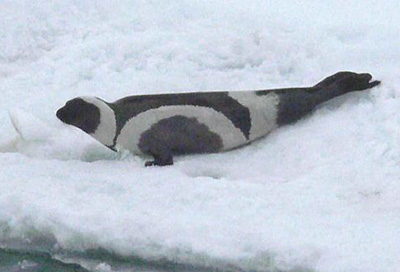
Ribbon seal (male)
Although there is, perhaps, more variety amongst seals than one might at first expect, when it comes to colouration, there isn't all that much to distinguish the different species. The majority are brown or grey, often with black or pale splotches of some kind. I've already described one exception, the harp seal, but arguably the most distinctive of all seal coat patterns belongs to its close relative, the ribbon seal (Histriophoca fasciata).

Male ribbon seals are black, or very dark brown, with clear, wide bands of pure white fur around their necks, shoulders, and just above the hips. Females are medium-brown with light tan stripes, so the pattern is less striking, but it's still present, and in the same shape. Neither sex is born like this; even once baby ribbon seals shed their pure white fur at around a month of age, they are initially plain in colour, only fully developing the stripes by the time they are two years old.

Sunday, 26 March 2017

Pinnipeds: Grey and Harp Seals

Grey seal
There are four different species of seal that live off the coasts of northern continental Europe. Perhaps the best known is the harbour seal, or "common seal", which is also the most widespread of all seal species, being found across both the North Atlantic and the North Pacific. When the scientific naming of species was introduced in 1758, it was the only such species recognised from the area, but it only took a few decades for proper scientific descriptions of the others to follow, recognising that they were distinct from their "common" cousin.

The last of the four to be split off was the animal we now know as the grey seal (Halichoerus grypus), in 1791. While that's still fairly early as such things go, the fact that it was the last of the local seals to be formally identified as something different from the regular sort is likely down to the fact that it does look very similar to the harbour seal. Although, in fairness, it was first named by an entomologist, so clearly you don't have to be a mammal specialist to tell them apart.

Sunday, 26 February 2017

Pinnipeds: Harbour and Spotted Seals

Harbour seal
When the modern system of scientific names for organisms was devised, and the first recognised catalogue of such things was published in 1758, Carl Linnaeus named four species of seal. Two of these are, for anatomical reasons explained in my previous post, no longer considered members of the "true" seal family. One of the others was the elephant seal, which Linnaeus had presumably only heard of by reputation. The remaining one, however, was likely an animal he was much more familiar with, given that they are found around the coasts of his native Sweden.

In fact, when Linnaeus described what was essentially a typical "seal-like" animal, he would have been thinking of what we now know to constitute, like the "elephant seal", a number of different species. The one that was likely the most familiar to him, however, is the one that retains the scientific name that he gave it, and which is known in many parts of the world simply as "the common seal". In more recent times, the alternative name of harbour seal (Phoca vitulina) has become more widely used, and it's this that I'll use to describe the animal to which, taxonomically speaking, all other seals are in some sense compared.

Sunday, 29 January 2017

Pinnipeds: The Difference Between Seals and Sea Lions

Otariid (above) and Phocid (below)
Mammals, being air-breathing animals, mostly live on land. Even when they hunt or graze for food in the water, they generally return to dry ground to do things like sleeping. Nonetheless, an aquatic lifestyle has evolved several times amongst mammals, and four of those lineages survive today. Perhaps the best adapted, because their young are born able to swim, are the cetaceans (whales, dolphins, etc.) and the sirenians (such as manatees). The other two are sea otters and pinnipeds.

There are three recognised families of pinniped alive today: seals, sea lions, and another that includes only the walrus. All are distinguished by having flippers instead of feet, and a lifestyle that requires them to climb out of the water in order to breed and raise their young.

Leaving the walrus aside, the names I've just given to the other two families (and thus the title of the post) are really a bit misleading. This is because a group of animals called "fur seals" actually belong to what I'm calling the "sea lion family" (technically the Otariidae), and in casual usage, the term "seal" is often extended to pinnipeds in general. As a result, if we really want to be accurate, we need some term to distinguish members of the other family from seals more generally. The technical term for these animals is "phocids", but other commonly used terms include "true seals" and "earless seals".