Showing posts with label ground sloth. Show all posts

Sunday, 11 May 2025

Oligocene (pt 15): Land of the Fire-Beasts

Pyrotherium
Even at the dawn of the Oligocene, South America had already long been isolated from the northern continents, giving it the opportunity to evolve its own distinct mammalian fauna, with many animals quite unlike those seen elsewhere. Most of these strange animals would die out millions of years later when the Isthmus of Panama finally formed. The armadillos are among the exceptions.

Armadillos first evolved on the continent during the previous epoch, if not earlier, but most of the older fossils are incomplete, making it difficult to trace their detailed relationships. The oldest reasonably complete armadillo skulls belong to Kuntinaru, first described in 2011. This lived in Bolivia towards the end of the Oligocene, around 27 million years ago and would already have looked much like modern armadillos, albeit somewhat smaller than the species most familiar to North Americans. 

Sunday, 17 December 2023

Prehistoric Mammal Discoveries 2023

Potamotherium
It's the last post of the year for 2023, and that means it's time once again to take a brief look at discoveries from the last year in the world of fossil mammals that didn't make it into this blog. Because, while dinosaurs are undoubtedly popular, the study of prehistoric mammals is also a major field, aided by that, being (mostly) relatively recent they tend to be more numerous and better preserved. Of course, everyone's heard of woolly mammoths and sabretooth cats but there's plenty more out there and, if I'm going to zip through them at speed today, I'm also going to try and cover as wide a range as possible. So, let's get going...

Sunday, 11 June 2023

A Tale of Three Ground Sloths

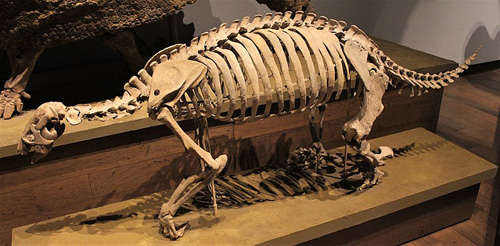
Today, sloths are slow-moving tree-dwelling animals found only in South and Central America. For most of their evolutionary history, however, the majority of sloths have been ground-dwellers, in many cases too large to have climbed a tree even if they had wanted to. In comparison, tree sloths are a relatively recent evolutionary development. 

Ground sloths, however, are not a single type of animal in the strict biological sense. This is because the two-toed and three-toed sloths that we have today are not especially close relatives, last sharing a common ancestor at least 28 million years ago. In fact, tree sloths evolved twice, in separate branches of the sloth family tree, and some ground sloths were more closely related to one or the other. On this basis, we used to divide the ground sloths into two families, but the fact that some of lived recently enough that we can recover and analyse DNA from their fossils gave us some surprising detail and a key 2019 study suggested that we should consider there to be no fewer than six different families of ground sloth.

So whatever we can say about one sort of ground sloth isn't necessarily true of all the others, even on quite a broad scale.

Sunday, 18 December 2022

Prehistoric Mammal Discoveries 2022

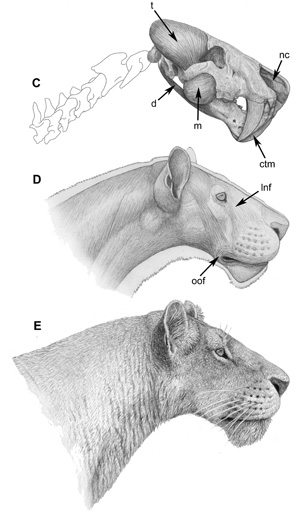
New reconstruction of the sabretooth cat
Homotherium, showing that the teeth
would not have been as visible as popularly
supposed
2022 approaches its conclusion and I have to say that, while far from perfect, it was an improvement on the previous two years. There were a couple of weeks without posts this year, one for positive reasons, and one less so, but overall it has been good. Next year, you can look forward to something other than monkeys in my "family" series of posts and also to the conclusion of the long-running Miocene series, which should be as early as February. Until then, here is the now-traditional year-end look back at the paleontological discoveries that didn't quite make it into the blog.

Large Herbivores

Probably the most distinctive thing about deer is that the males have antlers; branching bony head ornaments that are shed and regrown each year. This naturally raises the question of how this evolved, since no other animal has quite the same thing. Acteocemas was an Early Miocene deer, but despite living very early in the group's evolutionary history, it already had antlers that split into two near the tip - which the horns of animals such as cows and true antelopes never do. A Spanish fossil of the antlers described earlier this year showed that it was already shed and regrown, but microscopic analysis indicated that it appeared to have been present for over a year, suggesting longer a more irregular pattern of shedding that must have changed to the seasonal pattern we are familiar with more recently, perhaps in the Middle Miocene.

Sunday, 17 April 2022

Miocene (Pt 32): Time of the Sea-Sloths

Pronothrotherium
In the absence of the sorts of herbivore more familiar to us today - and already current in the Northern Hemisphere of the day - the large herbivores of Late Miocene South America were nonetheless varied. Many took up habits similar to those of their northern counterparts, so that, at a brief glance, they would not necessarily have appeared so odd to a passing time traveller. 

The mesotheres are a possible case in point. They were a group of notoungulates, one of the two orders of native hoofed mammal that had survived into the Late Miocene along with the litopterns. Earlier in the Miocene, they had perhaps looked even less remarkable, digging herbivores of a similar size and shape to wombats. But as the epoch wore on, they gradually increased in size, while still retaining the adaptations to digging, which they would likely have used to get at tasty roots, and possibly for constructing burrows in which to live.

Sunday, 19 December 2021

Prehistoric Mammal Discoveries 2021

Lesmesodon, a weasel-sized hyenadont.
A new species from Early Eocene France was
 described this year
And so another year approaches its conclusion and the pandemic seemingly isn't done with us yet. I had to self-isolate after a positive test myself for a couple of weeks (no symptoms, though) but if there's one thing that doesn't interrupt, it's blogging, so everything went smoothly here. But now it's time for what's becoming a traditional look at the paleontological discoveries of the past year that didn't get covered here but are worthy of at least a brief mention.

Large Herbivores

When we think of vertebrate fossils, the first thing that pops to mind is almost certainly going to be a skeleton of some kind, or perhaps just part of one. But there are also such things as ichnofossils - fossilised remains of how an animal affected its environment that no longer include any physical part of the animal itself. Perhaps the most obvious of these are fossil trackways - footprints of long-gone animals preserved in mud or other soft material that has since turned to stone. A study published this year examined the tracks left by two species of fossil horse. One of them, a one-toed close relative of the living species inhabiting southern Canada during the Ice Ages, turned out to have been galloping at around 34 kph (21 mph), which is quite fast for its small size (perhaps it was running from something). More significantly, however, the three-toed Miocene horse Scaphohippus was using a relatively unusual gait called the "rack" typically only seen in specialised domestic breeds today. 

Sunday, 20 December 2020

Prehistoric Mammal Discoveries of 2020

The largest known Oligocene whale was
moved into the new genus Ankylorhiza
this year
Well, that year was... different. Fortunately, it didn't stop me posting and, indeed, a cancelled summer break meant that you got one more post than anticipated you lucky people, you. But as 2020 finally passes into the history books where it can bloody well stay, it's time for the end-of-year roundup of paleontological discoveries that didn't make the regular blog. As always, no theme, just a random assortment of journal papers that may, for all I know, be thoroughly contradicted by this time next year. But this is a collection of things that some scientist, somewhere, thinks that they demonstrated in 2020:

Sunday, 27 October 2019

How Sloths Turned Upside Down

One of the things that sloths are noted for is spending a lot of time hanging upside down. This isn't, of course, something they literally spend their entire lives doing; they come down out of the trees to defecate, and they do sometimes travel over the ground - or swim across rivers - to move from one tree to another. They have also been observed, especially in zoos, casually sitting about in what we'd consider a fairly normal posture. But even so, being upside down is how they spend most of their time.

This is obviously pretty odd, from the perspective of a mammal (or, indeed, most other animals). You might think that what must have happened is that, at some point in the distant past, some ancestral tree sloth first headed up into the branches, decided to do so by hanging from them rather than by the more obvious method favoured by (say) primates, and that all of its descendants simply happened to do the same thing. In other words, it's a one-off quirk of evolution.

Except that can't be right.

Sunday, 16 December 2018

Prehistoric Mammal Discoveries of 2018

Gordodon,
a new non-mammalian synapsid described this year
And so another year approaches its conclusion. As usual, I will wrap up here with a post looking at things from a slightly wider perspective. This time around, as I did last year, I am going to take a brief look at a range of scientific papers on fossil mammals that were published in 2018. There's not going to be any particular theme here beyond that, merely a list of things that caught my interest, and that were not, for various reasons, included in the blog proper. So, here we go:

Beginnings and Endings

In the modern day, it's pretty easy to tell mammals and reptiles apart. But, if we go far enough back in time, that eventually ceases to be so true. A common misunderstanding is that mammals evolved 'from' reptiles, but, in reality, mammals and reptiles are separate evolutionary lines that have lived alongside one another since long before there were dinosaurs. At least, that's true if we use the modern definition of 'reptile' since, of course, the animals that mammals really did evolve from would have looked an awful lot like reptiles if we'd been able to see them in the flesh.

Sunday, 16 June 2013

Pleistocene (Pt 9): Before the Bison


Megatherium
The Pleistocene in North America can be divided into three 'land mammal stages', defined by the kinds of animal that inhabited the continent. The first, which was only recently added to the Pleistocene, is the one that comes before the Ice Ages proper, so that the Ice Ages themselves are, as I mentioned in part 8, divided into just two. As I said back then, the first of these starts with the arrival, not only of the ice, but also of the first American mammoths. The second, called the Rancholabrean after the famous tar pits, is much shorter, and essentially refers only to exceptionally bitter cold of the Last Ice Age. In terms of animal life, though, it is defined by the arrival of bison.

Today, when we think of America before the white man arrived, vast herds of bison are often part of our mental picture. And that, on the whole, is pretty much accurate, and is why their first appearance is deemed so significant in the ongoing evolution of North American wildlife. But what was the American wilderness like before there were any bison? What dominated the continent during the earlier, "Irvingtonian", stage?

As always, of course, the most common animals were the smallest. But, important though the teeth of (for example) voles are for the precise dating of geological deposits from this time, the eyes of any time travelling visitor would inevitably have been drawn to much larger animals. Obviously, mammoths and mastodons are a large part of the answer, and the presence of large elephantine animals crossing the plains would have been enough to tell our time traveller that, while he might still be in Kansas, it isn't really the same one he left. But there are many other beasts that would provide just as quick a clue.

Deer, peccaries, and horses are all examples of animals that aren't so unfamiliar today, although in many cases, the exact Pleistocene species were different from those alive now. Horses, for example, had, by this point, evolved to the modern single-toed form, but the last North American native horses died out around 12,000 BC, when the Pleistocene ended, leaving the ancestors of the domesticated forms behind in Asia. Exactly how many species of wild horse there were in America at this time, though, is unclear, with as many as fifty having been named - in my view, it's somewhat unlikely that they're really all distinct. There were, however, at least two broad types, one similar to the modern domestic horse, and the other, the so-called stilt-legged onager (Equus francisci, among others), which looked much more like a wild ass.