Showing posts with label whales. Show all posts

Sunday, 26 October 2025

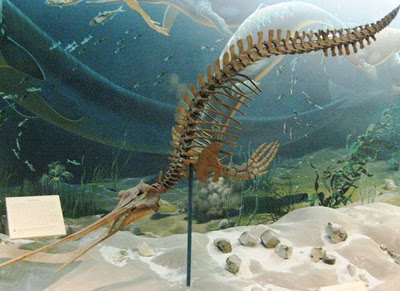
Oligocene (Pt 18): Sawfish-Dolphins and Baleen Whales with Teeth

Olympicetus, a simocetid whale
Although the oldest fossils of seal-like animals may date back to the end of the Oligocene, there are very few of these, and the dating may not be wholly reliable. Whales, however, are a different matter and were already well established even at the beginning of the epoch, 33 million years ago. In fact, the Oligocene marks an important phase in their evolution, since it was at this time that the oldest living groups first appeared and that, potentially, the last common ancestor of all living whales roamed the seas.

Even so, especially towards the end of the epoch, it is possible to place some Oligocene cetaceans into groups we are familiar with today. For example, there was Kentriodon, which is better known from the Miocene, but first appeared in the southern oceans at the tail end of the Oligocene. Although it is not placed in any living family, it is the oldest member of a branch that diverged from the common ancestor of dolphins and porpoises around this time. It likely looked rather similar and had a similar fish-and-squid-based diet.

Sunday, 7 September 2025

Delphinids: Pilot Whales

Long-finned pilot whale
The term "dolphin" is not, strictly speaking, a scientific one. It refers, in common parlance, to any small cetacean, often even including porpoises. Even ignoring the porpoises, however, not all dolphins are members of the dolphin family, technically referred to as "delphinids". This is because some freshwater animals are not closely related to the dolphins proper (or, indeed, to the porpoises). We call them "dolphins" because they're about the right size, a similar shape, and... well, we don't have a better word, at least for them all collectively.

But it works the other way, too. Not all members of the dolphin family are commonly called "dolphins". With the exception of the melon-headed whale, which it's hard to think of as anything other than a dolphin, this is because they're too big. We call them "whales" - another term that doesn't map to anything scientifically - since that's what we call any large cetacean.

Sunday, 26 May 2024

The Vocabulary of Sperm Whales

It's well known that whales and dolphins can communicate using sound, sometimes over long distances. In some cases, this can involve sophisticated "whalesong" that animals can use, for example, to identify each other, and that may impart other information, too. But there are a great many species of cetacean, and what is true for one won't necessarily be true for all of the others, just as what's true of chimps won't always be true for baboons or marmosets.

We'd expect the most complex messages to come from those species with the most complex social lives. In these cases, it would be useful for the animal to identify not only its gender, fitness, sexual status, and so on, but also which other whales it might associate with, and where it stands in the local hierarchy. Most (but not all) cetaceans live in pods although, for many, we haven't gotten very far in identifying how those are structured. They all, however, have relatively large brains and it can be worth asking, for any given species, just how complex their communication really is.

Saturday, 25 November 2023

The First Whales to Use Sonar?

Xenorophus
Other than their obvious physical adaptations, one of the most familiar features of dolphins and whales is their ability to use ultrasound to echolocate. All dolphins, porpoises, and toothed whales (collectively called odontocetes) can echolocate and, while some of the fine details do vary between, say, sperm whales and some of the smaller species, the basic mechanism is much the same. Ultrasound would not have been useful to the large, ground-dwelling ancestors of whales in the same way that it is for bats, so it must have evolved after they entered the water. But how soon after?

We can put some limits on this. At the younger end, since all odontocetes echolocate, it's unlikely to have evolved any later than their last common ancestor, which is estimated to have lived around 34 million years ago. On the other hand, it's notable that the toothless, baleen, whales do not use ultrasound; in fact, they are specialised in the exact opposite direction to produce sounds well below, not above, the range of human hearing. This suggests that they evolved along different lines, and that the origins of ultrasonic echolocation lie somewhere after the two split. 

Sunday, 22 January 2023

Miocene (Pt 37): The Miocene Oceans

Xiphiacetus
Given their extreme adaptations to a life at sea, it should not be surprising that whales and dolphins have a long evolutionary history. Even at the dawn of the Miocene, when seals were at best, only very recent arrivals, and may still have been semi-aquatic, like otters, the cetaceans were already well-established. A time-travelling whale-watching expedition at almost any point during the Miocene would likely have been just as rewarding as one today and, especially so far as one would have been able to see them above the waves, the animals you would have been spotting would not have looked all that different.

At a more detailed anatomical scale, that would have been less true and many of the creatures would not have been as closely related to the modern forms as one might have supposed. Today, the largest number of cetacean species belong to the "true" or "oceanic" dolphin family, including not only all of the sea-going dolphins but some larger animals such as killer whales. But in the Miocene, true dolphins seem to have been comparatively rare and we know of very few fossils predating the subsequent, Pliocene, epoch.

Sunday, 24 July 2022

How Big is a Small Whale?

The ongoing expansion of humanity has placed several animal species under threat of population decline or extinction, whether due to direct effects such as loss of wild spaces or more indirect ones such as climate change. (And a great many of these species are non-mammalian, of course, despite the focus of this blog). On the other hand, there have also been many conservation efforts that aim to restore, or at least preserve, species at risk. As I've previously described, for example, both black-footed ferrets and European bison went completely extinct in the wild during the 20th century, but are now back living in their original native habitats, if only in small numbers.

Not all such restoration efforts have been successful, and there can be many different reasons for this, not all of which are necessarily biological. Better then, of course, to try and prevent species from becoming endangered in the first place. For this reason, many species are protected even if they are not currently at risk. The more we can understand about these species, the better we will be able to keep them that way. 

Sunday, 26 June 2022

I Would Swim Five Thousand Miles...

Breeding can be an energetically costly business, whether that's the effort put into finding and attracting a mate, or that required to raise young. The latter is a particularly important factor in mammals, which can't simply lay eggs somewhere where there's plenty of food and hope that the hatchlings do well for themselves as, say, an insect might be able to. Therefore, we might well expect that mammals will feed more during the breeding season, to compensate for all that extra energy they will be using. 

For males, there can be a downside, in that all the time you are spending finding and eating food is time not spend wooing and mating with females. Thus, in animals such as deer, we may find that males actually eat less during the mating season than they do at other times because their mind is far too much on other things. But females, given the needs of both pregnancy and lactation, ought to be different.

Sunday, 19 December 2021

Prehistoric Mammal Discoveries 2021

Lesmesodon, a weasel-sized hyenadont.
A new species from Early Eocene France was
 described this year
And so another year approaches its conclusion and the pandemic seemingly isn't done with us yet. I had to self-isolate after a positive test myself for a couple of weeks (no symptoms, though) but if there's one thing that doesn't interrupt, it's blogging, so everything went smoothly here. But now it's time for what's becoming a traditional look at the paleontological discoveries of the past year that didn't get covered here but are worthy of at least a brief mention.

Large Herbivores

When we think of vertebrate fossils, the first thing that pops to mind is almost certainly going to be a skeleton of some kind, or perhaps just part of one. But there are also such things as ichnofossils - fossilised remains of how an animal affected its environment that no longer include any physical part of the animal itself. Perhaps the most obvious of these are fossil trackways - footprints of long-gone animals preserved in mud or other soft material that has since turned to stone. A study published this year examined the tracks left by two species of fossil horse. One of them, a one-toed close relative of the living species inhabiting southern Canada during the Ice Ages, turned out to have been galloping at around 34 kph (21 mph), which is quite fast for its small size (perhaps it was running from something). More significantly, however, the three-toed Miocene horse Scaphohippus was using a relatively unusual gait called the "rack" typically only seen in specialised domestic breeds today. 

Sunday, 17 January 2021

Sperm Whale Bromance

While there are a few exceptions, there is a general rule among mammals that males travel far from home when they approach adulthood, while females tend to stay in their local neighbourhood. The purpose of this separation is to ensure that, once they become sexually active, the females that a male is going to have the opportunity to mate with aren't all his own sisters or close cousins. Many mammals live essentially solitary lives, so this is merely an issue of the male travelling further than the female when he leaves home; other than that, their social lives aren't really all that different.

In social species, however, the end result is that herds (or other groupings) are united primarily by their female relationships. The females in a herd are likely sisters or other close relatives, while the males have travelled from elsewhere and are not only not closely related to the females, but may not even be closely related to each other, either. Often males spend some time living on their own before they find a suitable herd to join (perhaps because the existing dominant male is getting on a bit) with the result that there's a distinct female-bias in membership of the group. 

Sunday, 15 December 2019

Prehistoric Mammal Discoveries of 2019

Nehalaennia, an 8 million-year-old rorqual
from the Netherlands, first described this year
As the year - and decade - approach their inevitable conclusion, it's time again to look back at a few palaeontological findings of 2019 that didn't, for whatever reason, make it into the regular Synapsida posts. As always, there is no theme to this list, just a sample of what seemed interesting linked only by when it happened to be published.

Sunday, 20 January 2019

Murderous Whales of the Eocene Oceans

The relationships between what animals eat can be thought of as a pyramid. At the bottom are plants, which are eaten by herbivores, which are eaten by carnivores, which are eaten by larger carnivores. The reality is much more complex, and is more accurately thought of as a web (omnivores exist, large carnivores also eat herbivores, etc.), but the general principle is broadly true. In particular, the further up the ladder you go, the fewer animals there are, since the transfer of energy from one level to the next can never be 100% perfect.

At the top of the pyramid are the "apex predators". These are the carnivores that have no predators of their own, that are able to feed without fear of being eaten themselves. Again, the reality is more complex - an adult of one apex predator might occasionally kill and eat the young of a different kind, for instance. And, of course, everything gets eaten by worms (or whatever) once they're dead. Nonetheless, really big scary predators clearly do exist, even if, by their nature, they aren't very common.

Sunday, 16 December 2018

Prehistoric Mammal Discoveries of 2018

Gordodon,
a new non-mammalian synapsid described this year
And so another year approaches its conclusion. As usual, I will wrap up here with a post looking at things from a slightly wider perspective. This time around, as I did last year, I am going to take a brief look at a range of scientific papers on fossil mammals that were published in 2018. There's not going to be any particular theme here beyond that, merely a list of things that caught my interest, and that were not, for various reasons, included in the blog proper. So, here we go:

Beginnings and Endings

In the modern day, it's pretty easy to tell mammals and reptiles apart. But, if we go far enough back in time, that eventually ceases to be so true. A common misunderstanding is that mammals evolved 'from' reptiles, but, in reality, mammals and reptiles are separate evolutionary lines that have lived alongside one another since long before there were dinosaurs. At least, that's true if we use the modern definition of 'reptile' since, of course, the animals that mammals really did evolve from would have looked an awful lot like reptiles if we'd been able to see them in the flesh.

Sunday, 6 May 2018

Diving for Your Dinner

Dinner!
Cetaceans (whales, dolphins, and porpoises) are the best adapted of all mammals to life underwater. Their food is often found far below the waves, requiring them to dive deep to find it. But this, of course, is countered by the fact that, not being fish, they also have to return to the surface to breathe. The deeper the desirable food happens to be, the longer they will have to dive for just to reach it, and the longer they will have to spend recovering on the surface afterwards - even if the actual feeding time remains the same.

Such pay-offs are arguably particularly important for the huge rorqual whales, which feed by lunging at great masses of krill or other small prey and gulping them down. For them, it really matters that wherever they are diving is rich in food, so that they can find enough to offset the effort required to catch it. Quite how they strike that balance should depend on how good they are at diving, which relates to things such as their lung capacity and how much oxygen they need to sustain their bodies.

Sunday, 18 February 2018

Early Whales of the North Pacific

The majority of living cetacean species belong to a group called the odontocetes, or "toothed whales". Most of them aren't really what we think of as "whales" at all, since the group includes all of the dolphins and porpoises. The group does, however, include a number of much larger species - some of them just really big dolphins, such as the killer whales, but others being less closely related, such as sperm whales, beaked whales, and narwhals.

The odontocetes as a whole stretch back far into the fossil record, with the oldest known examples dating back to around the dawn of the Oligocene epoch 34 million years ago. They rapidly spread across the globe, unhindered by the geographical barriers that often affect more land-based mammals. (The continents were all separate at the time, which would have helped, since it was possible to swim right around the globe without leaving the mid-latitudes).

Sunday, 5 June 2016

Heading South for Supper

Birds are by no means the only animals to make lengthy annual migrations. While most annual migrations by mammals are of the relatively short-distance kind - moving down the side of a mountain as winter approaches, say - some can be surprisingly impressive. To travel a truly long distance, walking is generally not your best bet, so most mammals that do so are not the kind that would travel overland. Given their parallels with birds, perhaps the most obvious mammalian examples are bats. While most sleep away the insect-free winter in a cave, some bats do travel long distances. As just one example, straw-coloured fruit bats (Eidolon helvum) have been reported to travel up to 2,500 km between Congo-Kinshasa and Zambia in search of the best ripe fruit in any given season.

Which isn't up there with the most impressive of the migrating birds, by any means, but isn't exactly a short hop, either. And, if you can't fly, swimming is another option. Indeed, one of the mammalian species that migrates the furthest is the humpback whale (Megaptera novaeangliae), with migrations of up to 10,000 km having been reported.

Humpback whales are, in fact, found just about everywhere on Earth that's covered by seawater, excepting only the Arctic Ocean and some smaller seas with restricted physical access (such as the Mediterranean). Different populations, therefore, can migrate along very different routes. But the pattern is generally the same: they spend the summer in cold waters, where they stuff themselves with krill, and then head towards warmer climes as the winter sets in, giving birth and raising their young over the summer before returning to their feeding grounds.

Sunday, 12 October 2014

The Mysterious Songs of the Blue Whale

The blue whale (Balaenoptera musculus) is, as is fairly known, not only the largest animal alive today, but the largest that has ever lived. Far larger, for instance, than anything that lived during the time of the dinosaurs. Yet, because, like all whales, they are not that easy to study, they remain relatively mysterious, compared with large land-based mammals.

There, however, are a number of different ways in which we can study them, and one of them is to listen to their calls. Like other whales, blue whales produce 'songs' that travel for miles through the deep, and, by listening to them, we can get at least some idea of where they are, and how numerous they are, and perhaps further information besides.

Compared with cetaceans like the humpback whale, the songs of blue whale are not particularly complex - although they remain more so than deep clicking sounds of sperm whales. For the most part, blue whale songs consist of the same element repeated over and over. This element, termed a "Z-call" because of the shape it produces on a spectrograph, has three parts: a long, deep rumble, followed by a rapid dip and then a short, musical tone at an even deeper pitch. The first part is commonly somewhere about the A four below middle-C, which is the very lowest note than can be produced on a grand piano. The last part is about three or four notes lower than that, which is generally considered below the range of normal human hearing.

Sunday, 6 April 2014

Deep Dives to Dark Depths

There are something like ninety species of cetacean, which are usually grouped into fourteen families. Perhaps the most obscure and little known of these families - and among the most obscure of all mammal families - is that of the beaked whales. It's actually quite a large family, with over twenty species, representing almost a quarter of all known cetacean species, and around a half of all those that are noticeably larger than dolphin-sized. And, since they typically weigh a ton or more, they're hardly small themselves.

The main reason we know so little is where they live. These are deep-water animals, that rarely come in close to shore, and so just aren't seen very often. Combine this with the fact that they're mostly of little interest to whalers, and it becomes apparent that studying them is neither easy, nor likely to be commercially motivated.

Sunday, 9 March 2014

Clicking Clans

There are two broad types of whale alive today: those with teeth and those without. Generally speaking, it's the members of the latter group that are physically larger: these are the great filter-feeding, krill-slurping, baleen whales. The toothed whales, in contrast, tend to be much smaller. The biological group of toothed "whales", after all, includes dolphins, porpoises, and all their strange fresh-water relatives. Even the big ones, such as killer whales, are smaller than the great majority of baleen whales.

But there is an exception, and its by far and away the largest of all the toothed whales. This is, of course, the sperm whale (Physeter macrocephalus), and, while it's merely average when compared with the great baleen whales, at up to 50 tons in weight, it's nothing to be sniffed at. (The second-largest, incidentally, is probably the relatively obscure Baird's beaked whale, at 12 tons, which is itself about half again the weight of the animal in the #3 spot).

Thursday, 22 November 2012

News in Brief #7

Geoffroy's spider monkey
Monkey Sleep, Monkey Poo

Poo is useful stuff to zoologists: a lot of field work involves examining the stuff. It can tell you what an animal has been eating, how it behaves, and maybe something about it's genetics. And, of course, it can also tell you where it's been. Take Geoffroy's spider monkey (Ateles geoffroyi), for example.

Spider monkeys are moderately sized monkeys, noted for their prehensile tails and remarkable agility. I saw some (although not Geoffroy's species) at London Zoo on Monday, and, despite the poor weather, they really were a delight to watch, full of enthusiasm and energy. Seeing them at play, it's hard to escape the impression that they have five arms: their feet are effectively an extra pair of hands, and their tail is so flexible and has such a good grip that it might as well be a fifth one.

They live, unsurprisingly enough, up in the trees - specifically ones in Central America - sleeping in them at night and travelling between them to feed during the day. They have particular favoured trees to sleep in, and deposit a lot of dung at the base over the course of the night. Such 'latrine' use is common among many mammals, and just finding where they are provides a good means of establishing what the monkeys are up to without having to disturb them.

Sunday, 20 November 2011

When Whales Walked the Land

Protocetus, a close relative of the new species
The Eocene, the second epoch of the Age of Mammals, was a time of many strange creatures. The mammals were well established by this point, but few of the modern groups of mammal we are familiar with had yet evolved, and those that had did not necessarily look the same as they do today. Take the whales, for example:

Today, there are two basic types of whale. The odontocetes, or toothed whales, are the largest group, and include the porpoises and dolphins, as well as several larger species, including the mighty sperm whale. The other group are the mysticetes, or baleen whales, which have no teeth, and are instead filter feeders. This latter group includes the right whales and, perhaps most famously, the blue whale, which, so far as we know, is the largest animal ever to have lived.

Both of these groups first appeared at the end of the Eocene, but in those days, they shared the seas with a third, older, type of whale, that would die out during the following, Oligocene, epoch. These were the archaeocetes, and they include the original whales from which all the others later evolved.