.png) |
| Computer reconstruction of the skeleton of the Miocene right whale Megabalaena, published this year |
Large Herbivores
Land mammals don't come much larger than mammoths, and such animals, and their mastodon relatives, have shaped the world around them through their mere presence and the food they chose to eat. A study on southern mammoths (Mammuthus meridionalis) uncovered at a million-year-old site in northern Spain showed that the climate at the time was already Mediterranean, a warm gap within the Ice Ages, causing them to feed more on grasslands than trees. While hyenas had fed on some of the carcasses, they were not alone, as the evidence also shows clear signs of butchering with stone tools.
Elsewhere, a new study found that the South American gomphothere, Notiomastodon, which had entered the continent when the Panama Land Bridge formed, had a diet rich in fruit. When they went extinct as the climate warmed 10,000 years ago, their disappearance spelt trouble for the plants with large, fleshy fruit that had relied on them for seed dispersal.
But if Spain had a reasonably modern Mediterranean climate one million years ago, that obviously didn't last. Although we know they must have existed earlier, until this year, the oldest known cold-adapted mammals from Spain dated to no more 190,000 years ago, during the second-to-last Ice Age. This year, however, a reindeer tooth was described from the country that could date back as far as 300,000 years, during the Ice Age prior to that - it's the most southerly known reindeer fossil ever discovered.
On the subject of deer, a new analysis of the DNA of the Toronto Subway deer (Torontoceros hypogaeus) discovered during the construction of the eponymous transport system suggested that, while undeniably a distinct species, it might be more closely related to the living white-tailed deer than previously thought. It lived in open habitats, and was driven to extinction at least partly by the spread of the forests that now cover the area.
Studies of isotope ratios in the short-legged hippo-shaped rhinceros Teleoceras from Nebraska showed that they lived in much in the same areas throughout their lives, not migrating, or even moving as far as we would expect when they reached adulthood and left their parents. This may have been because they relied on habitats with plenty of water to wallow in, and they just couldn't find them elsewhere. Over in eastern Siberia, the longest ever fossilised horn from a woolly rhino (Coelodonta antiquitatis) was described; it was over 164 cm (65 inches) long, far larger than those of any living rhino.
Fossils are not necessarily of things like bones and horns, however. This year, the oldest known fossilised cowpat was described from 20 million-year-old deposits, also in Nebraska. At least it looks like a cowpat - it's about the right size and shape, and it's obviously dung - but cows didn't exist that far back, and, honestly, neither did anything closely related to them. So, probably a ruminant of some sort, but what kind will likely always remain a mystery.
Carnivores
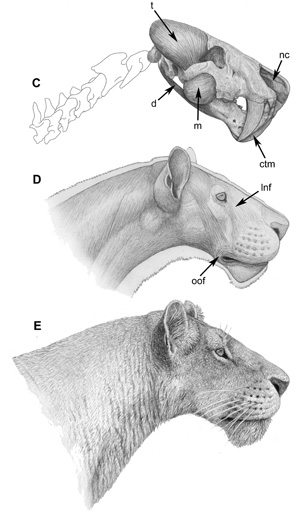
Europe is devoid of big cats today, unless you count the occasional lynx. This was not always so, however, and a publication this year expanded the range of the European jaguar (Panthera gombazagoensis) to Poland and to Suffolk in England between 700,000 and 350,000 years ago. Another large cat, the famous sabretooth Smilodon fatalis, was discovered further south than ever before - in Uruguay.
We already knew about leopards (the modern species) in the Pyrenees during the Ice Ages, but their fossils are rare. A new study of their overall distribution and history showed that they became steadily larger as the Pleistocene wore on, and also that males and females were more similar in size than in living members of their species. Moreover, they showed a preference for mountainous habitats, and their body shape shifted towards that of modern snow leopards prior to their local extinction.
The largest mammalian carnivore during the Ice Ages in North America was the giant short-faced bear (Arctodus simus), with some individuals estimated to have weighed up to 950 kg (2,000 lbs). However, some fossils were significantly smaller than this and had been suggested to represent a distinct subspecies. Genetic analysis this year was unable to find any significant differences between the larger and smaller specimens except for one: all the large ones were male, and the small ones female...
And, well, yes, I should probably mention this, since it was all over the news. This year, a company claimed to have returned the dire wolf (Aenocyon dirus) from extinction, in the form of three, rather cute, white puppies. Almost nobody outside the company with any expertise agrees that this is really what they have done, simply adding a few dire wolf-like genes to what are rather obviously grey wolves.
Cetaceans are also carnivores, although descended from creatures that were not. An analysis of the skull of the very primitive dolphin-sized Protocetus showed that it had already developed the large brain that cetaceans are known for today but, more importantly, that it still had a keen sense of smell. Modern whales and dolphins have no use for smell but Protocetus likely spent at least some of its time on land, giving it a very different lifestyle.
Among more recognisable whales, Idiophorus is either the most primitive known sperm whale or a close relative of their last common ancestor. Recovered from Miocene age deposits in Patagonia, it had a long snout shaped like a wine bottle (so hardly like a modern sperm whale) and was around 6.6 metres (22 feet) in length. The key fossil was thoroughly re-examined this year for the first time since it was uncovered in the 19th century, revealing that it was a deadly predator feeding on relatively large vertebrate prey, unlike other known sperm whale species living in the area at the time.
At the other end of the Americas, and a few million years earlier, Fucaia was a Canadian whale belonging to a now-extinct group. Analysis of a well-preserved fossil this year showed that, like Idiophorus, it was an agile and active predator, although, partly because it was rather smaller, its hunting style was probably most like that of a modern sea lion. Despite this, its closest living relatives include the toothless krill-feeding baleen whales.
Other Placentals
Glyptodonts were gigantic relatives of armadillos, their heavy armour plating making them the mammalian equivalent of tanks. A study this year provided the first analysis of damage to that armour in three South American species, adding to those already performed on more common ones. It also confirmed that, like certain dinosaurs, they likely did wallop each other with the clubs on their tails, likely while competing for mates or territory.
Ground sloths have a long evolutionary history, much larger relatives of the small(ish) tree-dwelling animals that are their only remaining close relatives. A new analysis shows how they gradually increased in size as the climate shifted, but that, probably to the surprise of few people, it was not climate change that eventually drove them to extinction, but the arrival of humans.
Look at any reconstruction of a ground sloth, and it will inevitably show a large, somewhat shaggy animal. But it had been argued that, like elephants and rhinos, the largest ground sloths may not have had much fur at all, being so big that they did not lose much body heat anyway. It was a minority view, but geochemical analyses and simulations published this year seem to put the nail in its coffin. Given the relatively cool environments in which they lived, the simulations suggest that even the largest species would have needed a pelt of fur 10mm (0.4 inches) thick, and some would have needed fur three to five times that long. This, despite the fact that palaeothermometric analysis in the same study showed that they had unusually low body temperatures for their size.
Several studies this year took a look at the development of increasing brain size during primate evolution - primarily monkeys and apes. They did not all come to the same conclusions, which, while they don't necessarily contradict one another, either, suggests that there was probably a lot going on rather than one single answer. One study pinpoints visual processing as the main factor, with visual parts of the brain becoming disproportionately large before the rest caught up, something that would make sense for an animal that had to navigate through tree branches.
Another points to socialisation, with parts of the brain responsible for some of our most complex behaviour starting to enlarge early on. A third points out that brain enlargement correlates, to some extent, with the elongation of our thumbs (which are obviously very different from those of most non-primates), implying that fine manipulation of objects may have been another key element in the drive for greater intelligence.
Going further back in time, another study this year challenged the traditional view of primates originating in tropical jungles. Instead, it suggests that the very first primates appeared in cold and temperate habitats in the north, the changeable climates of such areas promoting the evolution and dispersal that allowed them to reach the tropics later on.
Among the rodents, analysis of a new fossil and comparison to others already known shed light on the origins of the group that includes the gophers. The fossil belongs to an unusually large relative of the ancestor of gophers and kangaroo rats, and seems to have already been a skilled digger. This supports existing theories that the ancestral gopher looked like, and had a similar lifestyle to, today's pocket mice.
An unusually complete fossil free-tailed bat found north of Marseilles in France dates back over 30 million years to the Early Oligocene. The shape of the wings and muscular anchors in the body shows that it was fast and capable of sustained flight, probably catching insects in the air as it flew over what was then a large lake.
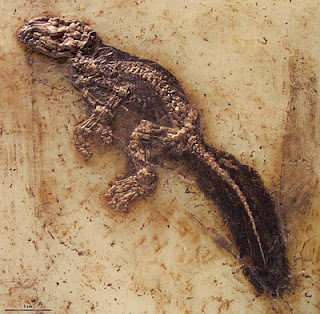
Conoryctes was a medium-sized burrowing mammal living in North America just 3 million years after the extinction of the non-avian dinosaurs. It's probably a placental mammal, but it has been argued that it may actually be an early relative that's simply closer to true placentals than to marsupials. A study of the microscopic structure of its bones shows that it must have grown rapidly, reaching adult body size in a single year and that it would have been weaned at about the age we would expect for a true placental of its size. So even if, by some chance, it wasn't literally a placental mammal, it lived very much like one.
Marsupials and More
The best-known and distinctive marsupial species are probably the kangaroos and wallabies. All but one living species belong to a subfamily that spread through Australia starting around 11 million years ago. The oldest known fossil belonging to this subfamily belongs to Dorcopsoides, which may hold some clues as to why the group became so succesful on their home continent. A new analysis published this year found that it was a more efficient hopper than had previously been thought, suggesting that it was already adapted to open environments, something that was just starting to become more common at the time, as the Australian outback began to dry out.
It may have helped that, as another new analysis of the wear patterns on their teeth showed, Ice Age kangaroos had a wider diet than was apparent from their anatomy alone. On the downside, if they were adaptable, the fact that so many kangaroo species went extinct around 40,000 years ago is probably not primarily due to the change towards a colder climate...
While fairly detailed DNA analysis is possible for mammoths and other Ice Age animals preserved in permafrost, it is much harder for animals of similar age in warmer climates. A new study this year therefore used the molecular structure of collagen from sinews and other tissue to confirm the relationships between some of the marsupials that went extinct in the last 100,000 years. Perhaps the most significant finding was that the closest living relative of the extinct carnivorous marsupial lion Thylacoleo may be the koala, rather than it being an earlier relative of the koala-wombat common ancestor.
On the subject of carnivorous marsupials, these were at least as prominent in South America in prehistoric times, dominated in particular by the large sparassodonts. A new analysis of the skulls of South American marsupials this year showed that, while most had similarly shaped (elongated) brains to modern marsupials, that of the sabretooth marsupial Thylacosmilus was more rounded, due to its shorter, cat-like face. More significantly, revised estimates of its body weight showed that its brain was smaller than previously thought, in the range of some of its earliest ancestors, its size having evolved less than expected.
Similar analysis of an armbone belonging to the mysterious mammal Kryorectes confirmed that it was, as previously thought, a monotreme. Living alongside Australian dinosaurs a whopping 106 million years ago - 40% further back in time than Tyrannosaurus rex - the study also showed that it was probably a semiaquatic burrowing animal. The platypus lifestyle may be truly ancient.
Finally, the multituberculates were neither placental, marsupial, nor monotreme but a fourth grouping that survived well into the Age of Mammals. An analysis this year of their habitats and distribution across North America suggested that, at least on that continent, they were restricted to damp temperate forests dominated by redwoods and swamp cypress and that they finally disappeared when those forests dramatically declined as the world cooled at the end of the Eocene. This contradicts the popular theory that it was competition with newly arrived rodents that killed them off, since they were apparently living elsewhere at the time.
Synapsida is taking a break for the holiday period and will return on the 4th January
[Image from Yanaka et al. 2025, available under CC-BY-4.0]