Showing posts with label baleen. Show all posts

Sunday, 26 October 2025

Oligocene (Pt 18): Sawfish-Dolphins and Baleen Whales with Teeth

Olympicetus, a simocetid whale
Although the oldest fossils of seal-like animals may date back to the end of the Oligocene, there are very few of these, and the dating may not be wholly reliable. Whales, however, are a different matter and were already well established even at the beginning of the epoch, 33 million years ago. In fact, the Oligocene marks an important phase in their evolution, since it was at this time that the oldest living groups first appeared and that, potentially, the last common ancestor of all living whales roamed the seas.

Even so, especially towards the end of the epoch, it is possible to place some Oligocene cetaceans into groups we are familiar with today. For example, there was Kentriodon, which is better known from the Miocene, but first appeared in the southern oceans at the tail end of the Oligocene. Although it is not placed in any living family, it is the oldest member of a branch that diverged from the common ancestor of dolphins and porpoises around this time. It likely looked rather similar and had a similar fish-and-squid-based diet.

Sunday, 19 December 2021

Prehistoric Mammal Discoveries 2021

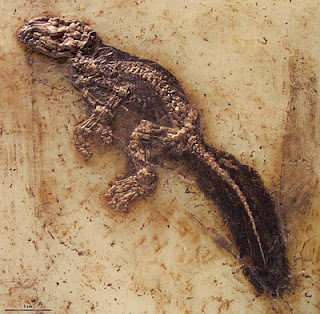
Lesmesodon, a weasel-sized hyenadont.
A new species from Early Eocene France was
 described this year
And so another year approaches its conclusion and the pandemic seemingly isn't done with us yet. I had to self-isolate after a positive test myself for a couple of weeks (no symptoms, though) but if there's one thing that doesn't interrupt, it's blogging, so everything went smoothly here. But now it's time for what's becoming a traditional look at the paleontological discoveries of the past year that didn't get covered here but are worthy of at least a brief mention.

Large Herbivores

When we think of vertebrate fossils, the first thing that pops to mind is almost certainly going to be a skeleton of some kind, or perhaps just part of one. But there are also such things as ichnofossils - fossilised remains of how an animal affected its environment that no longer include any physical part of the animal itself. Perhaps the most obvious of these are fossil trackways - footprints of long-gone animals preserved in mud or other soft material that has since turned to stone. A study published this year examined the tracks left by two species of fossil horse. One of them, a one-toed close relative of the living species inhabiting southern Canada during the Ice Ages, turned out to have been galloping at around 34 kph (21 mph), which is quite fast for its small size (perhaps it was running from something). More significantly, however, the three-toed Miocene horse Scaphohippus was using a relatively unusual gait called the "rack" typically only seen in specialised domestic breeds today. 

Sunday, 16 December 2018

Prehistoric Mammal Discoveries of 2018

Gordodon,
a new non-mammalian synapsid described this year
And so another year approaches its conclusion. As usual, I will wrap up here with a post looking at things from a slightly wider perspective. This time around, as I did last year, I am going to take a brief look at a range of scientific papers on fossil mammals that were published in 2018. There's not going to be any particular theme here beyond that, merely a list of things that caught my interest, and that were not, for various reasons, included in the blog proper. So, here we go:

Beginnings and Endings

In the modern day, it's pretty easy to tell mammals and reptiles apart. But, if we go far enough back in time, that eventually ceases to be so true. A common misunderstanding is that mammals evolved 'from' reptiles, but, in reality, mammals and reptiles are separate evolutionary lines that have lived alongside one another since long before there were dinosaurs. At least, that's true if we use the modern definition of 'reptile' since, of course, the animals that mammals really did evolve from would have looked an awful lot like reptiles if we'd been able to see them in the flesh.