Showing posts with label cave lion. Show all posts

Sunday, 19 December 2021

Prehistoric Mammal Discoveries 2021

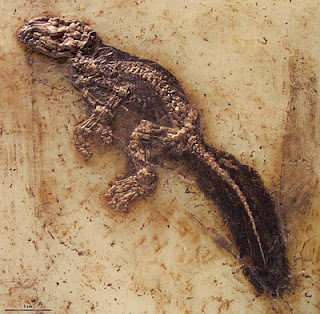
Lesmesodon, a weasel-sized hyenadont.
A new species from Early Eocene France was
 described this year
And so another year approaches its conclusion and the pandemic seemingly isn't done with us yet. I had to self-isolate after a positive test myself for a couple of weeks (no symptoms, though) but if there's one thing that doesn't interrupt, it's blogging, so everything went smoothly here. But now it's time for what's becoming a traditional look at the paleontological discoveries of the past year that didn't get covered here but are worthy of at least a brief mention.

Large Herbivores

When we think of vertebrate fossils, the first thing that pops to mind is almost certainly going to be a skeleton of some kind, or perhaps just part of one. But there are also such things as ichnofossils - fossilised remains of how an animal affected its environment that no longer include any physical part of the animal itself. Perhaps the most obvious of these are fossil trackways - footprints of long-gone animals preserved in mud or other soft material that has since turned to stone. A study published this year examined the tracks left by two species of fossil horse. One of them, a one-toed close relative of the living species inhabiting southern Canada during the Ice Ages, turned out to have been galloping at around 34 kph (21 mph), which is quite fast for its small size (perhaps it was running from something). More significantly, however, the three-toed Miocene horse Scaphohippus was using a relatively unusual gait called the "rack" typically only seen in specialised domestic breeds today. 

Sunday, 2 August 2020

Were 'Cave Lions' Really Lions?

A theme that crops up on this blog every now and then is that some animal that many people probably assume is a single species is actually two or more. There are, for example, three species of zebra, three jackals, and seven different kinds of musk deer. The lion (Panthera leo) is not one of these animals; there really is only one species alive today - and it's been around for a long, long time.

I remember a few years ago, at London Zoo, I happened to be passing the lion enclosure when one of the keepers was giving a talk. The lions at the zoo were obtained from the Gir Forest in Gujarat, India, rather than being the African sort. The keeper repeatedly referred to "this species" of lion when, for example, he was indicating how much more endangered the Indian population is than the African one.

Saturday, 29 September 2018

Lions in the Carpathians

When I last talked about Eurasian cave lions, back in 2013, I said that there was some debate as to whether they were a distinct species, or just an unusual subspecies of the modern, living, lion. Although the issue is, perhaps, still not entirely resolved, it's probably fair to say that the clear majority opinion these days is that they were a separate species (Panthera spelaea).

This swing in opinion has been helped by new genetic data, something that we can obtain because the animals died out so recently - around 12,000 BC by most estimates. Specifically, an analysis published in 2016 was able to obtain the full mitochondrial genome of a pair of cave lions, allowing a more detailed genetic analysis than ever before. This showed that, as expected based on earlier studies, cave lions really were "lions" in the sense that they were more closely related to modern lions than thy were to, say, leopards.

Saturday, 26 January 2013

Pleistocene (Pt 6): Lions, Hyenas, and Bears, oh my

Cave lions
(original artist unknown, c. 33,000 BC)
The iconic Ice Age carnivore is, of course, the sabretooth cat. However, as I mentioned when discussing the Mid Pleistocene, sabretooth cats when extinct in Europe well before the Last Ice Age. (Well, maybe not... but at any rate, they seem to have been very rare). So what were the dominant predators in Europe during that final, and most extreme, period of intense cold?

It probably depends on how small a predator you're willing to count. Animals like weasels, stoats, and shrews were presumably very numerous, even if their skeletons are often too delicate to preserve well. Moving up the scale, the most numerous carnivoran fossils from the time belong to foxes. Both the modern red fox and the Arctic fox were widespread in central Europe at the time, although the latter was presumably more comfortable.

Another modern animal that we wouldn't be surprised to find among the snowy forests and open tundra was the grey wolf. Indeed, grey wolves may well have originated in Europe from an American ancestor, before heading back over the Bering land bridge. If so, they were probably quite quick about it, since they are found across the Arctic on both sides of the Pacific from an early date.

All of these are creatures that are still found in Europe today, although not necessarily in large numbers - wolves are more common in the wilds of Asia and North America than they are in densely settled Europe. But I've been harping on through this series about how "African" European wildlife looked at the time, and that's as true of the big carnivores as it is of herbivores such as elephants/mammoths and rhinos. One of the clearest instances of this is the presence in Pleistocene Europe of lions.