Showing posts with label sloths. Show all posts

Sunday, 14 December 2025

Prehistoric Mammal Discoveries 2025

Computer reconstruction of the skeleton of the Miocene
 right whale Megabalaena, published this year
As another year draws to a close, it's time to take another dash through the mammalian palaeontological findings of the last twelve months. As always, this will be a rapid survey of some discoveries that I find particularly interesting without any detailed discussion, but hopefully covering as wide a range of prehistoric mammals as I can.

Large Herbivores

Land mammals don't come much larger than mammoths, and such animals, and their mastodon relatives, have shaped the world around them through their mere presence and the food they chose to eat. A study on southern mammoths (Mammuthus meridionalis) uncovered at a million-year-old site in northern Spain showed that the climate at the time was already Mediterranean, a warm gap within the Ice Ages, causing them to feed more on grasslands than trees. While hyenas had fed on some of the carcasses, they were not alone, as the evidence also shows clear signs of butchering with stone tools.

Sunday, 15 December 2024

Prehistoric Mammal Discoveries 2024

Zalamdalestes
I have reached the end of another year and that means it's time for what has become a tradition on this blog over the last eight years: a look back at some of the discoveries about fossil mammals made in 2024 that didn't make into the regular posts. As usual, this will be a quick whistle-stop tour of mammalian palaeontology, hopefully focusing on some of the more interesting findings. Like any field of science, it has not been standing still.

Large Herbivores

Woolly mammoths (Mammuthus primigenius) are among the best-known of all prehistorical mammals to the general public and, aided by the fact that some lived recently enough to be preserved in permafrost, they are also amongst the best-studied. But there is still more to learn about the details of their lives and habits. A study published this year looked at the detailed isotopic composition of a fossil mammoth that had died about 12,000 BC in Alaska, showing that she was female, and had migrated over 1000 km (600 miles) during her lifetime, having originally been born in the Yukon. The area in which she died was popular with mammoths, but also with humans - she may have died peacefully, but the presence of people where mammoths congregated may not be a coincidence.

Sunday, 18 December 2022

Prehistoric Mammal Discoveries 2022

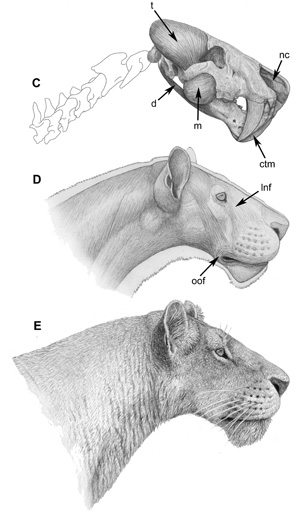
New reconstruction of the sabretooth cat
Homotherium, showing that the teeth
would not have been as visible as popularly
supposed
2022 approaches its conclusion and I have to say that, while far from perfect, it was an improvement on the previous two years. There were a couple of weeks without posts this year, one for positive reasons, and one less so, but overall it has been good. Next year, you can look forward to something other than monkeys in my "family" series of posts and also to the conclusion of the long-running Miocene series, which should be as early as February. Until then, here is the now-traditional year-end look back at the paleontological discoveries that didn't quite make it into the blog.

Large Herbivores

Probably the most distinctive thing about deer is that the males have antlers; branching bony head ornaments that are shed and regrown each year. This naturally raises the question of how this evolved, since no other animal has quite the same thing. Acteocemas was an Early Miocene deer, but despite living very early in the group's evolutionary history, it already had antlers that split into two near the tip - which the horns of animals such as cows and true antelopes never do. A Spanish fossil of the antlers described earlier this year showed that it was already shed and regrown, but microscopic analysis indicated that it appeared to have been present for over a year, suggesting longer a more irregular pattern of shedding that must have changed to the seasonal pattern we are familiar with more recently, perhaps in the Middle Miocene.

Sunday, 27 October 2019

How Sloths Turned Upside Down

One of the things that sloths are noted for is spending a lot of time hanging upside down. This isn't, of course, something they literally spend their entire lives doing; they come down out of the trees to defecate, and they do sometimes travel over the ground - or swim across rivers - to move from one tree to another. They have also been observed, especially in zoos, casually sitting about in what we'd consider a fairly normal posture. But even so, being upside down is how they spend most of their time.

This is obviously pretty odd, from the perspective of a mammal (or, indeed, most other animals). You might think that what must have happened is that, at some point in the distant past, some ancestral tree sloth first headed up into the branches, decided to do so by hanging from them rather than by the more obvious method favoured by (say) primates, and that all of its descendants simply happened to do the same thing. In other words, it's a one-off quirk of evolution.

Except that can't be right.

Sunday, 12 November 2017

Sex in the Slow Lane

There are many different mating systems in use across the animal kingdom, but the one that is most common among mammals is polygyny. In this system, one male mates with multiple females, typically because he won't let other males anywhere near them. From an evolutionary perspective this makes sense, since a male can sire offspring with multiple partners simultaneously, while females are limited by the size of their litters, and the effort required to look after the resulting young (which is more of a consideration for mammals than it is, for example, for most fish).

In fact, it has been estimated that something like 90% of all mammal species practice polygyny to at least some degree. There are, of course, other options. For example, where it takes a particularly large amount of effort to look after young, it may really help if the male assists in doing that, something that naturally tends to favour monogamy. This is the case among humans, where childcare is both lengthy and arduous, so that two parents are better than one, where this can be managed. However, it has been observed that not all male humans are 100% loyal to their spouses (I hope this isn't too big a shock) so that monogamy isn't the absolute rule that it might be.

The same thing happens with other mammal species. The species as a whole might be polygynous (or whatever), but that doesn't mean that every single individual always follows the usual pattern.

Sunday, 13 September 2015

A Forest Fit for Sloths

One of the main problems facing the continued survival of wild animal species across the world is loss of habitat. (Naturally, this goes for all kinds of animals, and plants, too, even if we're mainly interested in mammals here). As humans expand in numbers and push into the wilderness, we turn a lot of it into farmland to feed ourselves, use it for logging or mining, or simply build roads across it. The animals that are least concerned about this are those that we have domesticated, whether as pets or as livestock, with supremely adaptable generalists such as rats and pigeons following not far behind.

At the opposite extreme, of course, are the specialists, those that require one very specific sort of land to live in. In between there are a great spectrum of other animals, that can cope with some change, but not too much, that find orchards and plantations a reasonable substitute for forest, and so on. If we're interested in conserving particular animals, one of the first things we need to understand is just what their requirements are.

Even then, it's not enough to know that a particular animal "likes forests". What kind of forests? Do they really have to be primeval and untouched, or are there are at least some viable alternatives? Are there, perhaps, particular parts of the forest that they like more than others? In the grand scheme of things, just leaving stuff alone is probably the best answer from a conservation perspective, but, since human numbers aren't going to start falling any time soon, compromise is often inevitable. So the question then becomes: on what can we compromise?

Sunday, 6 September 2015

A History of the Strange-Jointed Beasts

All living species of mammal fall into one of three major groups, representing the lowest branches of the mammalian family tree: the placental mammals, the marsupials, and the bizarre, egg-laying, monotremes. Well over 90% of identified living species fall into the first of those groups, which prompts the interesting question of how we divide those up - what, in short, are the next branches on the tree?

In the strict, old-style, system of classification, the next major level down is that of the "order", groups of broadly similar creatures that are in turn, divided into more than one hundred "families". Primates, for instance, are an order.

What the orders are, and how many of them there might be, has varied a little down the years, but nineteen or twenty would be a good, modern estimate. But, of course, the orders themselves are entirely arbitrary, and, even if they weren't, it isn't as if they all sprang simultaneously from the same stock. In evolutionary terms, there must have been some early branches in the placental family tree from which the "orders" that we know today descended.

The question of how to group the orders together into some higher level pattern is one that mammalogists have been been pondering for well over a hundred years. The problem is that the orders are pretty distinctive - is a moose more like a wolf than it is a monkey? When all you have to go in is physical anatomy, these are not the simplest questions to answer, and it's not surprising that people have come up with different answers.

Sunday, 15 May 2011

When Sloths Roamed the Grasslands

The Altiplano - where ground sloths may once have grazed
I've mentioned before that the living tree sloths are the last remnant of a much larger group of ground-living animals. These animals originated in South America during the long time that that continent was an island, connected only to Antarctica. Eventually, the land mass collided with North America, bringing with at an array of more modern mammals, such as foxes, deer, and cats, as well as a few that have died out elsewhere since, like tapirs and llama.

The ground sloths actually did reasonably well after the other mammals arrived, and a very wide array of fossil species are known, the last of them having died out as recently as 9000 BC. Indeed, they crossed Central America heading in the other direction, leaving fossils in the northern continent, and at least one species, Megalonyx, even crossed the Arctic Circle to live in the cold wastelands of northern Canada. Many inhabited forests, but others preferred grasslands, or even semi-desert, while Thalassocnus may have been semi-aquatic. There was also a huge range of different sizes, from some that were barely larger than modern tree sloths, up to the multi-ton Megatherium.

Sunday, 3 October 2010

Ground Sloths and the Size of Fossils


The sloths are among the stranger groups of mammals, belonging to a lineage that split off from all other placental mammals probably even before the dinosaurs went extinct. They originated in South America, a continent that was, for a long time, as isolated as Australia is today. Just as marsupials survived in Australia, so a number of strange and early placentals survived in South America (as did some marsupials, come to that). Of course, South America eventually joined itself up to North America, and a great number of odd animals went extinct as more familiar forms crossed the Panama land bridge heading south. The sloths, however, survived - or, at least, some of them did.

Today, there are only six living species of sloth, all of which are tree-dwelling animals. Their ancestors lived not in trees, but on the ground, and many of them were much, much, bigger than those that live today. The last of these giant ground sloths died out remarkably recently, perhaps around 9000 BC, meaning that they must have lived alongside humans for thousands of years.

Perhaps the best known ground sloth is the largest one, Megatherium, which reached the size of an elephant. But there were a number of others, many of which were still quite substantial. In zoological terms, the ground sloths aren't even a real group; this is because they just represent those sloths that didn't happen to head up into the trees, and they aren't all directly related. Instead, the ground sloths form a number of different families, with at least some being more closely related to one or other of the families of living tree sloth than to each other.