Sunday, 13 May 2012

Weasels in Cool Rivers: The Common Otters

Eurasian otter
The otters are, arguably, the least weasel-like of all the members of the weasel family. Although the relationship has been clear for a long time - the first scientific description of an otter, by Linnaeus in 1758, actually placed it in the genus Mustela, to which stoats and weasels belong - so have the differences. As early as 1771, Danish zoologist Morten Thrane Brünnich split them off from their fellow mustelids, erecting the new genus Lutra to describe them.

By 1838, at least three genera of otter had been described, and the group were raised to 'subfamily' status to distinguish them from their terrestrial kin. Other subfamilies were erected later, largely to distinguish the badgers, but the otters have remained as a clearly distinct group within the overall weasel family.

Genetic studies in the last four years have given us a much clearer picture of how the various kinds of mustelid are related to one another, and it turns out to be more complicated than we thought. For example, martens turn out to have been around longer than otters have, which was something of a surprise. The otters, however, survived the revision unscathed, confirmed as a genuine evolutionary group, albeit one that is younger than we might have guessed. Their closest relatives within the family turn out to be the mustelines, the group that, among others, includes the semi-aquatic mink.

Sunday, 6 May 2012

Dugongs of Italy

Metaxatherium floridanum, a Caribbean species
Three different orders of mammal include at least some species that have returned to the sea. Of these, perhaps the best adapted at the cetaceans, including the whales and dolphins. All cetaceans are carnivores, feeding on various aquatic animals, ranging in size from krill to their fellow cetaceans, and often doing so far from land. Similarly, seals and some species of otter spend much of their lives at sea, and they, too, are carnivores - mostly feeding on fish, although some tackle other prey, such as penguins. This is unsurprising because, aside from plankton, there isn't generally a lot of plant matter far out at sea, and mammals generally aren't as good at eating plankton as fish are.

But the third group of truly aquatic mammals are, in fact, herbivorous. These are the sirenians, and there are only four species alive today. Three belong to the manatee family, including one species that lives off the southeastern coast of America. The fourth is the dugong (Dugong dugon), an inhabitant of coastal waters around the Indian Ocean and into the western Pacific. The dugong is the only living member of its family, and, like manatees, it inhabits shallow waters because there, the sunlight can reach the seabed and permit the growth of the seagrasses that it eats.

Sunday, 29 April 2012

Does Colder Mean Bigger?

Amne Machin, Qinghai
In 1847, German biologist Christian Bergmann formulated what has since become known as Bergmann's Rule. Over the following 165 years, the Rule has been somewhat modified and re-interpreted from Bergmann's original statement, but a common modern version is that warm-blooded animals tend to be larger the colder the environment they live in. Bergmann was originally thinking of closely related species; for example, polar bears tend to be larger than most brown bears. However, the rule is now often applied to individuals and populations within species; for instance, Siberian tigers are larger than those that live in the tropics.

The rule has, as I've noted before, been the focus of some controversy. Is it, in other words, actually true? Certainly, there are many counter-examples - snow leopards are the smallest cats in their genus, for example. But are these rare exceptions to a general rule?

Sunday, 22 April 2012

Making your Mark

For most humans, the dominant sense is that of vision. Although the other senses are important, vision is particularly important to us, and it is generally well-developed in other primates, too, perhaps because most of them spend a lot of their time swinging through trees, where a good idea of the location of nearby branches is definitely helpful. But, for most mammals, the sense of smell is much better developed than it is in us, and far more important to the way they interpret the world.

One of the many ways that they make use of this is through scent marking. Apart from those that spend most of their lives in the water, the great majority of mammals scent mark in some way, and humans are a bit of an oddity in this respect. To assist them in scent marking, many mammals possess special glands producing smelly secretions that they can place on prominent landmarks, or in other locations that fellow members of their species might come across. And, of course, any cat or dog owner is familiar with the concept of using urine as a mark - the urine contains unique chemicals that can provide far more information to the animals concerned than it does to us.

The actual purpose of scent marking varies depending on the nature of the animal, and, particularly, its lifestyle and habits. For many animals, it can be used to stake out patches of territory, or to advertise sexual receptivity, for example, and that will depend both on how the animal claims territory, and on the details of their mating habits, such as how promiscuous they might be.

Along with polar bears, brown bears (Ursus arctos) are amongst the largest of all carnivorans. Like many carnivores - although unlike, say, wolves, lions, or otters - they are solitary animals as adults. Scent marking is therefore particularly useful for them, allowing them to record their presence and leave information for any other bears that may happen to wander through the same area. However, they are not particularly territorial. They do, like most other mammals, have a "home range" through which they habitually travel, but this regularly overlaps with those of other bears, of either sex, especially where food is abundant, and several bears live relatively close together.

Sunday, 15 April 2012

Weasels in the Tundra and the Jungle: Wolverines and Tayras

The largest terrestrial member of the weasel family is the wolverine (Gulo gulo). Indeed, by the standards of weasels, it's exceptionally large, around twice the weight of badgers, and about three feet long, not counting the tail. Within the weasel family, it belongs to the same evolutionary branch as the pine martens and their kin, and, size aside, that is apparent in its appearance.

Compared with martens, however, the wolverine is not only larger, but stockier, and much of its weight - three times that of the next largest marten-like animal, the fisher - is muscle. Indeed, they may well be the most physically powerful of all mammals in their size range. Other martens vary in the degree to which they live in the trees, but wolverines are the most terrestrial of them all, although they remain capable of climbing trees when the need arises. Compared with other marten-like animals, they have flat-soled feet, which are large and furry, making them ideal for running on snow. They also lack the pale 'bib' commonly seen on the throat of martens, although there is generally a band of paler fur running across their flanks to the base of the tail. Their fur is also exceptionally thick, which makes them look even larger than they are.

Sunday, 8 April 2012

The Horns of Early Rhinos

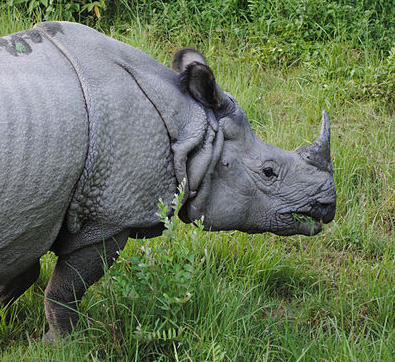
Indian rhino (Rhinoceros unicornis)
There are just five living species of rhinoceros, the second largest land animal, after the elephants. Three of those species are on the verge of extinction, and neither of the other two is entirely safe. Yet, as is so often the case, these five species are but the last remnants of a group of animals that was once much more numerous. Rhinos, or their close relatives, once wandered across much of the world, from the tropics to the edge of the Arctic, and they were found, not only in Africa and Asia, where they are found today, but also in Europe and North America.

How many different kinds there were depends, in part, on what you consider to be a rhinoceros. Today, there isn't much else that's like a rhino. Their closest living relatives are the tapirs, but, while there are a number of anatomical similarities (a similar digestive system, placing most of their weight on their middle toe, and so on), you'd never confuse one for the other. Indeed, tapirs and rhinos are not particularly close, probably having last had a common ancestor in the early Eocene, almost at the beginning of the Age of Mammals.

Since that time, the evolutionary line that led to modern rhinos has developed on its own, and into a much wider range of forms than the modern species might suggest. It's generally agreed now that there were at least three different families of rhinoceros-like animal; one of them long-legged and relatively swift, one semi-aquatic with a vague resemblance to hippos, and one that contains the "true", living, rhinos.

Saturday, 31 March 2012

The Life of an Endangered Porcupine

Porcupines are among the most distinctive of all rodents. With their combination of long quills, long tails, and large rodent teeth, they're pretty difficult to mistake for anything else. However, there are actually two families of porcupine, which are not directly related to each other, and which live on opposite sides of the Atlantic Ocean. The porcupines of Africa and Asia and those of the Americas are different in a number of ways; perhaps most notably, the American ones live up trees, while those elsewhere live only on the ground.

Of all the porcupines, though, one of the strangest is the thin-spined porcupine (Chaetomys subspinosa) of eastern Brazil. Although it was first described way back in 1818, for most of the twentieth century, no scientist had even seen one, until a survey in 1986 confirmed their continued existence. Much smaller than other porcupines, and more bristly than spiny, there has been considerable debate as to whether it even is a porcupine. Instead, it's been argued that it might actually be a type of animal called a spiny rat, another fairly odd family of rodents which it does certainly resemble.

The question was settled in 2009 when genetic and chromosomal studies proved, quite conclusively, that it is a porcupine, albeit an unusually small and rat-like one. Indeed, its ancestors seem to have separated from those of all other American porcupines as far back as the early Miocene, around 20 million years ago. In comparison, the next branch we know of within the family is the split between the North American porcupine and its assorted South American cousins around 10 million years ago, with all the other branches being considerably more recent than that.