Showing posts with label Birds. Show all posts

Saturday, 28 March 2026

The Thrush-beaked Consort Bird

A modern thrush
This post will be the latest as of 1st April, so it's that time again...

About 40% of all living mammal species are rodents. Over a third of those that aren't are bats, leaving just 38% belonging to any other group - primates, cloven-hoofed mammals and all the rest. These are, at least in terms of speciation, clearly very successful body plans.

But the bias is even stronger with birds. A whopping 60% of living bird species belong to just one order: the Passeriformes. The chances are that, if you think of a "typical bird" the image that pops into your head is of a passerine. There are about 140 different families of passerine (the exact number being a matter of taste among ornithologists), of which 123 constitute the songbirds.

Saturday, 29 March 2025

The Earliest Landfowl

Gallinuloides
This post will be the latest as of 1st April, so if you've been following this blog for a while, you'll know what that means... 

The humble chicken (Gallus domesticus) is a member of the pheasant family. This is a moderately-sized family, with around 180 species. Alongside the chicken and its wild ancestor, this also includes, not just pheasants, but many similar ground-dwelling birds, such as grouse, partridges, true quails, turkeys, and peacocks. 

It is, in turn, a part of a larger taxonomic group technically referred to as the Galliformes, or more commonly the "landfowl". The other four living families in this order have fewer species and are generally less well-known, but they share the same features of being generally plump, often quite large by avian standards, and having short, rounded wings unsuited for long-distance flight. 

Saturday, 30 March 2024

Flight of the Fossil Pelicans

Dalmatian pelican
Pelicans are distinctive birds with long necks, short legs, and a remarkably long beak the bottom half of which is attached to a large extensible pouch for holding captured fish. They are also large, with even the smallest species having a 180 cm (6 foot) wingspan and the largest being half that again. They are, of course, water birds, with many living along coasts or in brackish waters, but others found in lakes and rivers far inland.

They are also not mammals, which is a timely reminder that, yes, this is the post that will be live on 1st April, when I switch things about for one post a year.

Saturday, 1 April 2023

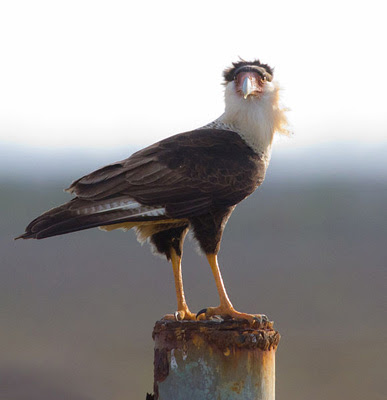
First of the Falcons?

Crested caracara
As I write this, it's 1st April, and that means, in lieu of trying to make a joke that somebody in the future will think is a real science item when they fail to notice the date, that it's time for: birds!

Trying to figure out the higher-level evolutionary relationships among animals can be tricky. Until the last few decades, we had to rely on physical comparisons and visible points of similarity, essentially a more sophisticated and well-informed version of what Linnaeus did back in the 18th century. With lower-level groups this can be reliable; nobody is surprised to discover that a moose is a type of deer or that rats are related to mice. But even here, parallel evolution can leave a misleading signal. It is not, for example, obvious that hyenas are more closely related to cats than to dogs (although, of course, they're neither). 

This problem gets bigger when we move to higher-level groups where physical similarity is no longer a reliable guide at all. Is a mouse more closely related to a dolphin than an elephant? That's not an easy one to answer on physical grounds alone. (Dolphin, probably, before anyone asks). It's much the same with birds.

Saturday, 26 March 2022

Monster Birds of South America

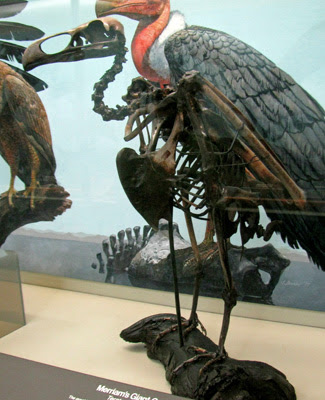
Teratornis
Yes, it's that time of year again. This post will be current as of 1st April, and that means it's time to hand over to... birds!

The largest birds, both living and extinct, are flightless. This is hardly surprising, since being small and light is a considerable boon to anything that wants to get off the ground. Nonetheless, there are some really big birds that can, in fact, fly. Going by wingspan, rather than body weight, the largest flying bird alive today is the wandering albatross (Diomedea exulans). In second place, and also the third-heaviest of any flying bird behind a couple of species of bustard, is the Andean condor (Vultur gryphus). This has a whopping wingspan of up to 310 cm (10' 2") and North Americans probably won't be surprised to discover that the California condor (Gymnogyps californianus) isn't far behind.

The Andean and California condors are, indeed, each other's closest relatives. They are both members of the New World vulture family, which also includes such things as the widespread turkey vultures. They are distinct from the Old World vultures, which are members of the hawk family, although they're very much in the same corner of the bird family tree.

Saturday, 27 March 2021

Before Owls Ate Mice

Palaeoglaux
Most bird species are diurnal. Doubtless, if you're flying about and don't have sonar, as bats do, it helps to be able to see where you're going. Nonetheless, there are many exceptions to this general rule, and none are more obviously so than the owls.

There are well over 200 living species of owl currently recognised, ranging in size from the mighty Eurasian eagle-owl (Bubo bubo) with a wingspan of up to 180 cm (6 feet) down to the tiny elf owl (Micrathene whitneyi) with a wingspan of just 27 cm (10 inches). They are grouped into two closely related families; the great majority of species belong in the Strigidae family, with just 20 assigned to the barn owl family, the Tytonidae. While there are some internal differences between the two, the most visible in the living animal is that barn owls, unlike regular owls, have distinctive heart-shaped faces.

Both families have been around rather longer than most mammal families have, with fossil representatives dating back to at least the Early Oligocene, around 35 million years ago. The two families are, however, rather like pigs and peccaries, each others' closest relatives, together forming the order Strigiformes. Since few people would deny that a barn owl is, in fact, an owl, it's this order that's really the scientific counterpart of our everyday understanding of the word.

Saturday, 28 March 2020

Giant Ostriches of Europe

This post will be current as of 1st April, and that means it's time once again for... Diapsida!

The largest species of birds alive today are the ostriches. Since 2014, we have recognised two species of ostrich, but, as the fact it took us that long to notice might imply, they're about the same size, so which is actually "the largest" is debatable, although the common ostrich (Struthio camelus) tends to be the one given the honour.

Under the system of classification used throughout the 20th century, ostriches are a kind of ratite, a group of flightless birds, most of which are large, long-legged and long-necked, and all of which lack the keel on their breastbone to which the flight muscles would be anchored in other birds. In 2010, the first evidence surfaced that the ratites were not a natural evolutionary group, when it turned out that the South American tinamous formed a branch within the "ratite" family tree. Since tinamous can fly (albeit not very well) and, more importantly, do have a keel, they aren't ratites themselves, so the old terminology had to be dumped.

Saturday, 30 March 2019

On the Origin of Ducks

Presbyornis
This is the post that will be current as of 1st April, when Synapsida traditionally hands over to the Lords of Misrule. Or, failing that, birds.

The fossil history of birds is less well-studied than that of mammals. This is hardly to say that it has been ignored, and we do know a reasonable amount about it. But a key problem with bird fossils is that, in order to fly, birds have light and fragile bones. These don't tend to survive the fossilisation process intact (bats don't do much better) and birds also lack the great standby of palaeontologists specialising in mammals - teeth.

Of course, a notable exception to this are the flightless birds, which can be enormous, and tend to have reasonably solid bones even when they aren't. It's a lot easier to find a reasonably intact skeleton of a terror bird, or even a penguin or fossil ostrich, than it is of something that flies. There's a reason that the previous posts in this April series have all focussed on the flightless sort.

But most birds do fly and are, let's be honest, well known for it. And, despite the difficulties, we do have a number of fossils of flying birds of various kinds - all the way back to Archaeopteryx - so that their evolutionary history is very far from being a blank book.

Sunday, 1 April 2018

First of the Flightless Penguins

Waimanu
Penguins are unusual birds. They walk fully upright, have short legs that force them to waddle, and have wings adapted into flippers to propel them through the water. Compared with many other bird groups, there aren't all that many of them - there are no more than twenty living species, and possibly less, depending on who you talk to.

Surprisingly, perhaps, we have, however, named many more fossil species than living ones, and our understanding of penguin evolution is rather better than that of most families of flying bird - which tend to have light and fragile bones that don't fossilise well. Unfortunately, as is often the way, it's the earliest and most interesting part of that fossil history that's most obscure, since, being older, these are the fossils least likely to be preserved.

But that doesn't mean we have nothing from that time.

Saturday, 1 April 2017

Deadly Demon Ducks of Doom

Since today is 1st April, although I'm not doing a spoof post, I am taking my annual break from mammals to talk about birds. Specifically demon ducks, although I nearly went with flightless boobies. It's that sort of day.

Australia is the most isolated continent to possess native mammals, so perhaps it shouldn't be surprising that the mammals that live there are particularly unusual, often only distantly related to those elsewhere. Birds, however, have an advantage that most mammals don't, in that they can fly long distances between land masses without dying. (They may not be doing so deliberately, of course, but being blown off course in a storm is the sort of risk they have to put up with). It's notable, in fact, that one of the two groups of native placental mammals in Australia are the bats, which are also also found further out in the Pacific islands.

Anyway, the upshot of this is that the birds of Australia frequently fall into taxonomic groups familiar from elsewhere in the world; Australia has owls, doves, seagulls, and parrots, among many others. At the same time, however, it is isolated enough that it does include some unique kinds of bird that are not found on other continents - less than the number of unique mammal groups, to be sure, but a number nonetheless. For example, lyrebirds are endemic to Australia, and are considered to form the oldest living branch of the songbird family tree.

Sunday, 26 June 2016

Bats v. Hawks

Bat hawk
There are not many animals that eat bats. Or, at least, that's often been the received wisdom. Bats only come out at night, fly through the air, where it's difficult to catch them, and many spend the day sheltering in caves that are difficult to access, and that rapidly become filled with so much bat poo that not much else is willing to venture within. But they don't all live in caves, they aren't the only things that come out at night, and, anyway, there's just an awful lot of them, so surely something must, in fact, eat them?

And, of course, the answer is "yes". In fact, there are actually quite a lot of animals that eat bats from time to time. In Brazil, for instance, snakes, especially tree-dwelling constrictors, have been reported to prey on bats. So do other vertebrates, from fish to mammals, and even a few invertebrates, such as, yes, really - giant centipedes. But, considering all that flying they do, it's perhaps unsurprising that the main predators of bats are, in fact, birds. And, among the birds, it's doubtless also not a great shock to discover that owls are the primary culprits.

For instance, it has been estimated that in Britain, at least 11% of all bat deaths (and probably more than that) are caused by birds. Around three quarters of those attacks are by tawny owls (Strix aluco), and 90% of all predation incidents on bats in Britain are due to owls of some kind. With 5% of predation incidents having nothing to do with birds at all, it nonetheless follows that a further 5% must be due to birds that aren't owls... and, of course, this is just Britain, where (for example) tree-roosting bats are quite rare.

Saturday, 26 March 2016

Dive of the Fossil Penguins

This is the post that will be current as of 1st April 2016. I will therefore be following my long-running annual tradition (that's "long-running" as in, "I've kept up this annual tradition for a whole year now") of posting about something that isn't a mammal, or even a synapsid.

When we think of 'birds' the ability to fly is surely one of the first things that come to mind. Indeed, the development of flight was surely one of - if not the - defining moments in early bird evolution. But, whereas bats have never given up that particular evolutionary innovation, flightless birds have evolved more than once. And, because we know that the very first birds could already fly, it follows that all flightless birds have ancestors that were perfectly capable of flight, but, for whatever reason, lost the ability.

Many, such as ostriches, did so to develop a fully land-based lifestyle, often becoming much larger in the process. But others swapped flight for diving ability. Of course, there are a great many diving birds that are still able to fly, but sometimes there is an advantage in really specialising in diving to the point that flight is no longer an option. This has, in fact, happened more than once in the course of avian evolution, but the only flightless diving birds we have now are the penguins, propelling themselves through the water with wings shaped like flippers.

Saturday, 28 March 2015

Terror Birds!

The terror bird Titanis
This will be the Synapsida post that is current as of 1st April this year. Now, I'm not going to do an April Fool's post, not least because this won't actually go up on the 1st. But, nonetheless, as a sort of reversal-of-expectations, why not, just this once, do something a little bit different?

So here we go: a post about a bird! Gasp!

Birds, despite being warm-blooded, air-breathing vertebrates, are, of course, not mammals, or even synapsids. Instead, they are diapsids, part of an evolutionary line that parted company from the synapsid/mammalian line over 300 million years ago, and which today also includes most, perhaps even all, of the reptiles. (The position of turtles is, to the best of my knowledge, still slightly contentious - they don't look anatomically like diapsids, but there are reasons to think that might be misleading. This is, however, a subject well beyond the scope of this post).

As a result of this long evolutionary separation, birds and mammals are substantially different in a number of ways. The most obvious is perhaps that birds have feathers, and mammals (usually) have hair, but there are many more differences 'under the skin'. For example, the wings of bats and those of birds, while performing the same function, have quite a different skeletal structure to them.