Sunday, 19 December 2010

When to be Awake

The activity patterns of mammals fall into three broad categories. Diurnal animals, such as humans, are active during the day, waking up in the morning and going to sleep at night. This has the obvious advantage that you can see where you're going, but does also make it easier for predators to spot you. The opposite is, of course, being nocturnal - active during the night, and resting during the day. The darkness may help hide you from predators, although you'll naturally need some means of finding your own food, whether its by exceptionally good eyesight (as is the case, for example, with owls), or relying on senses other than vision (as in bats). For animals in many areas, the simple fact that humans aren't around much at night may also be an advantage.

The third pattern is crepuscularity. Crepuscular animals are active mainly at dawn and dusk, resting both during the night and during the day. This gives the animals something of the advantages of both the other modes of activity, and it is rather more common than is often recognised. Such animals can keep out of the heat of the day, and find it easier to avoid predators in the twilight, but still have enough light to see by when they're searching for food.

For at least some animals, this is clearly a response to the lighting levels themselves, rather than just an instinctual daily rhythm of getting up twice a day. This is apparent because they also tend to be more active on bright moonlit nights, which give them enough light to see by long after they'd normally go to sleep. In contrast, its generally thought that truly nocturnal animals don't much like the moonlight, which eliminates some of the advantages that the darkness normally gives them.

It's not always as easy as one might think to work out whether an animal is genuinely nocturnal, or just crepuscular. But this can be important if, for example, you want to know how many animals of a particular species are around for conservation purposes. For a start, what exactly do we mean by "active"? Clearly, not being asleep is a good start, but given that, in the wild, you can't generally watch particular animals 24 hours a day, what exactly they're doing when they're awake may make quite a difference.

The North American river otter (Lontra canadensis) is the animal most Americans think of when they think of otters. They're the only species of freshwater otter in North America, and are found throughout much of the US and Canada. Americans often call it the "common otter" as a result, but this isn't terribly helpful, since that's exactly what Europeans call the European otter (Lutra lutra) - which, despite the name, is found everywhere from Britain to Vietnam. Otters form a natural group within the rather diverse weasel family, and there are many species besides these two, found in Africa, South America, and Asia, plus the sea otters of the north Pacific coast.

N. American     S. American     European      Giant
River Otter       Otters       Otter, etc.    Otter
     |              ^              ^            |
     |              |              |            |
     ----------------              |            |
            |                      |            |       Weasels
            |                      |            |          ^ 
            ------------------------            |          |
                       |                        |          |
                       |                        |          |
                       --------------------------          |
                                   |                       |
                                   |                       |
                                   -------------------------
                                               |
                                               |


The North American river otter is generally thought to be crepuscular. But it turns out that the story isn't quite so simple. In the recently published study, a number of otters were caught and radio-tagged in the Whiteriver area of Minnesota, then released into the wild and followed for about three and a half months. Crucially, the researchers looked at two different measures of the animals' activity. Like many mammals, male otters consistently wander across a far wider area than females. Indeed, in this case, males occupy home ranges of around thirty square kilometres (twelve square miles), and females only around a third of that. Since the males' ranges overlap with those of several of the females, this gives them plenty of mating opportunities, and this is also a fairly common pattern amongst mammals. On the other hand, otters are pretty social animals, and don't tend to fight each other when they meet or defend their territories aggressively.

So, one measure of activity is to see when radio-tagged animals are travelling between different parts of their home range, and their locations are being picked up by different receivers. This is the usual way that these sorts of studies are done, and an animal is fairly obviously active if it's moving from one area to another. The results showed that, as expected, the otters were most likely to move about just after sunset and just before dawn. Males moved about the most, especially during the breeding season, when they were actively searching for mates.

However, just because the otters aren't moving between different areas that doesn't necessarily mean they're asleep. So another possible measure is to look at the signal strength picked up by individual receivers. If that's changing a lot, then the otters presumably aren't sleeping in their dens, and must at least be doing something. When the researchers looked at this measure, they found that the otters were active throughout the night. So this means that the otters are basically nocturnal, and just travel the furthest during the hours of twilight - the rest of the time they're presumably foraging for food in specific locations.

In fact, when looked at in this way, both males and females are equally active; it's just that the females tend to stick to familiar hunting grounds within the river, rather than moving longer distances. Perhaps surprisingly, both sexes tended to be more active the colder the weather got. Most likely, they needed extra food to keep themselves warm, rather than staying at home out of the snow as a human might. Moonlight, on the other hand, made no difference to them at all. If you're swimming about underwater in a muddy river, it really doesn't matter how much moonlight there is anyway, and otters mainly seem to find fish using their sense of touch, rather than vision.

With nocturnal animals, you'd normally expect that they'd actually be less active during the full moon, something that's the case with many small mammals. This is largely because they're more likely to be spotted by predators when the moonlight is relatively strong, but that would be less of a concern for otters, which don't have that many predators, since animals like pumas and wolves tend not to follow them into the water.

However, its interesting to note that some smaller nocturnal animals don't seem to care about the moon, either. Another recent study showed that giant kangaroo rats (Dipodomys deserti) are, unlike most of their relatives, also equally active when the moon is full as when it is new. In their case, the suggestion is that, rather than just hoping predators don't see them, they are quite good at looking out for danger and then escaping at high speed before they can be eaten. For any animal that's good enough at doing that, the fact that they can see the predator coming when the moon is full might cancel out the increased odds of the predator spotting them, so that, all in all, it makes little difference.

Such exceptions to the general rules mean that animal behaviour isn't always as clear cut as one might think, even when it comes to something as basic as when they're awake and when they're asleep.

[Picture from Wikimedia Commons]

Sunday, 12 December 2010

Carnivores, Carnivorans, and Carnassials

Some time ago Irregular Webcomic ran, as one of its occasional polls the question "What do you consider the defining characteristic of a carnivorous animal?" Most of the answers, as you might suppose, centred around the extent to which the animal ate meat. But almost 10% of respondents replied "a member of the order Carnivora."

Now, this has to be interpreted in the context of an earlier poll which, in a game of twenty questions, asked whether the subject of the game was carnivorous or not, it having already been established that the animal was mammalian. If people were interpreting the later question in light of that, rather than answering the actual question as written, we might suppose that they were mentally ruling out anything non-mammalian. Otherwise 10% of IWC readers must think that, for example, crocodiles and sharks are not carnivorous. Which seems a bit unlikely.

Sunday, 5 December 2010

How to Steal Food and Get Away With It

Merriam's kangaroo rat
Many small rodents hide some of the food they have collected in caches scattered about their local environment. This is a useful thing to do when finding food might be difficult or unpredictable. When you do find some, its best to keep some in reserve in case it gets harder to find fresh food later on. In temperate environments we often associated this with winter - squirrels hoard away nuts so that they can find them once the winter comes and nuts are in short supply.

But it can be common anywhere that food is likely to be scarce, such as desert environments. If you find a sudden bonanza of more than you can eat, it makes sense to keep some of it safe to eat later. But there's a downside to this, in that some other animal might find and eat your secret stash. There really isn't much point in caching food if it's more likely to be eaten by someone else than by you.

One way to avoid this, if you're a really small rodent, is just to keep all the food in your burrow. Larger rodents then can't get at the food, because they're too big to squeeze into your burrow. But you don't want to keep all your seeds in one basket, as it were, so even small rodents often tend to hide caches of food here and there across the landscape. But do different types of rodent living in the same area hide food in different ways, and how good are they at stealing food from other species?

The kangaroo rat family includes around sixty species native to the Americas, most of which live in relatively dry environments. Despite the name, they have nothing to do with marsupials, and aren't actually rats, either, being more closely related to gophers. Several different species can live alongside one another, which suggests that they must have slightly different lifestyles - if they were all identical, one species would presumably be better at it than the others, and drive them to extinction. A recent study looked at three of these species, to see how they protected their food - and how good they were at stealing it off others.

Merriam's kangaroo rat (Dipodomys merriami) is a relatively large member of its family, with long hind legs adapted for hopping. The pale kangaroo mouse (Microdipodomys pallidus) is a fairly close relative, and looks fairly similar except (as you might imagine) for being smaller. The little pocket mouse (Perognathus longimembris), while also belonging to the kangaroo rat family, doesn't have the long kangaroo-like hind legs, and looks like a fairly typical mouse in appearance. The name "pocket mouse" comes from the fact that it has large cheek pouches for carrying seeds about - a feature it shares with other members of the family, and, of course, with the gophers.

 Pocket   Spiny Pocket      Kangaroo     Kangaroo
  Mice        Mice            Rats         Mice
    ^           ^              ^            ^
    |           |              |            |
    |           |              |            |        
    -------------              --------------       Gophers
          |                          |
          |                          |                 ^
           ---------------------------                 |
                       |                               |
                       |                               |
                       ---------------------------------
                                      |
                                      |

All three species can be found together in the deserts of Nevada. We already know that the pocket mice prefer to get their fresh seeds under the cover of the local shrubbery - which, in this part of the world tends to mean tumbleweed. Or at least it does these days, since tumbleweed is an Asian plant only introduced into America in the 19th century; there would, however, have been plenty of clumps of grass for the pocket mice to hide in before the tumbleweed arrived.

Little pocket mouse
At any rate, the other species are happier out in the open. Which might seem a little odd, since you'd think they're more likely to be eaten by larger animals while there. But it does mean that they can get at seeds that the pocket mice are too timid to reach, and their ability to rapidly leap away from a threat may make this less of a problem than it is for their mouse-shaped relatives.

In the first trial, each animal was given around 12 grams of seeds, and then allowed 24 hours to hide them wherever they wished. Each species showed a noticeably different tactic. The kangaroo rats buried their seeds out in the open, the kangaroo mice buried theirs under the edges of shrubs, and the pocket mice buried theirs as far as they could under cover. This is a little surprising for the kangaroo mice, since they don't normally spend much time around heavy cover, but it may be that the bigger kangaroo rats are more likely to steal food from them if buried out in the open. And, while heavy vegetation probably makes it harder to leap away from a predator without whacking into something, that may well be less of an issue for the smaller kangaroo mice than it is for their bigger relatives.

For the other two species, this still leaves an open question. Do they bury their food in those locations because it's just where they happen to be, and where thy feel safest, or because they don't expect the other species to come in there and steal it? In the second trial, the researchers buried small caches of food at random spots across an enclosure, and gave the animals 24 hours to find it. The question being - where would they look?

While the researchers couldn't find any kangaroo mice to test this way (the originals having been returned to the wild), the pocket mice turned out to look pretty much everywhere. Not having any of their own food with them might have made them hungry enough to venture out into the open, and the fact that their weren't any big kangaroo rats out there to chase them away probably helped to. But it does indicate that kangaroo rats simply putting their food out into the open is no protection against it getting nicked, because the pocket mice will look there if they can.

The kangaroo rats themselves were actually more likely to look under shrubs... and then to cart the food off and go and bury it out in the open. This would suggest that hiding food under a bush is a particularly naff tactic, since that's the first place anyone else is going to look for it. Clearly, the pocket mice are more worried about being eaten by predators - or chased off by bigger rodents - than they are about their dinner being stolen.

On the other hand, if their food keeps getting pinched, why don't they die out? It could be that, as mentioned above, they normally hide most of it in their burrow, which the kangaroo rats are too big to get into. Burying it under bushes may just be a back-up plan that isn't crucial to their survival.

Wandering about looking for another animal's secret stash of food is a bit of an effort, and it may be noteworthy that rodents in more fertile environments, such as chipmunks, often can't be bothered. They know where they put their own hoard, and that's quite enough. In the desert, it seems, you just can't get away from it; if you hide food, some of it will be pinched before you can get back to it. Which makes it all the more important that you're prepared to steal somebody else's to make up for what they stole from you.

Just remember to look in the right place.

[Pictures from Wikipedia and Wikimedia Commons]

Sunday, 28 November 2010

Telling fossil species apart - a brontothere's nose

Brontotherium skull - or should that be Brontotherium prousti?
When we think of specific kinds of living animals, we tend to think of individual species, at least where those animals are fairly familiar to us. But prehistoric animals are almost always referred to just by their genus name. A proper species name has two parts to it (such as Homo sapiens), but the genus name is just the first part of that, and that's how we think of most prehistoric creatures. Consider the dinosaurs, such as Triceratops, Velociraptor, and Diplodocus, or mammals such as Smilodon, the sabre-toothed cat. Probably the only exception - and arguably one of only two creatures whose common name is the same as its scientific name - is Tyrannosaurus rex. (The other one is Boa constrictor, if you're wondering).

A genus is a group of closely related species. There are many genera that only contain one species, but most have a number of different species at any given point in time, and even more when you look over the whole of their evolutionary history. It's as if we thought of the living genus Canis as a single entity, ignoring the fact that it includes wolves, coyotes, and jackals, never mind extinct species such as the dire wolf.

There's a reason for this, of course, which is that it's really tricky to tell actual species apart from their fossils. Taking the traditional definition of a species as something that doesn't cross-breed with other species to produce fertile hybrids (and the modern definition is a bit more complicated than that), how on Earth would you know, if you're only looking at a fossil? Instead, the definition more commonly used for fossil animals is that a species is a group of specimens so similar that there's no way to consistently tell them apart, even when you have a complete skeleton. But most fossils aren't complete, or are at least damaged by several million years of being squished under tons of rock, which makes it very difficult to spot the tell-tale differences between the equivalents of coyotes and jackals.

Sunday, 14 November 2010

The Polar Bear's Bite

Bears are generally omnivorous animals, and will eat pretty much whatever is available. Although they look fairly fearsome, and do, of course, eat meat, they also consume a relatively large amount of plant material, such as berries, leaves, grass, nuts, and so on. This is useful, especially for a large animal, since they are unlikely to go very hungry for long, and plants are always more readily available than animals.

The polar bear (Ursus maritimus) is, of course, an exception. Unlike all other living bears, they feed exclusively on meat, and really don't eat plants at all. They are, to use the technical term, hypercarnivores, more similar in this respect to cats than they are to their own relatives. Nor do the differences end there. Most obviously, they are adapted to bitterly cold environments, and, indeed, they soon get heat stroke if taken to places that most other bears would be perfectly happy - anything much above 10°C (50°F) makes them uncomfortable. Not only that, but they are also much better swimmers than other bears, and have claws that grip into the ice when they walk.

Given these differences, you might think that polar bears represent an early branch from the lineage that led to all the other bears, one that adapted itself to both an extreme environment and a (for bears) unusual diet. But that turns out not to be the case, with polar bears having diverged from their closest living relatives, the brown bears, long after that line split from the other species.

 Polar      Brown     Sun Bear     Black
 Bear       Bear                   Bears
   |          |          |           ^
   |          |          |           |         Sloth Bear
   ------------          -------------             |
        |                      |                   |
        |                      |                   |
        ------------------------                   |
                   |                               |
                   |                               |
                   ---------------------------------
                                  |
                                  | 


Rather more surprising, perhaps, is just how recently this happened. Genetic analyses show that the first polar bears evolved no more than 0.7 million years ago, which really isn't very long in evolutionary terms - in contrast, most other species of bear diverged around 5 million years ago. In fact, its quite probably a lot less than 0.7 million years. The oldest known skeleton of a polar bear is only around 130,000 years old, which is sufficiently young to retain a good deal of DNA.When that DNA was analysed earlier this year, it seemed to show that the animal in question was so incredibly close to brown bears that it probably lived at around the time that the two diverged, and would therefore have been one of the first members of its species - a rare find, indeed.

What this means is that, after they first evolved, polar bears must have undergone a very rapid sequence of changes, quickly adapting themselves to their environment and new diet. Judging from the shape of their skulls, they must have changed at least twice as quickly as any other bear species did, and that's probably an underestimate.

How has the polar bear managed to adapt to a new diet in such a short time? Generally speaking, hypercarnivores such as lions tend to have strong skulls with powerful jaw muscles and large shearing teeth, suitable for slicing through tough meat and bone. This is much less true of bears, adapted as they are (in most cases) to a more omnivorous diet. But, compared with brown bears, polar bears have a long, rather sleek skull, which is even weaker than the heavy rounded skulls of their relatives. This is probably, at least in part, to make it easier for them to nuzzle through holes in the ice to catch seals.

Some recent stress analyses using the sort of computer models normally used in engineering design have shown that while the jaw muscles of polar bears are just as strong as those of normal bears, the skull itself is less able to take up the strain of a powerful bite. Granted, that's assuming the computer models are right, but even so, it does seem a bit odd. Similarly, while they do have less premolar teeth than many other bears (a feature they share with cats, for example), the teeth overall seem somewhat weaker than one would expect for a purely carnivorous animal.

One reason may be what the polar bears are eating. Their diet consists almost entirely of seals, which, unlike the antelopes eaten by lions, have a lot of soft blubber. If their food is less tough than the meat favoured by other hypercarnivores, they don't need such strong jaws, and the evolutionary change required to adapt to that diet may be less than it first appears. It may also help that, while animals like leopards and wolves regularly take down prey  larger than themselves, polar bears obviously don't. Seals just don't get that big!

There is, however, a clear downside to this rapid evolution and specialisation. As ice sheets melt, the habitat of polar bears is shrinking. But what's bad for them can be quite good for their relatives, the brown bears. Brown bears (Ursus arctos) are a diverse species, including both the grizzlies and Kodiak bears of North America, and the "common" brown bears of Europe and Russia, among others. They're pretty adaptable, and can eat a wide range of food, making them at home in dense forests, open woodland, or even tundra. As the polar bears' preferred environment shrinks, brown bears can move steadily further north.

The sort of things that brown bears eat are often tougher than seal blubber, and their teeth and bites are accordingly stronger. This means that, even if polar bears were to start eating such things (which isn't, perhaps, very likely in the first place), the brown bears would still do better. Brown and polar bears are still so closely related that they can interbreed to produce hybrids, at least some of which are apparently fertile. If that continues to happen, and the brown bears muscle in on the polar bear's territory, out-competing them for food, then it's the browns that will eventually win out, diluting the purebred polars into non-existence.

As if the great white bears of the north didn't have enough problems to be going on with...

[Picture from Wikimedia Commons]

Tuesday, 2 November 2010

What is a Mammal?

I'm going to briefly pause from looking at recent mammalogical news to examine a more general question about mammals. And they don't come much more general than "what is a mammal?"

Doesn't sound a very difficult question, does it? A mammal is a warm-blooded, air-breathing vertebrate that, crucially, feeds its young with milk from its mammary glands. Right? Well, kind of...

For the last twenty years or so, animals have been placed into groups on the basis of something called cladistics. Essentially, the idea is that a proper, meaningful, group of animals will be one that contains a single common ancestor and all of its descendants. Or, to put it another way, that everything in the group has to be more closely related to other animals in that group than it is to anything else. Which seems pretty straightforward and common-sense, and, indeed, is a very useful way of doing things. But applying it strictly does sometimes lead to some fairly surprising results.

Vertebrates first freed themselves entirely from the water when they evolved a way of making their own little pools of water, surrounded by a protective shell, and leaving their tadpoles inside that pool with a supply of yolk to feed off until they became developed enough to hatch. The animals that evolved this feature are called amniotes. Later on, some mammals evolved a way of doing away with the shell, and keeping the pond inside a membranous sac in the mother's body, but the principle is the same, and they still count as amniotes.

Not long after the amniotes first appeared, they split into two great evolutionary lines. One led to the reptiles and birds, and the other, called the Synapsida, led to the mammals.

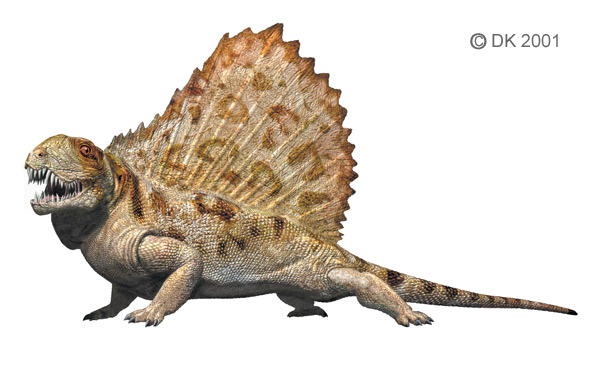
Wait a minute, I can hear you saying, but didn't mammals evolve from reptiles? Well, it depends what you mean by "reptile". Certainly, if we could look at the early synapsids today, most people would probably call them reptiles. They were cold-blooded, hairless, laid eggs, wouldn't have produced milk, and anyway, they just kind of looked reptilian. Take a look at this one, for example. By most people's standards, that's a reptile.

But here's how the early amniotes evolved into the animals we have today:

Crocodiles    Birds      Other      Turtles      Mammals
                        Reptiles 
    ^           ^          ^           ^            ^
    |           |          |           |            |
    |           |          |           |            |
    -------------          |           |            |
          |                |           |            |
          |                |           |            |
          ------------------           |            |
                   |                   |            |
                DIAPSIDA            ANAPSIDA    SYNAPSIDA
                   |                   |            |
                   ---------------------            |
                             |                      |
                            (A)                     |
                             |                      |
                             ------------------------
                                        |
                                        |

Bearing in mind out definition for what constitutes a "group" of animals (a monophyletic clade if we want to get technical - but let's not) there are two problems with this chart. The first is that reptiles aren't actually a proper group at all - they can't be, because crocodiles are more closely related to birds than they are to, say, turtles. Which isn't to say that crocodiles are particularly close to birds, admittedly, just that they're even further from turtles. (This is because birds evolved from dinosaurs, which were fairly close to crocodiles).

When we say that a proper biological group has to consist of a common ancestor, and all of its descendants, the key word is "all". The common ancestor of all living reptiles is at the point I've marked (A), and if we want to include all of its descendants, then we have to count the birds. Either birds are reptiles, or reptiles don't really exist as a meaningful group. Bummer!

Be that as it may, the other problem is that even if the reptiles are a group, their last common ancestor, and therefore the first reptile, is the creature at (A), and mammals didn't evolve from that. So mammals evolved from creatures that certainly looked very reptilian, but which weren't, in a strict scientific sense, reptiles as we understand them today. They are entirely their own line.

But, at any rate, it's fairly clear that while the early synapsids may not have been reptiles, they weren't mammals, either. At some point, they evolved into mammals, and all of the earlier forms of reptilian-looking synapsids died out. So at what point did that happen? When did not-mammals become mammals?

The obvious answer is "when they developed mammary glands and began producing milk". Which is all very well, but a bit of a bugger when all you've got to go on is fossil bones. How do you tell from the bones whether the animal produced milk or not? You can't, pretty much. So palaeontologists have to use a different definition.

Skull of a turtle - note that the lower jaw consists of at least four different bones. (d = dentary, ar = articular)
The lower jaws of the early amniotes consisted of multiple bones. For example, there was the dentary bone, which had most of the teeth, and the articular bone, which formed the hinge joint with the skull. In the line that led to reptiles and birds, this didn't change much (at least until birds evolved beaks), but in the synapsids, something strange began to happen. The dentary bone began to get larger, slowly pushing out and shrinking the other bones, until most of them disappeared altogether.

Eventually, the dentary formed its own joint with the skull, and the lower jaw actually had two joints on each side for a while. That's not much of a problem, so long as the joints are lined up properly, but there's really no need for it, so eventually, the only remaining other bone in the lower jaw, the articular, began to shrink as well. In the end, the dentary was the only bone left in the lower jaw at all; and in mammals, we call it the mandible.

Lower jaw of a mammal - note the absence of separate bones
But the articular bone, and its old joint with the skull didn't disappear altogether. Both it, and the skull bone that it used to attach to shrank and became entirely separated from the jaw, moving up the side of the head. They are still there today, still with the old joint between them, but now we call them the malleus and incus, and they form two out of the three bones in the middle ear.

And that, at least when you're looking at fossils, is the defining characteristic of a mammal: that it has one bone on  each side of the lower jaw, and three bones in each middle ear.


[Pictures from Wikimedia Commons]

Sunday, 31 October 2010

Pronghorn populations

The antelopes are not a true group of animals; generally speaking, the term just refers to any member of the cattle family that isn't a cow, sheep, or goat. There are many different kinds of antelope, found not only across Africa, but also in Asia.

Under this definition, however, the pronghorn (Antilocapra americana) is not really an antelope. At first glance, this North American animal certainly looks like one, with cloven hooves, horns, and a four-chambered stomach. But a closer look reveals some differences. A look at the cloven hooves of any member of the cattle family reveals that they have four toes: two that form the hoof itself, and two smaller, vestigial ones that don't reach the ground. In the pronghorn, these evolutionary remnants have vanished altogether (although there are still cannon bones within the leg), so that they only have two toes on each foot.

The horns are different, too. In members of the cattle family they are never branched - unlike the antlers of deer - but the male pronghorn, as its name suggests, has a forward-pointing prong on each horn. Furthermore, they shed the outer layer of skin from the horns each year, like deer do, but quite unlike cattle. (Unlike deer, however, they don't shed the horn itself).

All of this places the pronghorn in a family all of its own. While the pronghorn family today consists of just one species, in prehistoric times, it was much larger, representing a branch away from the line that led to true antelopes that crossed over into the Americas, and developed on its own.

Pronghorn     Cattle Family     Deer Family
                                    etc.
    |              ^                 ^
    |              |                 |
    |              |                 |         Camel Family
    ----------------                 |              ^
           |                         |              |
           |                         |              |
           ---------------------------              |
                         |                          |
                         |                          |
                         ----------------------------
                                      |
                                      |


The pronghorn is not an endangered species; it is present in large numbers across a wide swathe of the western parts of the USA, and also into Canada and Mexico in places. This doesn't mean that it's had everything its own way; as with many animals in North America, and elsewhere, it used to be present in much larger numbers in the nineteenth century than it is now. But, if anything, it is more numerous now than it was at the end of that century, due in part to the introduction of such factors as regulated hunting seasons.

However, it can still be useful to look at the various factors that affect the pronghorn population, some of which can be extended to other, similar, animals. One study looked at the population of pronghorn in western Nebraska from 1953 to 1993, to see what conditions favoured the animals, and which didn't. It turns out to be quite a complex story, indicating that conservation isn't always a simple matter of fixing one or two problems and getting the same result everywhere.

One does, incidentally, have to be a bit careful with this sort of retrospective study. Because it's looking back over a long period, there might be all sorts of differences in the way that the individual studies that comprise it were conducted. Indeed, in this case, the 1993 cut-off was chosen because population studies after that date were just too different to be compared with the older ones. But, bearing that in mind, some trends do appear to be visible.

For many animals, the advance of agriculture is generally a bad thing. It disrupts the natural habitat, and leads to competition with livestock if you're a herbivore, or being shot by farmers if you're a carnivore. Pronghorns, however, don't really seem to have this problem. There is no doubt that they are more numerous in the wilder parts of their range, but, at the same time, the presence of nearby agriculture seems to help protect their population from such problems as unexpectedly harsh winters.

There are probably a couple of reasons for this. Importantly, pronghorns and domestic cattle tend to eat different kinds of plants, so that the cows aren't eating all of the pronghorns' food. Indeed, if anything, cattle grazing promotes the growth of herbs and grasses that the pronghorns can then feed on, so that in years when the cattle suffer, the pronghorns also struggle. Agriculture also increases the presence of winter wheat, and of cattle feed such as alfalfa during the harsh winter months, both of which are available for the pronghorns as well as their intended recipients.

However, an interesting thing happens when populations get very small, as happened at times for the pronghorns over the forty years examined by the study. Normally, when populations in a given area get larger, each animal produces less offspring that survive to adulthood. There is, after all, only a certain amount of food to go around, and animals are effectively competing with members of their own herd for survival. As the population shrinks, there is less stress on individual animals to find food, shelter, or other resources, and they produce more offspring.

But if the population shrinks enough, something called the Allee Effect often kicks in. Here, the usual trend of increased reproduction for reduced population density reverses, making the population dip still further. Continue this for long enough and the animal is wiped out in that area - and, if the area affected is big enough, that may even mean extinction. Perhaps the major reason behind the Allee Effect is inbreeding, due to a limited choice of mates.

There may, however, be other reasons as well. In the case of herd animals like the pronghorn, for instance, because the herds themselves will get smaller, less of the animals will be available to keep guard against coyotes while the others are feeding. We can also see this effect in play in one of the world's rarest large mammals, Przewalski's gazelle (Procapra przewalskii), which now lives only in a small area around a single lake north of Tibet (and, which, incidentally, very clearly is threatened by advancing agriculture). Now present in numbers too small to properly guard against the local wolves, they are increasingly seen sidling up to herds of the closely related, and more numerous, Tibetan gazelle, so that at least somebody is on the lookout, even if it isn't a member of their own species.

In the case of the pronghorns of western Nebraska, the population densities did, at times, dip low enough for the Allee Effect to kick in. But, in every case, the population recovered as conditions improved in subsequent years, or the hunting season was temporarily halted. So they're hardly in any danger of extinction yet. But even here, exactly how far a population has to fall before problems arise varies considerably from area to area. In this case, where agriculture is more common, the pronghorn herds could reach far lower population densities before the Allee Effect began to take its toll, but for other animals, it could be quite the reverse. And even where it isn't, it may mean that you have to take conservation action sooner in wild areas than in better farmed ones - quite the opposite of what you'd normally expect.

[Picture from Wikimedia Commons]