Although they represent almost a third of non-American marsupial species, dasyuromorphs are far less diverse than their herbivorous counterparts, with all but one of the living species belonging to a single family, the dasyurids. Although the most famous example of the dasyurids is probably the Tasmanian devil, which eats comparatively large prey, most of the other species are small shrew-like animals feeding on insects. Alongside them, we can place the numbat and the extinct thylacine ("Tasmanian tiger" or "wolf") both of which are odd enough to be placed in families of their own.
Saturday, 30 September 2023
Hammer-Toothed Snail Eaters
Sunday, 24 September 2023
Return of the Rabbits?
![]() |
| This one is wearing a radio collar... |
Sunday, 17 September 2023
We're Up All Day to Get Lucky
In reality, however, it turns out that this can have a lot to do with the circumstances. And, in the modern world, those circumstances are most likely to be shaped by... what else, but humans?
The issue, of course, is that humans are for the most part diurnal. Which isn't much of a problem for animals that are naturally nocturnal, but can be if they, too, would prefer to be active during the daylight hours. What we see time and time again across the world, and across different mammal species, is that where humans are most likely to encounter wild animals, those animals shift their behaviour towards nocturnality to avoid the stress of meeting us too often.
Sunday, 10 September 2023
Skunks of the World: Spotted Skunks
![]() |
| Eastern spotted skunk |
That honour goes to the spotted skunk, which appeared in the earliest recognised list of scientific animal names in 1758. This isn't to say that nobody knew at the time what a striped skunk was, merely that the naturalists of the day had yet to identify them as something distinct from the spotted sort, and it was the latter that happened to be described first - the striped skunk followed less than twenty years later, in 1776. Before they were given their own genus, both species were originally placed in Viverra, which comes from the Latin word for "ferret" but seems to have been used for any small, slender mammalian carnivore that didn't fit elsewhere (not including, ironically, the ferrets).
Sunday, 3 September 2023
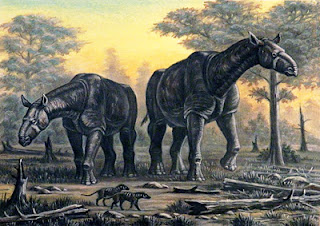
Oligocene (Pt 4): Time of the Giants
![]() |
| Paraceratherium |
At first glance, since the oldest fossil is German, it appears that tapirs originated in Europe and then spread east, and it's purely a coincidence that they happened to do so after the Coupure - which, after all, was a time of climatic change. The problem is, there wasn't anything remotely tapir-like living in Europe before the Coupure, but there were plenty of potential ancestors elsewhere. So it's perhaps more likely that the first true tapirs were Asian, and we simply haven't found their fossils yet. Even so, we can at least say that Protapirus, and its later relative Paratapirus (which never seems to have left Europe) really were tapirs, rather than some close relative. A key feature here is that, unlike their earlier relatives, they already had the modifications to the nasal bones that suggest the presence of the short trunk that modern tapirs have, although it was probably less prominent than in current species.
Sunday, 27 August 2023
Picking the Right Crevice
The problem with caves as a habitat, however, is that, in the grand scheme of things, they aren't all that common. Clearly, this depends on the type of landscape you're in, but many places just don't have lots of caves. In the tropics, hanging from a tree branch might well be sufficient, but where the weather is cold, especially in winter, that may not be such a good idea. So bats roost in many other places, too, such as hollows in trees and cracks and crevices in the ground that are similar to, but much smaller than, what we'd normally think of as a "cave".
Sunday, 20 August 2023
Love on the Mountain Tops
There are, as with many animal groups, more species of caprine than one might at first think, and I covered them all individually about ten years ago. Looking through that series, it should be possible to appreciate that the group is also varied, not only inhabiting a range of environments but also living varied lifestyles, from those that are near-solitary to those that prefer large herds. This is also reflected in their mating habits which, are as one might expect, related to the size of the community in which they live. One would also expect that the habitat would have some effect on how the animals choose to live, and, in turn, on that mating behaviour.

.jpg)

.jpg)

.jpg)
_Zoo_Salzburg_2014_h.jpg)