Sunday, 20 March 2022

Leaf-Eating Monkeys: Red Colobuses of Central Africa

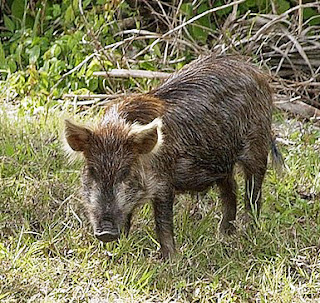
Ashy red colobus
The problem with being a primate subsisting primarily on leaves is that, on their own, they aren't very nutritious. Humans on a vegan diet can hardly be expected to live on lettuce alone; they need grains, pulses, nuts and so on, and we have the advantage of cooking making much of our food easier to eat and digest. Colobus monkeys have complex digestive systems that allow them to extract more nutrition from leaves than a primate would otherwise be able to, so they have the edge over us in that respect, but they still require plenty of fresh leaves and this leads to the more exclusively folivorous ones having specific habitat requirements that leave them vulnerable to any degradation or loss of their environment.

The end result of this is that many colobine monkeys are endangered. In Africa, the most endangered group, and probably the most threatened group of primates of any kind on the continent are the red colobuses.

Sunday, 13 March 2022

Vishnu's Otter in Bavaria

Otters are members of the weasel family, something that has been recognised since the dawn of taxonomy in 1758, when Linnaeus placed them in what was then the weasel genus (taxonomic families not yet being a concept). Their adaptations to the water, including their powerful muscular tails, were long thought significant enough that they were separated out into a distinct subfamily, a position they still retain, although it turns out that they are more closely related to the weasels proper than to some other members of the family such as, say, pine martens or wolverines.

Perhaps because rivers are a good environment for forming fossil-bearing sites, we know of a significant number of fossil otters and, most of them would doubtless have been instantly recognisable as otters were we able to see them in the flesh, there is perhaps more variety amongst them than we might at first expect. For example, a number of them are quite large - in some cases, larger even than the "giant otter" (Pteronura brasiliensis) of today's Amazon, the largest living member of the weasel family. (So, yes, it's bigger than a wolverine).

Sunday, 6 March 2022

Moving Away From Home

One common feature among many mammal species is that, once they become old enough to do so, they leave home to find a place to settle for themselves. Often, it's the young males that travel the furthest, and in animals that live in herds, colonies, or other groups, the females may not disperse at all, creating a matrilineal society - interestingly, the opposite is generally true in birds. This discrepancy between the sexes ensures that when the males do find somewhere to settle down, the females that will become their new neighbours or pack-mates will not also be their own sisters and other close relatives.

But there are other reasons why animals might choose to disperse, sometimes moving from one location to another once they are already adult. This may be due to some sudden disruption in their original habitat, or to longer-term effects, such as climate change. Either way, while it's not an easy subject to study in the wild, understanding the causes and practices of animal dispersal can be important for issues such as conservation and understanding wider population dynamics. 
Sunday, 27 February 2022

Leaf-eating Monkeys: Black-and-White Colobuses

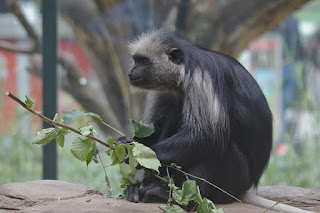
King colobus
The Old World leaf-monkeys are formally known as "colobine" monkeys, with the name of their subfamily coming from what British zoologist Thomas Jerdon considered to be the most typical member of their subfamily when he first named it in 1867. These, of course, are the colobus monkeys, of which there are a great number of species. Jerdon, however, was thinking in particular of what we would now call the black-and-white colobus monkeys, so it's these against which, taxonomically speaking, all other leaf monkeys are compared.

The first colobus monkey of any kind to be scientifically described was the animal now known as the king colobus (Colobus polykomos). This was in 1780, with Eberhard von Zimmerman basing his description on a specimen collected from an island off Sierra Leone. His original name meant something like "many-singing monkey", and it was only in 1811 that the word "colobus" was coined. This comes from the Greek word for "maimed" and refers to the fact that colobus monkeys have no visible thumbs, just a small lump on the side of the palm, making it look as if they have been cut off.

Sunday, 20 February 2022

Miocene (Pt 31): Terror Mice and the First Howler Monkeys

Phoberomys
As the heat of the Middle Miocene gave way to the more moderate temperatures of the Late Miocene, grasslands grew across much of the Northern Hemisphere. In South America, however, the changes were, perhaps, less significant due, in part to its more equatorial position. Nonetheless, even aside from the general worldwide cooling trend, the South American climate was changing as the Andes continued to rise, affecting weather patterns across the continent. It was also continuing to edge closer to North America, so that, towards the end of the epoch, it became possible for a few animals to make the crossing using the islands of what is now Central America as stepping stones.

Sunday, 13 February 2022

Are Animals Darker in the Tropics?

In 1833 Prussian ornithologist C. L. Gloger published the book Das Abändern der Vögel durch Einfluss des Klimas (roughly "the modification of birds by climatic influences"). In this, he put forward a proposal that the plumage of birds living in hot, humid, environments tends, on average, to be darker in colour than that of those which do not. In 1929, biologist Bernhard Rensch formalised this as "Gloger's Rule", one of a number of zoological "rules" that seemed to be true more often than not but for which there was not necessarily a clear explanation.

Crucially for this blog, it seemed to be true of the skin and hair of mammals as well. This observation raises a number of questions, of which the first is clearly "is it true?" 

Sunday, 6 February 2022

How Dolphins Got Their Large Brains

As a rule, larger animals tend to have larger brains, just as they have larger hearts, livers, and other internal organs. But the relationship is not a linear one, partly because, unlike the liver, there's a minimum size below which the brain doesn't have room for the basic housekeeping functions that keep the body ticking over, so that small animals have proportionately larger brains than large ones. If we want to know whether a particular creature has a larger, or smaller, brain than we'd expect then, as I've described before, we use a mathematical formula called the encephalisation quotient to determine what the size of the brain "should be". 

By definition, an average mammal should have an EQ of 1. The formula breaks if we try to apply it to non-mammalian animals, such as birds, probably because their brain architecture is different from ours at quite a fundamental level. Even for mammals, there is some debate as to exactly what formula we should be using; most older studies have determined that brain size typically rises as the 2/3 power of body size (that is, as the cube root of the square) but a 2019 study argued that it's perhaps more accurate to base it on the 3/4 power and this seems to be a growing consensus.