One of the main problems facing the continued survival of wild animal species across the world is loss of habitat. (Naturally, this goes for all kinds of animals, and plants, too, even if we're mainly interested in mammals here). As humans expand in numbers and push into the wilderness, we turn a lot of it into farmland to feed ourselves, use it for logging or mining, or simply build roads across it. The animals that are least concerned about this are those that we have domesticated, whether as pets or as livestock, with supremely adaptable generalists such as rats and pigeons following not far behind.
At the opposite extreme, of course, are the specialists, those that require one very specific sort of land to live in. In between there are a great spectrum of other animals, that can cope with some change, but not too much, that find orchards and plantations a reasonable substitute for forest, and so on. If we're interested in conserving particular animals, one of the first things we need to understand is just what their requirements are.
Even then, it's not enough to know that a particular animal "likes forests". What kind of forests? Do they really have to be primeval and untouched, or are there are at least some viable alternatives? Are there, perhaps, particular parts of the forest that they like more than others? In the grand scheme of things, just leaving stuff alone is probably the best answer from a conservation perspective, but, since human numbers aren't going to start falling any time soon, compromise is often inevitable. So the question then becomes: on what can we compromise?
Sunday, 13 September 2015
Sunday, 6 September 2015
A History of the Strange-Jointed Beasts
All living species of mammal fall into one of three major groups, representing the lowest branches of the mammalian family tree: the placental mammals, the marsupials, and the bizarre, egg-laying, monotremes. Well over 90% of identified living species fall into the first of those groups, which prompts the interesting question of how we divide those up - what, in short, are the next branches on the tree?
In the strict, old-style, system of classification, the next major level down is that of the "order", groups of broadly similar creatures that are in turn, divided into more than one hundred "families". Primates, for instance, are an order.
What the orders are, and how many of them there might be, has varied a little down the years, but nineteen or twenty would be a good, modern estimate. But, of course, the orders themselves are entirely arbitrary, and, even if they weren't, it isn't as if they all sprang simultaneously from the same stock. In evolutionary terms, there must have been some early branches in the placental family tree from which the "orders" that we know today descended.
The question of how to group the orders together into some higher level pattern is one that mammalogists have been been pondering for well over a hundred years. The problem is that the orders are pretty distinctive - is a moose more like a wolf than it is a monkey? When all you have to go in is physical anatomy, these are not the simplest questions to answer, and it's not surprising that people have come up with different answers.
In the strict, old-style, system of classification, the next major level down is that of the "order", groups of broadly similar creatures that are in turn, divided into more than one hundred "families". Primates, for instance, are an order.
What the orders are, and how many of them there might be, has varied a little down the years, but nineteen or twenty would be a good, modern estimate. But, of course, the orders themselves are entirely arbitrary, and, even if they weren't, it isn't as if they all sprang simultaneously from the same stock. In evolutionary terms, there must have been some early branches in the placental family tree from which the "orders" that we know today descended.
The question of how to group the orders together into some higher level pattern is one that mammalogists have been been pondering for well over a hundred years. The problem is that the orders are pretty distinctive - is a moose more like a wolf than it is a monkey? When all you have to go in is physical anatomy, these are not the simplest questions to answer, and it's not surprising that people have come up with different answers.
Sunday, 30 August 2015
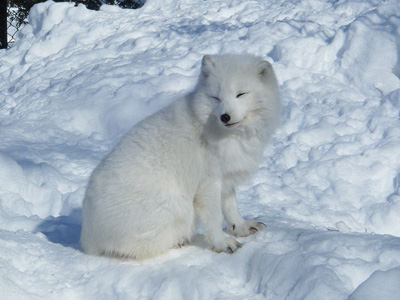
The Dog Family: Arctic and Grey Foxes
![]() |
| Arctic fox |
Arctic foxes are truly creatures of cold and desolate habitats. In Europe, they are found only in Norway, Iceland, and the coasts of the White and Barent's seas in northern Russia. Indeed, it is one of only two species of land-dwelling mammal native to Iceland - the other is the wood mouse, although there are some human-introduced animals there as well. Elsewhere Arctic foxes are found right round the coasts of the Arctic Ocean, in northern Siberia, in northern and western Alaska, northern Canada and its islands, and even in Greenland. Despite this wide, multi-continental, distribution, most belong to just one subspecies, although those living in Iceland, Greenland, and Svalbard form one or two distinct subspecies between them, and there are also distinct subspecies on the isolated Pribilof and Commander Islands in the Bering Sea.
Sunday, 23 August 2015
Tuskless Walruses of Japan
There are a number of mammal "families" that contain just one living species. Of course, what constitutes a "family" of animals is an arbitrary distinction, rather like the one that says Pluto isn't a planet. So, really, all we're saying is that there are some mammal species that, in our subjective and pro-mammalian opinion, are do distinct and unusual that we feel they ought to be placed in a group all of their own. If they were insects, or snails, or something like that, we'd probably feel differently. But they're mammals, like us, so we don't.
One such family is the walrus family, containing - you've guessed it - the walrus (Odobenus rosmarus). Walruses are pinnipeds, which is to say, they are related to seals and sea lions. Just by looking at them, we can tell that walruses can walk on all fours like sea lions and fur seals, but unlike "true" seals, yet lack the external ears that sea lions and fur seals have and true seals don't. When you get to the interior structure of the skeleton, and so on, there are a number of technical differences that tell us that, no, this isn't just our imagination, they really are a bit different from all the others. And, there's, you know... the tusks.
Sunday, 16 August 2015
Hearing Through (Part of) Your Jaw
![]() |
| The skull of Diademodon, a 6 foot long cynodont |
Instead, as I've discussed elsewhere, we have to pick a feature that survives in skeletons. Any decision we come to has to be arbitrary, and it's not going to line up with the very first point that mammals started giving milk to their young, since we don't know when that was. But one has to draw the line somewhere, and the one we've picked is the structure of the middle ear.
The mammalian middle ear consists of a cavity in the skull crossed by three tiny bones, connecting the outer ear (the visible bit, and the tube that runs in from it) to the inner ear, where sound is converted into neural signals that can be sent to the brain for interpretation. The first of these three bones is the malleus, or "hammer", which attaches to the inside of the eardrum at one end and to the second bone, the incus or "anvil", at the other. Finally, the incus connects to the innermost bone, the stapes, or "stirrup", which is attached, at its other end, to a particular part of the inner ear called the fenestra ovalis or "oval window".
Sunday, 9 August 2015
Of Moon Bears and Skunk Cabbages
One of the major debates in the study of human behaviour is that of "nature versus nurture". How much of what we do is the result of inbuilt tendencies and how much to the habitat we are raised in, including those things that we are taught? With non-human animals, the debate is, perhaps, less central, but there is still the question of inborn instinct versus learned behaviour.
Mammals being reasonably sophisticated animals, the possibility of some behaviour being learned - and moreover, of being learned socially, from other individuals, rather than by personal trial-and-error - is clearly one worth considering. For a great many behaviours in fact, there is going to be a bit of both; a mixture of instinct and learning.
For example, one of the things that most animals spend a large part of their time doing is searching for food. Much of the way that they do this is inborn. Cats, for instance, are born with the knowledge that anything that's small and scampering about is probably going to be tasty, and they instinctively know how to pounce on it, even if they have to practice to perfect the technique. On the other hand, social learning can also be important, both in determining what to eat, and where to find it. An example here is common marmosets, where the infants have been shown to avoid new and unfamiliar food unless an adult shows them that its safe to eat.
Mammals being reasonably sophisticated animals, the possibility of some behaviour being learned - and moreover, of being learned socially, from other individuals, rather than by personal trial-and-error - is clearly one worth considering. For a great many behaviours in fact, there is going to be a bit of both; a mixture of instinct and learning.
For example, one of the things that most animals spend a large part of their time doing is searching for food. Much of the way that they do this is inborn. Cats, for instance, are born with the knowledge that anything that's small and scampering about is probably going to be tasty, and they instinctively know how to pounce on it, even if they have to practice to perfect the technique. On the other hand, social learning can also be important, both in determining what to eat, and where to find it. An example here is common marmosets, where the infants have been shown to avoid new and unfamiliar food unless an adult shows them that its safe to eat.
Saturday, 1 August 2015
The Dog Family: Foxes of Africa
![]() |
| Fennec fox |
Fennec foxes (sometimes simply called "fennecs") are also among the most distinctive of foxes. For one thing, they're the smallest wild members of the dog family, with particularly small adults as little as 33 cm (13 inches) in length, plus tail, and weighing just 800 g (28 oz.) They have pale sandy-and-white fur, which is unusually long and soft - they even have fur on the pads of their feet, to give them some protection from baking hot sand. And, of course, there are the huge ears, quite out of proportion to the rest of the animal, which help to radiate away heat in an animal that would rather not lose too much water by panting.
Fennec foxes live across almost the whole of the Sahara Desert, from the Atlantic coast to the Nile valley. They are not typically found east of the Nile, where the closely related Blanford's foxes are found instead, but there are a few exceptions, and, for example, both species inhabit the Sinai. In fact, fennec foxes actually prefer the open sand dunes of the desert interior, an exceptionally harsh and arid environment.
Labels:
Canidae,
desert animals,
Dog family,
dogs,
fennec fox,
foxes
Subscribe to:
Posts (Atom)