Saturday, 26 November 2022

Miocene (Pt 36): Dawn of the Seals

Allodesmus
In this series so far, I have covered the mammalian wildlife of the Miocene continent by continent, showing how the diversity of animals then was just as great as it is now. But there is a group of mammals that a time traveller to the period would have been able to observe along the coasts of those continents - especially during their breeding season - that I have not yet mentioned.

Today, the seals are divided into two subfamilies (I have reviewed all living species of seal here): the phocine or "northern" seals, which live in the Northern Hemisphere, and the monachine or "southern" seals, which are primarily found in the Southern Hemisphere, but do include three living species in the north. 

Sunday, 20 November 2022

The Importance of Blue Bullshit

Monkeys and apes in general, and humans in particular, have a relatively poor sense of smell but the same is far from true of most other mammal species. For such animals, scent can be an important method of communication and this is often done through scent-marking, leaving long-term messages that can be understood by other passing members of your species.

A common way to do this is by rubbing specially adapted scent glands onto objects - these glands are often on the feet or the sides of face, which is why many animals will rub their heads against things to mark their territory. An alternative is to either urinate or defecate in a particular location, the natural aroma of the excreta often being aided by anal scent glands. We are all familiar with a dog's need to mark its territory in this way and it's hardly alone in this respect.

This can provide all sorts of useful information to other animals from the same species, such as territorial ownership, social dominance, willingness to mate, and so forth. When the method used to deposit this information is defecation rather than urinating, the result is termed a latrine or midden - which, in the biological sense, are basically alternative words for "dungheap". Animals that use this method of scent-marking include rhinoceroses, lemurs, and antelopes. (And we can but wonder what human cities would be like had we evolved from a species that communicated in this way).

Sunday, 13 November 2022

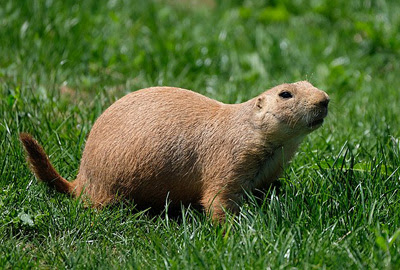
Plague and the Prairie Dogs

Populations of animals are not always stable from year to year, even ignoring the effects of direct human activity or climate change. If there is a prolonged drought, plants may die off, reducing the population of herbivores, which, in turn, reduces the number of predators that feed on them. This much is part of the natural cycle of life and death.

Perhaps the most famous example, sufficiently so to turn up in some school textbooks, is the case of the Canada lynx. This eats almost nothing but showshoe hares, so when the supply of the hares runs low, the lynx are more likely to be malnourished, so that mothers give birth to smaller litters. This means that there are fewer lynx around, which leads to the snowshoe hare booming, which means more food for the lynx, so they have larger litters, their population increases, they eat the hares so that the hare population goes down... and so on. Because the effect works through the litter size of the lynx, which take time to reach maturity, the lynx population rises and falls about a year behind that of the hares, and the entire cycle takes a decade or so to come full circle. We have records of this going back to the early 19th century from the fur-trappers of the Hudson Bay Company, and it doubtless goes back well into prehistory.

Sunday, 6 November 2022

Leaf-Eating Monkeys: Monkeys on the Mountainsides

Golden snub-nosed monkey
Much of eastern China is dominated by two great river basins: the Yellow River in the north and the Yangtze in the south. In the western parts of the country, the upper reaches of the two basins are separated by the Qinling Mountains, running eastward from the vast Tibetan Plateau. And here, in addition to many other unique animals and plants, we find a rather strange species of monkey.

This is the golden snub-nosed monkey (Rhinopithecus roxellana) and its oddity merely begins with its unusual appearance. As the name implies, its fur is mostly golden, ranging from a brownish-red hue to a much brighter golden-yellow. Contrasting stripes of black fur run down the outer edges of the limbs and there are white patches on the back of the thighs. All of these colour patterns are brighter in the males, which are also noticeably larger than the females, indicating that these are likely used in sexual signalling - something supported by the fact that the genitalia also have a contrasting dark colour.

Sunday, 30 October 2022

Horns v. Geography - Relationships Among Rhino Species

White rhino
Rhinoceroses are amongst the largest land animals alive today, exceeded in size only by the elephants. As one might imagine, given their distinctive appearance, the group has a long evolutionary history. What is perhaps less obvious is that the family was once much larger than it is today, with many species living side-by-side. In total, we have so far named something like 100 species of fossil rhinoceros and, while some of those will probably not survive more detailed analysis, it's also true that there must be several we haven't found yet. Either way, it's quite a lot.

Most of these lived during the Miocene epoch (although the family is older than this) with the number of species thinning out during the following, Pliocene, epoch between around 5 and 2 million years ago. Even so, we know of nine species that lived during the later Ice Ages. Four of these, however, did not survive their end, leaving us with the five that - in some cases only just - survive today.

Sunday, 23 October 2022

The Lion Stalks Tonight

In the jungle, the mighty jungle, the lion probably does not sleep tonight.

The main reason for this is that lions don't really live in the jungle. Their primary habitat is savannah and open grasslands and while they can be found found in dry woodland (especially in India) they aren't found in the tropical rainforests that we typically associate with the word "jungle". Indeed, a map of Africa showing where you can find lions would have a very noticeable gap in the middle where the Congo jungle is - along, of course, with blank spaces over the harsher deserts. The idea of lions living in dense jungle probably owes more to Tarzan than reality.

Sunday, 16 October 2022

Decline of the Woodrats

The wild mice and rats of the Americas are not members of the true "mouse family", the Muridae, but instead belong to the Cricetidae, a name which translates as "hamster family". The vast majority of species in the family are not, however, hamsters, since the group includes both the voles (of which there are many) and the aforementioned New World mice and rats. Many of these latter are found in South America, with plenty more in Mexico and Central America. Most of them are mouse-sized, an example of the great success of the mouse body-plan where, despite having diverged from the true mice over 30 million years ago, such creatures as the American deer-mice differ from the house mouse by, at best, having a different colour pattern.

Just as some members of the mouse family developed larger size, evolving into such things as the familiar sewer rat (which, of course, has been introduced to America, even though it's not native there) so to did some of their New World counterparts. In the southern US, three different lineages of such creatures can be found: the muskrat (which is actually a giant vole), the cotton rats (which are related to the vast collection of South American rats and mice), and a third group variously called pack rats or woodrats.