Sunday, 20 February 2022

Miocene (Pt 31): Terror Mice and the First Howler Monkeys

Phoberomys
As the heat of the Middle Miocene gave way to the more moderate temperatures of the Late Miocene, grasslands grew across much of the Northern Hemisphere. In South America, however, the changes were, perhaps, less significant due, in part to its more equatorial position. Nonetheless, even aside from the general worldwide cooling trend, the South American climate was changing as the Andes continued to rise, affecting weather patterns across the continent. It was also continuing to edge closer to North America, so that, towards the end of the epoch, it became possible for a few animals to make the crossing using the islands of what is now Central America as stepping stones.

Sunday, 13 February 2022

Are Animals Darker in the Tropics?
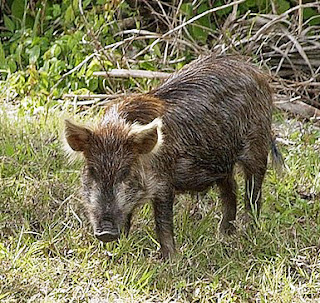
In 1833 Prussian ornithologist C. L. Gloger published the book Das Abändern der Vögel durch Einfluss des Klimas (roughly "the modification of birds by climatic influences"). In this, he put forward a proposal that the plumage of birds living in hot, humid, environments tends, on average, to be darker in colour than that of those which do not. In 1929, biologist Bernhard Rensch formalised this as "Gloger's Rule", one of a number of zoological "rules" that seemed to be true more often than not but for which there was not necessarily a clear explanation.

Crucially for this blog, it seemed to be true of the skin and hair of mammals as well. This observation raises a number of questions, of which the first is clearly "is it true?" 

Sunday, 6 February 2022

How Dolphins Got Their Large Brains

As a rule, larger animals tend to have larger brains, just as they have larger hearts, livers, and other internal organs. But the relationship is not a linear one, partly because, unlike the liver, there's a minimum size below which the brain doesn't have room for the basic housekeeping functions that keep the body ticking over, so that small animals have proportionately larger brains than large ones. If we want to know whether a particular creature has a larger, or smaller, brain than we'd expect then, as I've described before, we use a mathematical formula called the encephalisation quotient to determine what the size of the brain "should be". 

By definition, an average mammal should have an EQ of 1. The formula breaks if we try to apply it to non-mammalian animals, such as birds, probably because their brain architecture is different from ours at quite a fundamental level. Even for mammals, there is some debate as to exactly what formula we should be using; most older studies have determined that brain size typically rises as the 2/3 power of body size (that is, as the cube root of the square) but a 2019 study argued that it's perhaps more accurate to base it on the 3/4 power and this seems to be a growing consensus.

Saturday, 29 January 2022

Monkeys with Many Stomachs
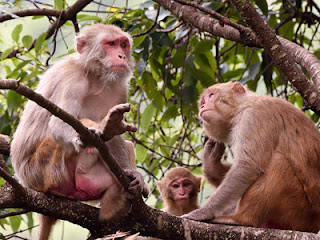
Rhesus monkeys have entirely
normal stomachs
The word "monkey" entered the English language relatively late, in the 16th century. It's not at all clear where it came from, and it doesn't have a direct counterpart in most other European languages. Instead, they, like medieval English, used the same word for both monkeys and apes (and that word was, in our case, "ape"). From a modern, scientific, point of view, these other languages are correct, because there is no scientifically definable group of animals that fits with what most people mean by "monkey".

This is due to the rule, often mentioned on this blog, that the members of any scientifically defined group of animals have to be more closely related to all the other members of that group than they are to anything else. The diagram further down this post showing how all the major groups of simian are related illustrates why this is. At the top, we have the macaques and the leaf monkeys, both of which are indisputably monkeys. But their closest relatives are the apes (which, of course, includes gibbons as well as "great apes"). Only then do we get to the other monkeys, which means that, for example, a macaque is more closely related to a gorilla than it is to a marmoset.

Sunday, 23 January 2022

Out of the Amazon: A History of the Opossums
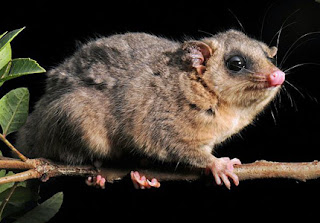
Tate's woolly mouse-opossum,
a marmosin species
When most people think of marsupials, it's likely that Australia is the first place to spring to mind; the land of kangaroos, koalas, and wombats among many others. In fact, even the "Australian" marsupials aren't restricted to that country, since they are also found further north, notably in New Guinea - which, for example, has its own species of wallabies. But, more significantly, marsupials are also found outside of Australasia, in the Americas.

The best known of these American marsupials is surely the Virginia opossum (Didelphis virginiana). This lives across most of the US outside of the western mountains and interior deserts, and is also found just across the border in parts of southern Canada, through the whole of Mexico, and well into Central America. It's the only species of opossum found north of Mexico, but it's very far from being the only species of opossum anywhere.

Sunday, 16 January 2022

Why Animals Have Whiskers
One of the key defining features of mammals is that they have hair, or are at least descended from other animals that once had hair. The primary purpose of hair is to keep the animal warm, something useful for any warm-blooded animal, especially if it's small (elephants and rhinos, for example, while they do have hair, aren't really what you'd call "furry"). But, over millions of years of evolution, hairs have also evolved to carry out other functions, such as the protective spines of hedgehogs and porcupines.

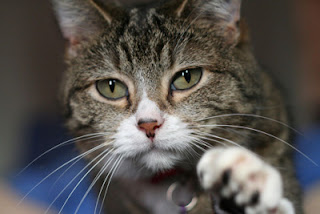
Another example of specialised hair is that of whiskers. Technically known as vibrissae, whiskers are remarkably common in mammals. When we think of whiskers, it's likely that most people's thoughts jump immediately to the long, mobile, whiskers of cats and mice. But whiskers can also be shorter and less mobile than this, as we see in such animals as horses. Indeed, even if we look at a cat, whiskers are not restricted to the long ones on the snout; they also have whiskers on the eyebrows, on the cheeks and chin, and on their forelegs just above the paws. 

Sunday, 9 January 2022

The Social Lives of Giraffes
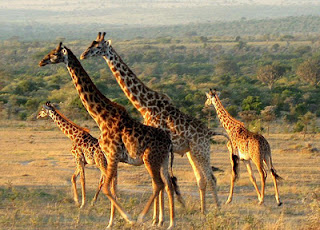
Many of the cloven-hoofed mammals are herd animals, living in large groups that typically have dominance hierarchies and other relatively complex internal structure. We see this in both of the main families of such animals: the deer and the "cattle family" (which includes goats, sheep, and antelopes besides the obvious). On the other hand, there are certainly plenty of exceptions. Smaller deer, such as muntjacs, for instance, tend to be relatively asocial, apparently gaining more benefit by hiding from predators than they would from living in large and watchful, but visibly obvious, herds.

But it isn't just the smaller cloven-hoofed mammals that can lack sophisticated social lives, because the same also seems to be true of the largest of all such animals: the giraffe (Giraffa camelopardalis). At which point, I should probably take a brief diversion to explain what a giraffe is, and where it fits in the larger mammalian family tree.